crazy baskets
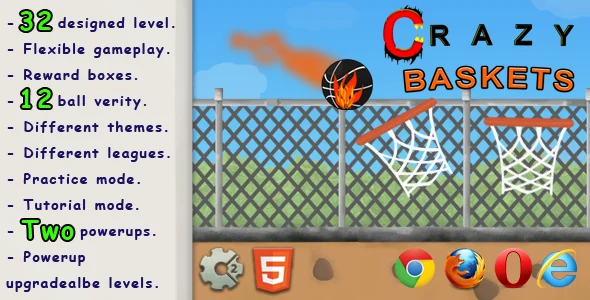
Crazy Baskets Overview & Physics-Based HTML5 Arcade Architecture
Crazy Baskets is a physics-driven HTML5 basketball arcade game built on the Construct 2 engine, engineered for web studios and casual-game publishers to deploy a fully playable, browser-native sports title across desktop environments. The core engineering challenge it resolves is the delivery of a 32-level progression system with moving-basket aiming mechanics that must run at interactive frame rates without any server-side runtime. Inside agency delivery pipelines, the package functions as a self-contained client-side bundle: a CAPX project file for logic modification, exported HTML5 assets for immediate hosting, and layered PSD sources for visual re-skinning.
Technical Specifications & Deployment Matrix
| Engineering Metric | Deployment Specification |
|---|---|
| Base Technology / Framework | Construct 2 event-system engine, distributed as editable CAPX project |
| Runtime / Language Requirements | Client-side JavaScript runtime; HTML5-compatible hosting (static file serving) |
| Browser Compatibility | Firefox, Safari, Opera, Chrome, Edge |
| Delivered File Formats | JavaScript JS, JavaScript JSON, HTML, CSS, Layered PSD |
| Display Standard | High-resolution output asset pipeline |
| Database / Persistence Footprint | None required; all game state executes within the browser runtime |
Moving-Target Aim Mechanics & Level Progression Pipeline
The gameplay loop is governed by a trajectory-and-collision pipeline: player input sets a launch vector, the engine resolves ball physics against basket colliders, and scoring events dispatch level-state transitions. The distinguishing mechanic is that baskets are active bodies that do not remain static, so every attempt demands recalculated aim rather than memorized timing. This transforms the codebase from a fixed-shooter into a reactive physics sandbox where collider positions are re-evaluated each frame by the engine’s event sheet.
Progression is organized into 32 levels that the author describes as nicely balanced, meaning difficulty curves are tuned through level data rather than runtime parameter spikes. To support player onboarding, the architecture separates three distinct runtime modes: a tutorial mode that teaches input and aiming fundamentals, a practice mode where skills can be trained without progression pressure, and the main league path where the 32 levels must be cleared to complete the game. This tri-mode split keeps instructional logic decoupled from scoring logic, which simplifies level editing inside the CAPX project.
Reward boxes punctuate the progression pipeline, granting unlock events that feed the customization layer. Two upgradeable powerup types are exposed to the player, and their upgrade logic is handled through the same event-driven data flow, meaning each powerup carries its own upgradeable state that scales with in-game progression rather than external configuration. On the presentation side, 12 ball skins and multiple themes are available as selectable assets, allowing visual variety without touching the underlying physics logic — a clean separation of presentation data from simulation data that Construct 2’s layout-object model enforces naturally.
Architectural & Functional Highlights
- 32-Level League Progression: Level completion is tracked through the event system, requiring all 32 stages to be cleared before the game and leagues register as beaten; level data remains editable inside the CAPX project.
- Moving-Basket Physics Colliders: Baskets function as dynamic bodies whose positions shift during play, forcing per-attempt aim recalculation and giving every level a reactive, non-static target geometry.
- Tri-Mode Runtime Separation: Tutorial, practice, and league modes run as distinct operational branches, letting instructional content stay isolated from competitive scoring logic during customization.
- Two Upgradeable Powerup Types: Both powerups expose upgrade paths driven by in-game progression events, providing meta-progression depth on top of the level pipeline.
- 12 Ball Skins & Theme Variants: Skin and theme selection operate as swappable presentation layers, and the included layered PSD files give designers direct access to source artwork for full re-skinning.
Production Implementation & Operational Resilience
Because the exported build consists of HTML, CSS, JavaScript, and JSON asset manifests, deployment reduces to serving a static directory from any web host, CDN, or object storage endpoint. Cross-browser behavior is covered across Firefox, Safari, Opera, Chrome, and Edge, so QA cycles can focus on layout and input consistency rather than engine compatibility. The package performs no database writes and issues no server round-trips during play; all level state, scoring, and unlock logic executes inside the browser’s JavaScript runtime, which removes backend provisioning from the delivery checklist entirely.
For studios planning client-specific branding, the customization boundary sits in two places: the CAPX project, where event sheets, level layouts, and gameplay parameters can be modified in Construct 2 before re-export, and the layered PSD sources, where sprites, UI panels, and theme artwork can be re-authored and re-exported into the asset pipeline. This dual-path structure means gameplay tuning and visual re-skinning can proceed in parallel without one blocking the other. High-resolution output assets are part of the deliverable set, so downscaling for specific viewport targets is handled during the asset-compression stage of the deployment workflow.
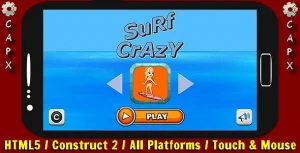
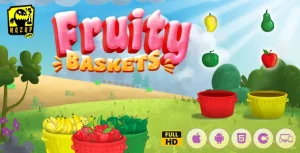
Studios assembling a broader HTML5 arcade portfolio can treat this title as one node in a catalog strategy rather than a standalone build. For decoupled implementations outside the basketball-sports niche, Fruity Baskets (Construct) Game runs as a separate fruit-matching Construct project, while Surf Crazy ships as its own Construct 2 CAPX package for studios that need an additional arcade SKU on the same engine toolchain.
Frequently Asked Questions
Does the package include the editable game project in addition to the exported web build?
Yes. The deliverables contain the Construct 2 CAPX project file, the exported HTML5 game files (HTML, CSS, JavaScript, JSON), and layered PSD design sources, so both the logic layer and the artwork layer are editable.
Is there a way to practice without affecting the main 32-level progression?
Yes. A dedicated practice mode exists specifically for skill improvement outside the league path, alongside a tutorial mode for onboarding, so players can train aiming mechanics independently of clearing the 32 campaign levels.
Are the two powerups fixed one-time abilities, or do they scale during play?
They scale. Both powerup types are explicitly upgradeable, meaning their effectiveness is tied to upgrade logic within the game’s progression system rather than remaining static single-use effects throughout the campaign.
Can the ball’s appearance and the game’s visual theme be changed?
Yes. The game exposes 12 ball skin variants and multiple selectable themes, and because layered PSD files are included, designers can additionally re-author the underlying artwork for fully custom visual output.