ChinaDS – WooCommerce Tmall-Taobao Dropshipping
ChinaDS WooCommerce Tmall-Taobao Dropshipping Overview & Import Automation Architecture
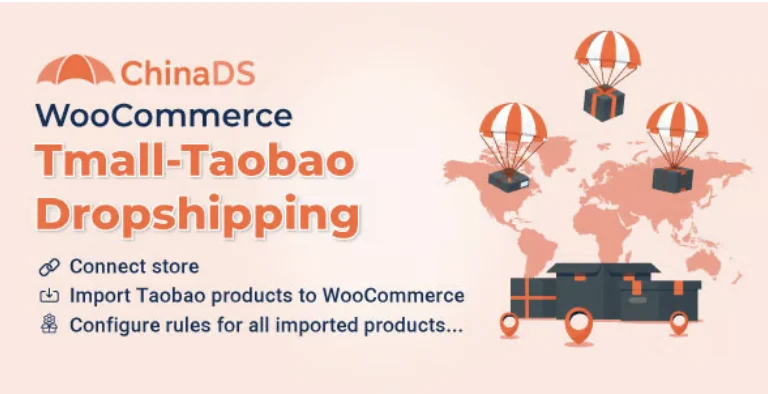
ChinaDS – WooCommerce Tmall-Taobao Dropshipping is a WordPress plugin extension engineered for WooCommerce store operators to import, reprice, and fulfill products sourced from taobao.com and tmall.com. The core bottleneck it resolves is the manual migration of product data — titles, descriptions, variation matrices, image galleries, and inventory figures — between Alibaba’s Chinese marketplaces and a WooCommerce catalog. Within an agency delivery pipeline, the module occupies the middleware layer of a dropshipping workflow: it captures source data, applies rule-based transformations, writes catalog records, and reverses the flow to fulfill customer orders on the originating marketplace.
Technical Specifications & Deployment Matrix
| Engineering Metric | Deployment Specification |
|---|---|
| Base Technology / Framework | WordPress plugin (PHP, JavaScript JS, CSS) operating with a browser extension bridge |
| Runtime / Version Requirements | WordPress 6.0.x through 6.8.x; WooCommerce 6.x, 7.x, 8.x, and 9.x |
| Data Exchange / Communication Protocols | Taobao/Tmall page-to-store extension channel; exchange rate feeds from Google Finance, Yahoo Finance, Cuex, and Wise |
| Front-End / Builder Dependencies | Gutenberg-optimized; compatible with Elementor, Elementor Pro, WPBakery Page Builder, Visual Composer, and WPML |
| Browser Support | Firefox, Safari, Opera, Chrome, Edge |
Rule-Based Import Engine & Execution Pipeline
The extension intercepts Taobao and Tmall product pages and routes their data through a staged, rule-driven import pipeline. Payloads are captured from single product pages, category listings, or entire category pages via bulk selection, then held in an Import List before any WooCommerce write occurs. Each staged record passes through configurable global rules: language translation into the site’s locale, SKU assignment using the {taobao_product_id} shortcode with automatic unique-SKU generation on collision, default product status (publish, pending, or draft), catalogue visibility, and conversion of variation attributes into global WooCommerce attributes. The price layer then applies CNY-to-store-currency conversion and margin logic across multiple quantity ranges — increase by fixed amount, increase by percentage, set-to, or multiply — before the record is committed to the catalog.
Every field remains editable per product inside the Import List: title, SKU, categories, tags, description composition (item specifics, product description, or both), selected variations, variation images, and calculated sale and regular prices. Once pushed, items behave as native WooCommerce products, which means storefront presentation stays fully decoupled from the import layer; styling product archives and single-product templates through Elementor widgets is handled by CoDesigner Pro without any modification to the ingestion code path.
Core Technical Capabilities of ChinaDS
- Global rules engine: A single configuration pass defines translation language, SKU policy, status defaults, taxonomy assignment, shipping class, stock management, and description composition for every subsequently imported item, eliminating per-product manual setup.
- Multi-range price markup with live exchange rates: Currency conversion pulls from four selectable rate sources with automatic refresh scheduling down to the second, while quantity-banded markup rules apply fixed, percentage, set-to, or multiplier arithmetic to CNY source prices.
- Automated order fulfillment loop: Customer orders placed in WooCommerce are previewed in a dedicated Taobao orders section, then fulfilled through the extension with order information automatically fetched and mapped back to the source marketplace.
- Product lifecycle utilities: Variable products can be split into single products by attribute or assigned variation, existing Woo products can be overridden and remapped to new Taobao source items, and product sync propagates upstream price and quantity changes to the store.
Production Implementation & Operational Resilience
Image ingestion is the heaviest payload in the pipeline, and the module handles it through a background download process that keeps the main product image synchronous while queuing gallery and variation assets. Operators on storage-constrained hosting can defer those assets to a Failed Images queue for manual recovery, or disable background processing entirely so only the primary image is fetched during import. A documented alternative offloads the storage footprint altogether: enabling external image URLs stores the original Taobao and Tmall image links through the EXMAGE WordPress Image Links plugin instead of copying files to the local server.
Resilience also extends into ongoing operations. Product Sync watches upstream price and inventory values and refreshes WooCommerce records when they shift, while the exchange rate module self-updates on a configurable schedule, reducing the risk of stale margin calculations on long-tail catalogs. Because order data flows through standard WooCommerce records, adjacent post-purchase workflows remain composable — for merchants blending dropshipping with physical retail, the POS Order Return Plugin for WooCommerce covers the reverse-logistics path (refunds, exchanges, inventory reconciliation) that sits outside ChinaDS’s fulfillment scope.
On the demand side, imported catalogs remain ordinary WooCommerce products, so conversion tooling attaches without custom code. Deploying WooCommerce Live Sales Notification Pro adds real-time social-proof popups driven by the same order stream the fulfillment engine reads, giving store owners a merchandising layer that shares the plugin’s data foundation rather than competing with it. Compatibility with WPML additionally permits multilingual catalogs when the translation rule outputs multiple locales across a network of client stores.
Frequently Asked Questions
Does the plugin support storing Taobao and Tmall product images off-server?
Yes. When the EXMAGE WordPress Image Links plugin is installed, an option saves the original marketplace image URLs externally instead of importing files to your server, which reduces the website’s storage footprint during large catalog migrations.
Can a variable product imported from Taobao be split into separate simple products?
Yes. The product splitting feature divides a variable product’s variations into standalone simple products, either by splitting a specified number of variations within an attribute or by assigning a particular variation, with automatic unique-SKU generation handling duplicates.
Are exchange rates updated automatically once configured?
Yes. The module supports automatic exchange rate refresh with a configurable schedule precise down to the second, sourcing rates from Google Finance, Yahoo Finance, Cuex, or Wise to keep CNY conversions aligned with your store currency.
Can an already-imported product be replaced by a different Taobao or Tmall source item?
Yes. Product overriding replaces an existing imported product with a new source listing, and configurable rules determine which product properties are retained or discarded during the override operation, preserving prior customization where needed.