Chess Game
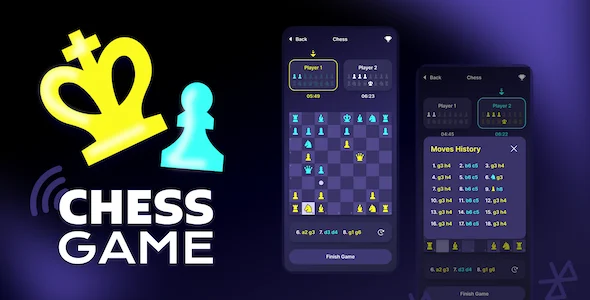
Chess Game Overview & Native iOS Multiplayer Game Engine
Chess Game is a native Swift source code package targeting iOS 13, built for mobile studios and independent developers who need to ship a local multiplayer chess experience without any server infrastructure. The package removes the dependency on physical boards and online match services by routing gameplay over Bluetooth personal area networks, peer-to-peer Wi-Fi, and infrastructure Wi-Fi transports exposed by the native iOS framework. Within a production workflow, it operates as a ready-to-configure game engine, complete with move validation, statistics tracking, and a documented MVVM codebase.
Technical Specifications & Deployment Matrix
| Engineering Metric | Deployment Specification |
|---|---|
| Base Technology / Framework | Native Swift development for the Apple platform |
| Minimum Runtime Target | iOS 13 deployment target |
| Source Artifacts Included | .h and .m files shipped alongside the Swift-compatible project |
| Communication Protocols | Infrastructure Wi-Fi networks, peer-to-peer Wi-Fi, and Bluetooth personal area networks as the underlying transport |
| Internet Dependency | None; matches are established locally with Bluetooth or enabled Wi-Fi on both devices |
| Persistence Footprint | Local leaderboard storing detailed per-player game statistics |
| Monetization Footprint | None; the codebase contains no in-app purchases and no advertisement modules |
Peer-to-Peer Session Architecture & Execution Pipeline
Gameplay sessions are established directly between nearby devices: the transport layer discovers peers over Bluetooth and Wi-Fi, then synchronizes board state without any Internet round-trip. On iOS, the framework handles discovery, connection negotiation, and data exchange across infrastructure Wi-Fi networks, peer-to-peer Wi-Fi, and Bluetooth personal area networks, which means two players can compete during a commute, in an office, or anywhere network access is unavailable. The application layer above this transport consumes synchronized move events, renders board updates, and writes results into the local statistics store that powers the leaderboard. This division of concerns keeps session logic decoupled from presentation logic, so the rendering pipeline can be restyled without touching connectivity code.
Architectural & Functional Highlights
- Assisted Move Rendering: The board highlights every legal destination for selected pieces, marks the opponent’s previous move, and flags any piece that is forced to move when a capture is available, reducing rule ambiguity during live play.
- Move History Tracking: Each synchronized move is recorded in a running history panel, letting players audit the full sequence of a match after completion.
- Local Leaderboard Statistics: Match outcomes feed a detailed statistics view, adding a competitive layer to repeated sessions between the same paired devices.
- Reactive Bot Feedback: Animated character bots respond to win, loss, and draw outcomes, providing lightweight result feedback without external asset streaming.
- Modular MVVM + Coordinators Structure: The codebase is organized into native components with simple, separated code patterns, making it straightforward to add or remove games and individual feature modules during reskin or extension work.
Because the engine relies exclusively on native components, maintenance and modification stay within the standard Xcode toolchain. For teams weighing a parallel single-player path on the same platform, AI Chess Master iOS exists as an independent template with an AI opponent, theming options, and monetization hooks, covering a use case this peer-to-peer package deliberately leaves out.
Production Deployment & Implementation Considerations
Deployment begins in Xcode: set the iOS 13 deployment target, compile the included .h and .m artifacts alongside the Swift sources, and run the build on physical hardware. Simulator testing has a hard boundary here, since the Bluetooth and peer-to-peer Wi-Fi transports require real devices with both radios enabled to establish a session; no Internet connection is needed at any point. The shipped PDF user guide plus the written developer documentation cover project setup and configuration steps end to end.
Implementation boundaries are equally explicit. Multiplayer is local by design, so there is no matchmaking server, remote opponent pool, or cross-region play, and the leaderboard reflects statistics gathered on the device rather than a synchronized cloud backend. Customization scope is where the architecture pays off: because games and components are modular, studios can strip the chess module down to its board engine, attach new rule sets, or reuse the connectivity layer for another board game within the same coordinator flow. Every UI element is built from native components, so theming happens through standard platform mechanisms rather than third-party dependency upgrades. For decoupled, cross-platform delivery outside the Apple toolchain entirely, 3D Chess Complete Unity Project With Admob stands as a separate Unity-based codebase covering the same genre for teams targeting multiple stores from one build pipeline.
Frequently Asked Questions
Does the package include developer documentation for setup?
Yes, the download ships with detailed documentation plus a PDF user guide, covering project configuration, build steps, and the connection workflow needed to get a peer-to-peer match running on target hardware.
Is an active Internet connection required for matches?
No, gameplay runs entirely over local transports. The iOS framework leverages infrastructure Wi-Fi networks, peer-to-peer Wi-Fi, and Bluetooth personal area networks, so two paired devices can complete full games without any online connectivity.
Can additional games or components be added to the codebase?
Yes, the project follows a modular MVVM plus Coordinators structure with only native components, which the documentation identifies as the supported method for adding or removing games and feature modules during extension work.
Are advertisements or in-app purchases embedded in the build?
No, the codebase contains no advertisement modules and no in-app purchase flows, keeping the binary free of monetization logic that studios would otherwise need to strip out before shipping their own branded release.