Candy Clash Mania
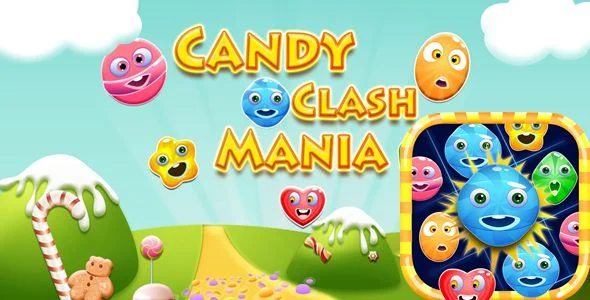
Candy Clash Mania Overview & Match-3 Engine Architecture
Candy Clash Mania is a Construct 3 HTML5 match-3 game engine, engineered for indie studios and agencies to deploy a complete puzzle title across web and native mobile channels. The package removes the engineering burden of building tile-swap logic, match-cascade resolution, unified input handling, and audio playback from scratch by shipping a full game project with its editable capx source file. Within production delivery pipelines, it functions as a reskinnable asset: graphics swap out through direct image replacement, while deeper logic modification is handled inside the Construct 3 editor itself.
Technical Specifications & Deployment Matrix
| Engineering Metric | Deployment Specification |
|---|---|
| Base Technology / Framework | Construct 3 event-sheet engine; editable capx project file included |
| Runtime / Language Requirements | HTML5 runtime; deliverables comprise JavaScript, JSON, and HTML files |
| Data Exchange / Communication Protocols | Facebook Share for score distribution; input received via unified touch and mouse event streams |
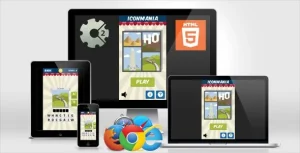
| Front-End / Engine Dependencies | None beyond the browser runtime — verified from IE6 through IE11 and onward to Edge, Firefox, Safari, Opera, and Chrome |
| Database / Persistence Footprint | None; execution is fully client-side with no server-side storage layer |
| Render Resolution | Fixed HD canvas at 1280 x 720 pixels |
Match-3 Execution Pipeline & Runtime Mechanics
The execution pipeline runs on the Construct 3 event-sheet model, where conditions trigger actions each tick instead of through hand-written script. Every player interaction enters through a single one-touch input layer that normalizes touch gestures and mouse clicks into one event stream, eliminating platform-specific branching. The event sheets then validate each swap against the grid, scan for matched tile groups, resolve cascades, and dispatch audio playback to the sound FX subsystem while the engine composites the scene onto the fixed 1280 x 720 canvas. Because the entire loop lives inside the included capx project, a developer opens the editor, inspects each event block, and adjusts difficulty curves, scoring rules, or visual timing without writing a line of JavaScript.
Core Technical Capabilities of Candy Clash Mania
- Full Event-Sheet Game Logic: The capx project contains the complete match-3 loop — swap validation, group detection, cascade resolution, and scoring — as inspectable event blocks rather than obfuscated code.
- Unified One-Touch Input Layer: Touch and mouse input feed one pointer-event handler, so a single build serves phones, tablets, and desktops without per-platform input code.
- Native Webview Export Path: The project is optimized for Cocoon.io, and export files for iOS and Android ship inside the package for app-store wrapping.
- Integrated Audio & Social Hooks: Built-in sound FX respond to gameplay events, and Facebook Share propagates scores to social channels.
- Asset-Decoupled Reskin Workflow: All imagery swaps through direct file replacement, letting art teams rebrand the game without opening the editor.
Portals running multiple Construct 3 titles on one domain benefit from consistent tooling; Dinosaur Cards HTML5 Construct 3 follows the same editable-project delivery pattern for a memory-game format, giving content teams a second genre from an identical workflow.
Production Implementation & Operational Resilience
Deployment is deliberately minimal: the package compiles to static JavaScript, JSON, and HTML files, so any static host or CDN edge serves the game with no backend provisioning, no database writes, and no cross-origin API surface beyond the Facebook Share call. The compatibility matrix is unusually wide for an HTML5 title — verified from legacy IE6 through IE11 and onward to Edge, Firefox, Safari, Opera, and Chrome — which matters for embedded game portals that still receive traffic from dated corporate browsers. Operationally, two boundaries define the workflow. First, opening and modifying the capx source requires an activated paid edition of Construct 3, and the project should be handled with the editor’s most stable release to avoid event-sheet regressions. Second, reskinning stays decoupled from that requirement: every sprite, background, and icon can be replaced by direct file substitution, so design teams rebrand the title without touching logic. For teams weighing an independent native-code path for mobile puzzle deployment, Candy Box ships as a separate Unity physics puzzle source project with its own Android export route, standing outside this HTML5 toolchain rather than merging into it.
Frequently Asked Questions
Does modifying the game logic require a paid Construct 3 edition?
Yes, editing the event sheets demands an activated paid edition of the Construct 3 editor, and the project calls for the most stable release of the program. Graphic reskinning bypasses that requirement entirely, since art assets swap out through direct file replacement without opening the editor.
Are native iOS and Android builds supported from this codebase?
Yes, export files for iOS and Android ship inside the package, and the project is optimized for Cocoon.io, which wraps the HTML5 output inside a native Webview container for app-store distribution on both platforms.
Can a single input handler serve both desktop and mobile players?
Yes, the game implements one-touch control, meaning a single pointer-event layer accepts both touch gestures and mouse clicks, so the same build runs unchanged on phones, tablets, and desktop browsers without platform-specific input branching.
Does the game require a backend server or database to run?
No, the deliverables are static JavaScript, JSON, and HTML files that execute entirely client-side in the browser, so any static host serves the game and no server-side persistence layer is involved at any point.