Bootic Full – An android eCommerce app with admin panel
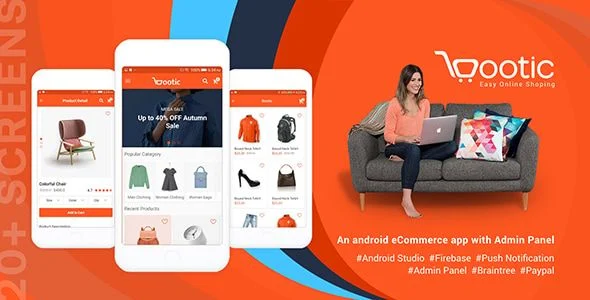
Bootic Android eCommerce App Overview & Full-Stack Commerce Foundation
Bootic is a native Java Android eCommerce application paired with a PHP/HTML admin panel, engineered for agencies and independent Android developers to ship production retail apps for fashion, electronics, grocery, and restaurant storefronts. The package removes the overhead of assembling a mobile storefront and its administrative control plane from separate codebases by delivering the Android Studio project (.java, .xml) and the server dashboard inside one distribution. In agency delivery pipelines, it operates as the commerce backbone: catalogs, subcategories, sliders, currencies, and order states are configured centrally in the admin panel while the mobile client consumes that configuration over REST-driven JSON exchange.
Technical Specifications & Deployment Matrix
| Engineering Metric | Deployment Specification |
|---|---|
| Base Technology / Framework | Native Java compiled in Android Studio; PHP/HTML server-side admin panel |
| Runtime / Target Platform | Android 9.0 (Pie) — compatibility fixes applied September 2019 |
| Data Exchange Protocol | REST-driven JSON API communication between client and backend; AJAX-driven order status updates in the admin panel |
| Payment Processing | Braintree integration (PayPal, debit and credit cards); Razorpay gateway added December 2020 |
| Messaging & Monetization | Firebase push notification dispatch from the admin panel; Google AdMob configuration managed server-side |
| Distributed Files | .apk, .java, .xml, and HTML assets; review imagery supports multi-image upload |
Commerce Execution Pipeline & Synchronous Admin Control
The core mechanism is a client-server loop: the Android client requests catalog, cart, and profile data as JSON payloads, while the admin panel mutates that dataset and pushes changes back to devices. When an administrator adjusts inventory, approves a review, or reconfigures the home slider, the client reflects those mutations on its next API cycle because layout assets such as the banner slider and product attributes are treated as dynamic server data rather than hardcoded resources. Order placement follows a hardened path — each order is encrypted before transmission, invoices are generated upon completion, and currency positioning is resolved at runtime from admin settings rather than fixed in layout XML. Authentication supports credential login with email confirmation and password recovery alongside Google and Facebook signup flows, with a known Facebook registration defect patched in the October 2020 release.
Architectural & Functional Highlights
- Dual payment processor routing: Braintree tokenizes PayPal, debit, and credit card transactions while Razorpay serves as an alternate gateway, giving deployments two configurable settlement paths without client-side rewrites.
- Server-initiated push messaging: Firebase Cloud Messaging carries broadcast notifications dispatched directly from the admin dashboard, removing the need to stage campaigns through a separate console.
- Remote AdMob configuration: advertisement unit identifiers are set from the admin panel, so monetization parameters can be revised per deployment without rebuilding the APK.
- Hierarchical catalog model: subcategory integration (March 2020) combined with dynamic product attributes and attribute enhancements (June 2019) supports deep category trees suited to electronics, grocery, and apparel inventories.
- Session persistence layer: auto-login after registration and address retention after first insert keep checkout state intact across process restarts.
For teams evaluating standalone Android utility templates outside the commerce vertical, Android Whats Web provides an independent codebase path, while this package remains focused on storefront logistics.
Production Implementation & Operational Resilience
Deployment begins by importing the Android Studio project, pointing the client at the backend endpoint, and configuring payment credentials and AdMob identifiers from the admin panel — a sequence the documentation classifies as installable with basic technical knowledge. Resilience behavior is built into the data layer: a retry mechanism activates when connectivity drops mid-request (October 2019), pagination guards both user lists and catalog endpoints against oversized payloads (October 2020 pagination fix), and the admin panel exposes search and filter functions to keep large order histories navigable. Error containment extends to interface hygiene — the in-app storage reader is switched off specifically to prevent duplicate launcher icons after install, and cart deletion edge cases were patched across the August and October 2020 releases.
Operational boundaries are worth documenting before client staging: the client targets Android 9.0, preview imagery is excluded from the distribution and exists only for demonstration, and every screen ships commented for secondary development. Because the codebase is native Java with XML layouts, agencies can restyle any of the 20+ screens per vertical — restaurant menus, grocery listings, or fashion galleries — by overriding layout resources and adjusting server-driven attributes rather than restructuring navigation logic. Monetization teams comparing AdMob-driven Android deployments can also study how Bitcoin Miner App with Admin Panel and Admob handles the same server-side ad-unit pattern under a different product model.
Frequently Asked Questions
Does the download include a compiled APK in addition to the editable source files?
Yes, the distribution contains an installable .apk binary alongside the .java source, .xml layout definitions, and HTML admin panel assets, allowing immediate device testing before any customization work begins.
Can the admin dashboard be evaluated before connecting a live client build?
Yes, a public demo login exists with the credentials admin and 123456, letting developers inspect catalog management, order handling, slider configuration, and push dispatch behavior prior to deploying the backend.
Are the product and preview images shown in the demo included in the package?
No, all imagery in the preview exists strictly for demonstration purposes and is not part of the download; deployments must supply their own catalog photography and banner slider assets through the admin panel.
Does the checkout flow support guest purchases without account registration?
No, the documented flow is account-based — registration triggers auto-login, email confirmation, and address capture, indicating that authenticated customer records are a structural requirement of the order pipeline.
6 App Template | eCommerce Food Grocery Delivery App| Peer to Peer Delivery | Courier App | DeliOne

Online Shopping Android App (eCommerce Android App, eCommerce Marketplace App)
Markeet – Ecommerce Android App 6.0