Aqualots | Aquarium Installation and Maintanance Services WordPress Theme
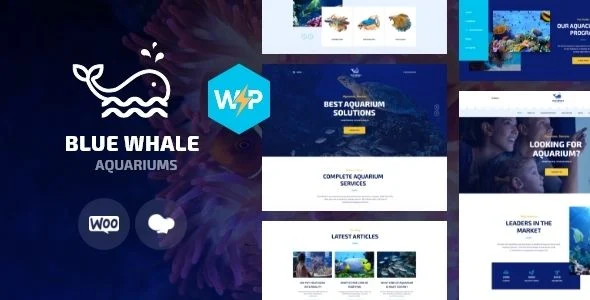
Aqualots Overview & Aquarium Service Commerce Foundation
Aqualots is a WordPress theme engineered for aquarium installation agencies and maintenance service firms to publish service catalogs, run inhabitant retail storefronts, and operate supply shops on a self-hosted WordPress runtime. The package closes the gap between service presentation and transactional commerce by shipping WooCommerce-integrated templates, custom post types, and shortcode-driven layout construction inside one inherited options framework. Within agency delivery workflows, it acts as the presentation and storefront layer for businesses handling aquarium setup, cleaning schedules, fish retail, and maintenance operations.
Technical Specifications & Deployment Matrix
| Engineering Metric | Deployment Specification |
|---|---|
| Base Technology / Framework | WordPress theme built on HTML5/CSS3 markup with PHP server-side rendering; tested across WordPress 4.9.x through 7.0.x |
| Runtime / Language Requirements | PHP with 7.4 and PHP 8 compatibility confirmed in the change log; merged script output for reduced asset fragmentation |
| Data Exchange / Communication Protocols | WooCommerce commerce layer (6.x–8.x), Contact Form 7 form handling, MailChimp for WP subscription sync, WPML translation compatibility |
| Front-End / Engine Dependencies | WPBakery Page Builder, Slider Revolution, Swiper Slider, Essential Grid, ThemeREX Addons |
| Database / Persistence Footprint | PHP, CSS, and JS deliverables; custom post types, custom widget sets, and Customizer option storage within the native WordPress schema |
Service Rendering Architecture & Execution Pipeline
Aqualots routes front-end rendering through WPBakery Page Builder and a setting-inheritance options framework. Inbound page requests traverse the standard WordPress template hierarchy, where the theme overrides archive, single, and blog templates with its own layout registry. Headers and footers are not hard-coded includes: both regions are composed as editable WPBakery layouts, so service CTAs, contact blocks, and navigation can be repositioned without editing PHP templates. The inheritance-and-override system cascades more than 750 Customizer parameters from global defaults down to individual pages, which means a palette or typography change propagates site-wide while page-level overrides stay isolated. Demo content is deployed through a one-click installer that registers custom post types, widget sets, and Essential Grid configurations in a single pass.
Core Technical Capabilities of Aqualots
- WPBakery Layout Composition: Every page region, including headers and footers, is assembled through the bundled page builder engine, replacing manual template hierarchy edits with visual drag-and-drop block assembly.
- WooCommerce Storefront Integration: The theme applies its design system to shop archives and product singles across WooCommerce 6.x–8.x, with product-per-row and rows-per-page controls relocated into the Customizer to prevent plugin setting collisions.
- Essential Grid Service Galleries: Portfolio and service showcases are rendered through grid configurations bound to custom post types, giving installation projects and fish inventory queryable, reusable display objects.
- Advanced Blog Engine: Multiple blog styles, 20+ post entrance animations, post views, likes, sharing buttons, and a related-posts section are wired into the single-template render path.
- Interactive Ajax Search: User queries execute asynchronously against indexed content, returning results without full page reloads and reducing server round-trips during navigation.
The commerce surface extends beyond products: MailChimp for WP handles list capture, Contact Form 7 processes service inquiries, and the ThemeREX Addons module supplies the shortcode and widget primitives that the layout system consumes. Agencies managing parallel field-service verticals, such as fenestration and renovation contractors, frequently evaluate W&D for those separate client installs, since both themes follow comparable service-catalog and booking-page construction patterns.
Production Implementation & Operational Resilience
Deployment targets self-hosted WordPress environments ranging from legacy 4.9.x installs to current 7.0.x releases, with PHP 7.4 and PHP 8 compatibility verified through iterative change-log revisions. Recent engine updates hardened the installer pipeline: object unserialization from demo data and theme options was disabled to neutralize PHP object-injection vectors, and front-end scripts are merged into a single file to cut request fragmentation and lessen render-blocking behavior on slow mobile connections.
Consent handling was reworked for regulatory alignment: default contact forms were rebuilt on Contact Form 7 with GDPR-compliant consent checkboxes, and a privacy policy scaffold ships with the demo package. Cross-browser rendering is validated against IE11, Firefox, Safari, Opera, Chrome, and Edge, while retina image support and a boxed-versus-fullwidth layout switch handle high-density displays and varied viewport strategies. Secondary development is expected to occur through shortcodes, custom widgets, and the Customizer options panel rather than forked templates, preserving upgrade paths across theme revisions.
For decoupled implementations outside the WPBakery pipeline, studios weighing a pure Elementor visual workflow can assess Shrimp as an independent template-kit path targeting aquatic retail and hobby-shop concepts on a different builder runtime.
Frequently Asked Questions
Can layouts be constructed with the native Gutenberg block editor?
No, the theme is documented as not Gutenberg-optimized; page assembly is handled exclusively through WPBakery Page Builder, bundled shortcodes, and the custom widget sets rather than native block patterns.
Are the images shown in the live preview included in the download package?
No, all preview imagery is copyrighted to third-party providers such as depositphotos, peopleimages, and flaticon; the delivered files comprise PHP, CSS, and JS sources plus demo data references, with typography supplied by Google Fonts.
Does the theme support multilingual service deployments?
Yes, WPML compatibility is listed among the verified integration attributes, allowing translation of service pages, product entries, and custom post type content within a single WordPress installation for multi-region agencies.
-
1.1.6 LatestOct 31, 2026
-
1.1.4September 27, 2026