AI Dreams: DALL-E 3 Image Generator
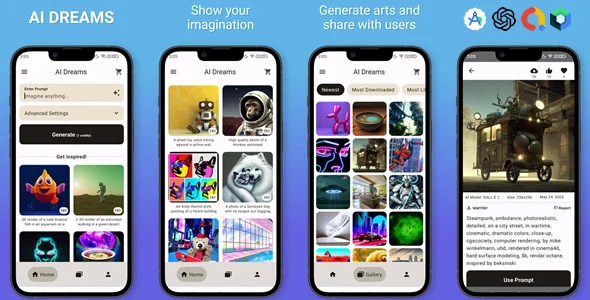
AI Dreams: DALL-E 3 Image Generator Overview & Native Android AI Art Engine
AI Dreams: DALL-E 3 Image Generator is a Kotlin 1.8 Android application source code, engineered for mobile developers and agencies to deploy a production-grade AI art generation and social sharing platform on Android 9.0 through 12.0. The codebase removes the recurring engineering bottleneck of binding OpenAI DALL-E 3 and DALL-E 2 inference into a native Android client by delivering a prebuilt MVVM architecture layered on Jetpack Compose, with credit metering, ad-based monetization, and Google authentication already wired. In agency delivery workflows, it functions as a deployable foundation: rebrand the Compose UI, attach your OpenAI credentials through the server-side key retrieval layer, and publish to Google Play with in-app purchases active from the first release candidate.
Technical Specifications & Deployment Matrix
| Engineering Metric | Deployment Specification |
|---|---|
| Base Technology / Framework | Kotlin 1.8, MVVM architecture, Jetpack Compose UI toolkit |
| Runtime / Language Requirements | Android 9.0, 10.0, 11.0, and 12.0 (UI and color system tuned for Android 12+ Material You theming) |
| Data Exchange / Communication Protocols | REST/JSON serialization against OpenAI DALL-E 3 and DALL-E 2 endpoints; server-side API key retrieval over encrypted transport |
| Front-End / Engine Dependencies | Google Play Billing Library for credit in-app purchases; Rewarded and Interstitial ad modules; Google Sign-In SDK; Chucker for debug network inspection |
| Database / Persistence Footprint | Distributed as a compiled .apk package with server-mediated credential storage; local gallery persistence for generated, liked, and favorited artwork |
DALL-E Inference Pipeline & Social Layer Execution Flow
The core execution pipeline routes every generation request through a validated text-or-image prompt into the OpenAI API, then persists and distributes the returned artwork through an integrated social graph. At runtime, a prompt submitted from the Compose UI is captured by a ViewModel, serialized to JSON, and dispatched to the DALL-E 3 or DALL-E 2 endpoint using an API key that the client fetches from the server rather than embedding in the binary, a security hardening introduced in version 1.3.2 that prevents static extraction of credentials through APK decompilation. The generated image returns through the serialization lifecycle into the gallery state, where the persistence layer indexes it for download, like, and favorite operations. The social module synchronizes user-shared artwork feeds so that creations from other users populate the discovery surface without leaving the native client. Credit accounting runs ahead of each generation call: users either consume purchased credits through Google Play Billing or restore quota by completing a Rewarded ad view, with Interstitial placements inserted at defined navigation boundaries to balance revenue density against session retention.
Core Technical Capabilities of AI Dreams: DALL-E 3 Image Generator
- Server-Mediated API Key Management: The OpenAI key is retrieved from a remote server at runtime and never compiled into the APK, closing the reverse-engineering vector that affects hardcoded-key builds and satisfying Google Play policy expectations for credential handling.
- MVVM State Management with Jetpack Compose: UI state flows through ViewModels into composable functions, so generation results, gallery updates, and credit balances re-render reactively without imperative view manipulation across the 11 supported languages.
- Hybrid Monetization Stack: Google Play Billing Library handles credit in-app purchases while Rewarded and Interstitial ad units gate extended usage, giving operators two parallel revenue paths that can be tuned independently.
- Multi-Language Runtime Switching: Eleven localizations, including English, German, Spanish, French, Italian, Japanese, Portuguese, Chinese, and Turkish, can be switched from inside the app without requiring a device-level locale change, broadening addressable markets within a single build.
- Social Distribution Graph: Users publish, download, like, and favorite artwork across a shared feed, converting one-shot generation output into recurring engagement loops anchored in the gallery screen redesigned in version 1.3.2.
Production Implementation & Operational Resilience
Deploying this source code into a client engagement begins with standing up the credential retrieval endpoint, since version 1.3.2 moved key custody server-side; the client expects that service to respond before any generation call is issued, and operators should validate that transport under production network conditions using the bundled Chucker integration, which exposes full request and response inspection during debug builds. Error paths around prompt validation, quota exhaustion, and network failure surface through the MVVM state layer, so failed generations return the UI to a recoverable state rather than a dead end, and the credit ledger is only debited after a confirmed API response. Authentication is delegated to Google Sign-In, which removes local password storage from the threat model entirely. For teams extending the same AI art delivery model into WordPress-based client properties, pairing this Android client with Open AI’s Dall-E AI Art Generator and Edior creates a consistent DALL-E generation surface across native mobile and CMS web touchpoints under a shared OpenAI account. Secondary development stays low-friction because the Kotlin codebase is documented at the class level: swapping the Compose theming tokens for a client brand, adjusting Dark and Light Mode palettes, or rewiring ad placement cadence are contained changes that do not touch the inference pipeline. Developers seeking adjacent native distribution use cases, such as wallpaper and photo discovery clients, can also study Image Finder Android App 1.1 for a complementary gallery-driven monetization pattern.
Frequently Asked Questions
Is the OpenAI API key stored inside the compiled APK?
No, version 1.3.2 retrieves the key from a remote server at runtime, keeping the credential out of the binary and preventing extraction through static APK analysis or decompilation by unauthorized parties.
Does the app support DALL-E 3, or only the older DALL-E 2 model?
Yes, DALL-E 3 support was added in version 1.3.2, and the codebase retains DALL-E 2 compatibility, letting operators choose between the two models depending on cost and output requirements.
Can users generate artwork from an existing image rather than only text prompts?
Yes, the generation pipeline accepts both text and image inputs, routing either prompt type through the same View Model serialization path into the DALL-E endpoints for processing.
Is Google Play Billing required, or can monetization run on ads alone?
Yes, the two channels operate independently, so a deployment can disable credit purchases and rely entirely on Rewarded and Interstitial ad inventory, or the reverse, without structural code changes.
Do I need to verify the Google Play Billing Library version before publishing?
Yes, the library was upgraded in version 1.3.2, and confirm your build targets a Billing Library revision that meets current Google Play policy deadlines before submitting a release candidate for review.
Threads Downloader – Videos, Images & Audios Downloader | ADMOB, FAN, APPLOVIN, FIREBASE, ONESIGNAL
Insta Saver – Instagram Videos, Images, Stories & Reels Downloader | ADMOB, FIREBASE, ONESIGNAL
VidoStatus – AI Image Generator & Video Status Maker, Status Saver, Quotes Creator, Admob Ads