Agrul – Agriculture WordPress Theme
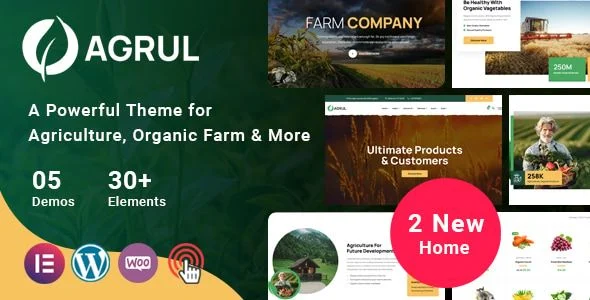
Agrul Agriculture WordPress Theme Overview & Elementor Rendering Foundation
Agrul Agriculture WordPress Theme is an Elementor-powered front-end solution engineered for agencies and farm-business operators to publish production agriculture websites without server-side hand-coding. The package eliminates the bottleneck of assembling custom template hierarchies from scratch by shipping five prebuilt homepages, thirty-five professionally structured inner pages, and a one-click demo importer that stages full demo content, including images, into a WordPress 6.x installation. Within agency delivery workflows, it functions as a deployable design system spanning organic food retail (WooCommerce 5.x through 9.x), multilingual publishing (WPML), and lead capture (Contact Form 7 plus Mailchimp newsletter integration).
Technical Specifications & Deployment Matrix
| Engineering Metric | Deployment Specification |
|---|---|
| Base Technology / Framework | WordPress theme (PHP/CSS/JS files) built on Bootstrap 5.x with Elementor Page Builder |
| Runtime / Language Requirements | WordPress 6.0.x through 7.0.x; PHP theme files with widget-ready sidebars |
| Data Exchange / Communication Protocols | Contact Form 7 form submissions, Mailchimp newsletter opt-in handling, WPML translation registry |
| Front-End / Engine Dependencies | Elementor drag-and-drop editor, 40+ custom Elementor widgets, custom header/footer builder |
| Database / Persistence Footprint | Standard WordPress schema; WooCommerce commerce tables activated when the shop layer is enabled |
Elementor Rendering Pipeline & Commerce Execution Architecture
Agrul delegates its entire visual rendering pipeline to the Elementor page builder running on a Bootstrap 5.x grid. Because the theme registers custom header and footer regions as editable Elementor documents, the native WordPress get_header() and get_footer() includes are replaced by builder-rendered DOM trees, giving designers direct control over site chrome without editing PHP partials. Forty-plus custom widgets extend the builder’s widget registry, so farm service grids, produce showcases, and harvest timelines are composed from prebuilt modules that output structured markup consistent with the WordPress template hierarchy.
The one-click demo importer executes against the WordPress database directly: it writes page and post records, assigns sidebar widgets, and registers the bundled premium images as media library attachments, collapsing a multi-day build into a single staging operation. Five homepage variants and thirty-five inner pages cover organic farms, livestock and dairy operations, gardening and landscaping services, and agricultural news outlets, each wired to reusable builder templates. On the commerce side, the WooCommerce integration ships dedicated product and shop layouts compatible with WooCommerce 5.x through 9.x template structures, letting operators sell organic produce, groceries, and natural food items through native product archives. For studios whose retail deliverable is a small artisan storefront rather than a produce catalog, Etruscan Handmade Pottery Store operates as a parallel WooCommerce storefront option within the same publishing platform.
Core Technical Capabilities of Agrul
- Elementor Header & Footer Builder: Header and footer regions are registered as Elementor-editable documents, overriding native template includes so global chrome is composed visually and rendered consistently across every page load.
- One-Click Demo Importer: The import routine writes pages, posts, widget assignments, and media attachments into the WordPress database, reproducing the demo layouts with bundled images in a single execution pass.
- WooCommerce Storefront Layer: Prebuilt shop and single-product layouts map onto WooCommerce template structures across the 5.x–9.x release line, enabling organic product sales without custom commerce development.
- WPML Multilingual Registry: Theme strings, widget content, and builder documents are registered for translation, allowing parallel-language page trees to share a single layout definition and asset base.
- Child Theme Isolation: A bundled child theme lets developers override parent templates, styles, and functions while keeping the parent codebase replaceable during update cycles.
Production Implementation & Operational Resilience
For agency staging environments, the practical deployment sequence is a standard theme upload, plugin activation for Elementor, WooCommerce, Contact Form 7, and Mailchimp, followed by the demo import. Because the importer processes a substantial media payload, PHP memory allocation should be reviewed before execution on constrained shared hosting; raising the memory limit and max execution time prevents partial imports. Cross-browser behavior is addressed at the CSS layer, with the Bootstrap 5.x foundation validated across Chrome, Firefox, Safari, Opera, Edge, and legacy Internet Explorer 9 through 11, and markup ships as W3C-valid, SEO-structured output that supports crawlable heading order and semantic sectioning.
Error handling follows WordPress conventions: form validation flows through Contact Form 7’s field-level checks, newsletter subscriptions route through Mailchimp’s processing layer, and the theme options panel plus Customizer expose unlimited color and typography configurations without file edits. Customization boundaries are well defined—layout work belongs in the Elementor editor, while PHP-level modifications belong in the child theme so parent updates never destroy client work. For decoupled implementations outside the self-hosted theme runtime—teams standardizing on kit-based design systems rather than PHP themes—Agria Agriculture Company Elementor Pro Template Kit offers a parallel design path for farm websites, though its kit structure remains a separate deliverable rather than an extension of this codebase.
Frequently Asked Questions
Does the package include a child theme for protecting template overrides?
Yes. A dedicated child theme ships inside the download, allowing developers to override parent template files, styles, and functions while keeping the parent codebase intact through successive version releases up to the current v1.4.0.
Are the premium images shown in the demo included with the demo content import?
Yes. The importer bundles the premium images displayed on the homepages and inner pages, so imported pages render consistent with the preview without sourcing placeholder media from external asset libraries or third-party stock services.
Can the native Gutenberg block editor serve as the primary page-building runtime for this theme?
No. The theme’s documentation explicitly lists it as not Gutenberg-optimized. All layout composition, including headers and footers, is intended to run through the Elementor drag-and-drop builder, and editing workflows should standardize on that engine.
-
5 May 2023 LatestSeptember 24, 2026