Mozzu – AI Based Online Food Ordering System & Multi-Restaurant with SaaS
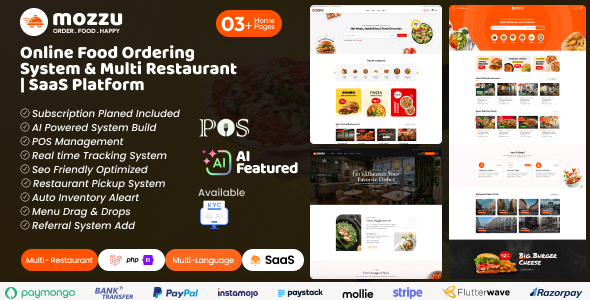
Mozzu Food Ordering: Technical Overview & Core Architecture
Mozzu – AI Based Online Food Ordering System & Multi-Restaurant with SaaS delivers a multi-tenant Laravel MVC codebase for Mozzu Food Ordering deployments tailored for restaurant franchisors, ghost kitchen syndicates, and on-demand delivery aggregators. The backend engine utilizes composite indexing across spatial geolocation tables and transactional order registries to suppress table scan latency during concurrent peak-hour cart submissions. An event-driven WebSocket and Redis worker pipeline broadcasts status mutations across customer, vendor, and driver frontends in real time without triggering HTTP polling overhead.
Modular service providers decouple vendor catalog structures, automated menu generation algorithms, and payment dispatchers into independent controller layers connected via tokenized RESTful API contracts. The centralized administration panel enables operators to configure multi-tier commission splits, geographic delivery radii, payment gateway webhook endpoints, and automated subscription billing cycles without manual edits to environment files.
Key Functional Features of Mozzu Food Ordering for Modern Deployments
- AI-Driven Menu Generation: Automated natural language processors convert raw ingredient lists and nutritional constraints into categorized catalog items, localized descriptions, and item modification groups directly inside the vendor dashboard.
- Multi-Tenant Data Partitioning: Relational schemas enforce tenant isolation using strict query scopes, guaranteeing distinct product inventories, earnings reports, and customer profiles for each registered restaurant entity.
- Dynamic Geofencing and Dispatch Logic: Spatial coordinate calculations evaluate active delivery zone polygons, computing delivery tariffs and assigning available couriers based on proximity and kitchen prep thresholds.
- Automated SaaS Subscription Engine: Scheduled worker daemons bill recurring platform fees, deduct variable order commission rates, and execute escrow balance settlements according to preset payment schedules.
- Real-Time Kitchen Display Synchronization: The Mozzu Food Ordering interface routes order statuses across kitchen monitors instantly via non-blocking sockets, advancing tickets from preparation through courier pickup.
Real-World Deployment Scenarios
- Multi-Brand Ghost Kitchen Hubs: Centralized kitchen operators deploy the food ordering platform to route incoming tickets across six distinct virtual restaurant brands from a single kitchen display terminal, synchronizing shared inventory allocations to prevent out-of-stock orders.
- Regional Multi-Vendor Delivery Aggregators: Local delivery consortiums manage regional vendor onboarding, variable zone-based commission structures, and real-time courier tracking across distinct postal codes with sub-second driver GPS position updates.
- Enterprise Restaurant Franchise Networks: Corporate food chains implement localized sub-stores with unified brand governance, allowing regional franchise managers to adjust menu availability and localized pricing while financial reconciliations stream to corporate ledgers.
Technical Architecture & Compatibility Standards
The production stack requires PHP 8.2 or higher with BCMath, Ctype, cURL, DOM, Fileinfo, JSON, Mbstring, OpenSSL, PCRE, PDO, and Tokenizer extensions enabled alongside MySQL 8.0 or MariaDB 10.5+. Nginx configurations must execute with HTTP/2 protocol support, serving static assets directly while reverse-proxying WebSocket connections through Redis-backed queue daemons.
System response benchmarks sustain average server response times below 180 milliseconds under concurrent transaction loads when caching layers are active. Native REST endpoints adhere to OpenAPI specifications, facilitating direct interoperability with third-party POS systems, thermal receipt printers, and external fleet tracking telematics.
Frequently Asked Questions
What server infrastructure is required to host the multi-restaurant system?
Dedicated VPS or cloud instances running Ubuntu 22.04 LTS with at least 4 CPU cores, 8GB RAM, Redis, and MySQL 8.0 provide optimal baseline throughput for medium-to-high transaction volumes.
How does the platform isolate vendor financial data across multi-tenant setups?
The database architecture enforces tenant-level query scoping using foreign key constraints and isolated accounting ledger tables, preventing cross-tenant data leakage during automated payout calculations.
Can third-party dispatch fleets integrate with the automated delivery pipeline?
Outbound Webhook triggers transmit real-time order payloads and coordinate handoffs directly to external logistics APIs whenever a kitchen marks ticket preparation as complete.