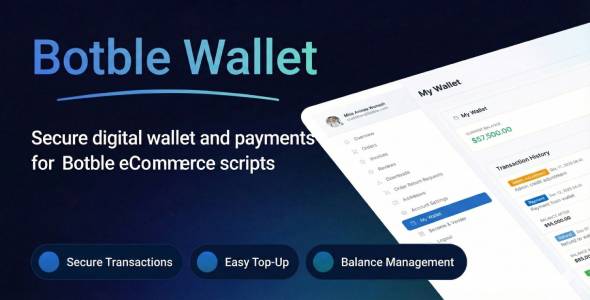
E-Wallet – Payment Wallet System For Botble eCommerce scripts
Payment Wallet System: Technical Overview & Core Architecture
E-Wallet – Payment Wallet System For Botble eCommerce scripts operates as a modular Laravel-based financial transaction package engineered for marketplace operators, Laravel full-stack developers, and multi-vendor platform administrators. The internal schema eliminates relational database bottlenecks through indexed double-entry transaction ledgers, strict database constraints, and optimized Eloquent model queries during concurrent balance mutations. An asynchronous event pipeline processes top-ups, payouts, and internal account transfers via background worker queues and secure AJAX endpoints, maintaining UI reactivity without blocking HTTP request threads.
Component integration utilizes standard Botble service providers and event listeners to bind the digital wallet module directly into existing product purchase workflows, vendor payout pipelines, and user profile dashboards. The centralized administrative control panel permits direct configuration of deposit minimums, fixed withdrawal thresholds, percentage-based transaction commissions, and supported currency exchange parameters without altering the underlying code.
Key Functional Features of the Payment Wallet System for Modern Deployments
- Atomic Ledger Accounting: The system records every credit and debit mutation as paired entries in the database, verifying balance integrity prior to commit operations and preventing duplicate balance deductions.
- Multi-Gateway Deposit Pipeline: Users initiate account balance top-ups through existing Botble payment gateways, triggering automated webhook verifications that credit user balances upon payment confirmation.
- Direct Checkout Integration: The digital wallet module exposes a dedicated checkout option during order processing, evaluating available funds against invoice totals and completing transactions via a single database commit.
- Peer-to-Peer Balance Transfers: Authenticated customers transfer funds to other registered platform users via email identification, backed by administrative fee deduction rules and immediate ledger updates.
- Granular Withdrawal Management: Platform vendors and customers submit payout requests through structured forms, allowing store managers to audit, approve, or reject transactions with automated balance reversals on decline.
Real-World Deployment Scenarios
- Multi-Vendor Marketplace Settlement: Platform administrators automate vendor payouts by crediting earnings directly to vendor wallets, reducing external gateway payout transaction fees and managing minimum withdrawal schedules.
- Customer Loyalty and Cash-Back Infrastructure: Retailers credit promotional rebates and refund balances directly to customer accounts, retaining capital within the platform ecosystem and accelerating repeat checkout operations.
- Micro-Transaction and Service Platforms: Digital content stores utilize pre-funded balances for low-value downloads, eliminating recurring micro-payment processing surcharges from external payment gateways.
Technical Architecture & Compatibility Standards
The codebase runs on PHP 8.1 or PHP 8.2 and requires an active Botble CMS eCommerce installation running Laravel 10 or 11. Database operations are optimized for MySQL 8.0, MariaDB 10.5+, and PostgreSQL 14+, utilizing InnoDB row-level locking to safeguard balance updates under heavy concurrent traffic.
The Payment Wallet System maintains zero client-side external dependencies, rendering interfaces through native Blade templates and vanilla JavaScript modules to guarantee zero cumulative layout shifts (CLS) and minimal time to interactive (TTI). External integrations interface via signed webhook handlers and standard Botble plugin hooks.
Frequently Asked Questions
Does the wallet support automated transaction reconciliation?
The system executes automated transaction reconciliation using strict database ledger tables, recording distinct debit and credit logs for every balance change to eliminate mathematical discrepancies.
Can administrators impose transaction fees on user deposits and withdrawals?
Administrators configure percentage or flat commission fees within the administrative dashboard, which calculate and deduct charges automatically prior to processing deposit credits or withdrawal requests.
How does the wallet handle insufficient balance events at checkout?
The checkout controller performs real-time balance validation prior to order processing, terminating execution and returning an explicit notification if available funds do not cover the transaction total.