
MulteCart Ultimate Ecommerce – Digital Multivendor Marketplace Online Store – eShop CMS
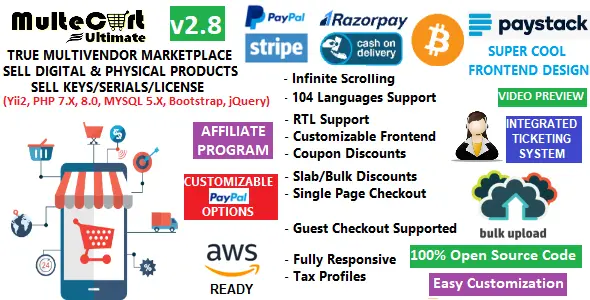
Architectural Analysis & Runtime Mechanics of MulteCart Ultimate Ecommerce
MulteCart Ultimate Ecommerce – Digital Multivendor Marketplace Online Store – eShop CMS provides a multivendor marketplace CMS engineered for enterprise platform operators, independent software vendors, and technical retail aggregators to scale unified merchant ecosystems. The relational data schema optimizes transaction throughput by establishing indexed foreign keys across vendor catalogs, isolating order ledger records, and executing batched eager loading to eliminate redundant SQL queries during peak navigation traffic. Asynchronous background worker queues decouple time-sensitive order status dispatching, digital asset verification, and vendor revenue calculations from client-facing HTTP execution threads.
Modular service providers interface with external payment processors, transactional email services, and cloud storage buckets through standardized REST contracts and event listeners. The centralized administrative console configures global commission percentages, automated vendor disbursement thresholds, multi-currency conversion ratios, and digital file access expiration intervals without altering the underlying PHP codebase.
Operational Features & Execution Engine in MulteCart Ultimate Ecommerce
- Vendor Commission Split Ledger: The transaction processor automatically divides incoming order values according to predetermined commission rules, recording net seller proceeds into isolated escrow tables prior to fund clearance.
- Tokenized Digital Asset Delivery: Upon confirmed payment receipt, the system generates cryptographically signed temporary access URLs, streaming digital files through byte-range PHP handlers that obscure direct server storage paths.
- Dynamic Multi-Vendor Shipping Engine: The routing module calculates separate consignment packages per vendor, executing regional courier matrix lookups to combine parcel fulfillment metrics within a unified transaction.
- Granular Role-Based Access Matrix: The administrative permission module enforces custom capability flags across sub-administrators, support staff, and merchant representatives, protecting financial audit ledgers and platform settings from unauthorized modification.
- Asynchronous Product Attribute Matrix: The inventory management screen allows merchants to bind multi-level product options and SKU variants, evaluating real-time stock thresholds without requiring full administrative page reloads.
Practical Production Implementations
- Digital Asset and Creative Software Marketplace: Independent graphic designers and plugin authors distribute binary packages through individual vendor stores, automating licensing key assignment and file transmission to verified buyers.
- Regional Multi-Merchant Commercial Hub: Local retail cooperatives consolidate independent storefront inventories into a unified regional portal, coordinating disparate vendor parcel dispatches through centralized dispatch tracking.
- B2B Wholesale Procurement Portal: Industrial equipment distributors deploy the multi-tier role system to manage specialized business accounts, processing high-volume quotation orders through localized merchant accounts.
Infrastructure Requirements & Integration Standards
MulteCart Ultimate Ecommerce operates on LAMP and LEMP production environments running PHP 8.1 through PHP 8.3, paired with MySQL 5.7 or MariaDB 10.4 database engines. The platform mandates standard PHP extensions including OpenSSL, PDO, Mbstring, Tokenizer, XML, and cURL to handle secure cryptographic operations and external API integrations. Optimized asset bundling and automated image compression routines ensure low rendering latency, consistently maintaining a Cumulative Layout Shift score below 0.02 and Largest Contentful Paint benchmarks under 1.2 seconds on enterprise cloud hosting.
The software architecture supports deployment behind Nginx reverse proxies, Cloudflare edge caching, and Redis memory caches to streamline session state persistence across high-concurrency visitor sessions. Operating as an enterprise multivendor marketplace CMS, the codebase implements strict CSRF token validation, input sanitization pipelines, and prepared PDO statements to defend merchant financial data against web application vulnerabilities.
Frequently Asked Questions
Does the system store digital media files in publicly accessible web directories?
No, the codebase stores all uploaded digital media outside public web roots, generating expiring cryptographic signature tokens that validate client permissions before streaming binary file data through protected internal PHP buffer streams.
How are commissions divided when an order includes items from multiple merchants?
The settlement engine calculates order line items individually, applying distinct vendor percentage splits and administrative commissions before posting isolated transaction credits to respective merchant financial ledgers automatically upon payment confirmation.
Can administrators restrict vendor access to platform-wide configuration settings?
Yes, the role-based access module enforces strict permission hierarchies, ensuring vendor accounts authenticate strictly into isolated sub-merchant dashboards without access to platform configuration settings, central tax definitions, or server infrastructure logs.
How does the platform prevent race conditions during concurrent stock reservations?
Database transaction locks wrap inventory reservation queries, verifying item availability within atomic SQL operations to prevent inventory overselling or negative quantity states during high-concurrency customer ordering sessions across shared product listings.
Can external payment gateways be integrated using custom webhook listeners?
Yes, the modular payment architecture provides standardized interface classes, enabling developers to integrate custom gateway SDKs and register asynchronous webhook listener routes that trigger order fulfillment workflows upon external settlement notifications.
-
2.6 LatestSeptember 20, 2026