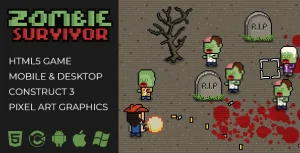
Zombie Defense – HTML5/Mobile Game – (C3p)
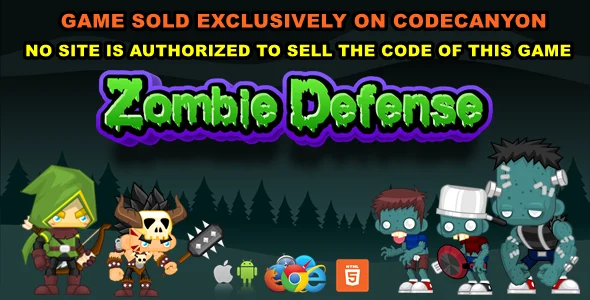
Zombie Defense Overview & Lane-Based Defense Engine
Zombie Defense is a Construct 3 HTML5 game package built for web studios and indie publishers who need to ship a lane-based defense title across browser and mobile channels. The codebase tackles the recurring bottleneck of cross-platform browser distribution by exporting one self-contained build — JavaScript, JSON, HTML, and CSS — that runs on IE9 through IE11, Edge, Firefox, Safari, Opera, and Chrome with no plugin dependency. Inside production workflows it operates as a drop-in arcade asset suited to portal embedding, WebView wrapping for Android and iOS, and AdMob-monetized mobile export.
Technical Specifications & Deployment Matrix
| Engineering Metric | Deployment Specification |
|---|---|
| Base Technology / Framework | Construct 3 engine; editable .c3p project file included with full source |
| Runtime / Language Requirements | HTML5 export — JavaScript, JSON, HTML, CSS; no plugins or server-side runtime |
| Browser Compatibility | IE9, IE10, IE11, Firefox, Safari, Opera, Chrome, Edge |
| Display Pipeline | High Definition 1280×720 canvas coordinate space |
| Platform Targets | PC, mobile browsers, Android, and iOS via WebView wrapping |
| Monetization Surface | AdMob integration supported through the Construct 3 editor (ad units not bundled) |
| Persistence Footprint | Client-side high score retention across the ten-level campaign |
Lane-Based Defense Logic & Runtime Execution Pipeline
The defense loop is driven by Construct 3’s event-sheet engine, which dispatches tick-based logic into a canvas renderer every frame. Monster entities advance along attack lanes toward the valley the player must hold, and each of the ten levels introduces escalating spawn pressure countered through unit placement and resource management. Because the package ships as a native .c3p project, every event sheet, layout, and object definition stays editable rather than locked inside a pre-compiled binary.
At runtime, the engine preloads sprite and audio assets before the first level initializes, preventing mid-wave texture stalls on slower mobile connections. Input is normalized at the event layer: touch events from mobile browsers and WebView containers map to the same placement handlers as pointer and keyboard input on desktop, which is why one exported build serves every listed platform. Score and progression state are synchronized through the engine’s session variables, so the retained high score carries across level transitions without any external backend. Studios assembling a broader Construct 3 arcade catalog can position Desert Building Stacking as a parallel browser title running the same runtime pattern.
Architectural & Functional Highlights
- Ten-Level Campaign Structure: Level progression is organized as discrete stages with escalating wave difficulty, giving level designers editable wave tables inside the event sheets rather than hard-coded spawn scripts.
- High Score Retention: The engine records the player’s best result across the campaign and persists it within session state, providing a replay incentive without requiring a database layer.
- Dual Input Architecture: Touch and desktop control schemes coexist in a single build, eliminating the need to maintain separate mobile and PC distribution variants.
- HD Canvas Rendering: Rendering targets a 1280×720 coordinate space, keeping art proportions consistent while the engine scales the viewport to the host display.
- Reskin-Ready Source: Sprites, layouts, and object definitions live in the open .c3p project, so visual replacement can proceed without touching gameplay event logic.
Production Implementation & Operational Resilience
Deployment reduces to static hosting: the exported folder contains the JavaScript, JSON, HTML, and CSS files served over standard HTTP or HTTPS, so any web server or CDN can host the title without server-side processing or database provisioning. When the game is embedded into an existing portal, keeping the asset folder on the same origin avoids cross-origin resource loading failures; if assets are split across domains, the asset host must return permissive CORS headers for the canvas context to initialize correctly. On underpowered devices, the preloading sequence gates the first playable frame until sprite sheets finish decoding, which prevents partially rendered waves from reaching the player.
For native distribution, the build wraps in a WebView container on Android and iOS, with AdMob integration handled through Construct 3’s export pipeline — the ad units themselves are not bundled and must be configured in the editor before producing a store build. Secondary development stays contained within the .c3p project: replacing sprite atlases, adjusting wave tables, and retuning unit statistics are all performed in the Construct 3 editor using the included source. For decoupled arcade variety outside the defense genre, Neon Rocket ships as a standalone Construct 3 source package that follows the same editor-based customization path.
Frequently Asked Questions
Does the exported build require the Construct 3 editor to be installed for players to run the game?
No. The runtime footprint consists of JavaScript, JSON, HTML, and CSS files that execute directly in the browser or a WebView container; the editor is only needed when developers open the included .c3p project for edits.
Are AdMob ad units pre-configured and ready to generate revenue out of the box?
No. AdMob integration is supported through the Construct 3 environment, but the ad units are not included with the package; a developer must configure them in the editor and produce a fresh export before monetized builds go live.
Can a single exported build serve both mobile touch players and desktop players?
Yes. The package ships with mobile controls and PC controls compiled into one build, so the same HTML5 export handles touch input on Android and iOS devices and pointer input on desktop browsers.
Is it possible to replace the visual theme without rewriting the gameplay event logic?
Yes. The project is documented as easy to reskin, and because all sprites and object definitions reside in the included .c3p source, artists can swap assets in the Construct 3 editor while leaving the underlying event sheets untouched.