Zata – Construction WordPress Theme
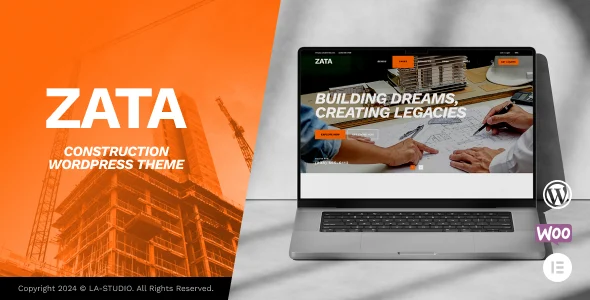
Zata Construction WordPress Theme Overview & Front-End Builder Architecture
Zata Construction WordPress Theme is an Elementor-driven WordPress theme engineered for construction firms, contractors, electricians, plumbers, and engineering agencies that must publish service catalogs, project portfolios, and WooCommerce storefronts from a single codebase. The package removes the bottleneck of hand-building industry-specific layouts by bundling 120+ drag-and-drop front-end elements, a header and footer builder, and a one-click demo importer that reproduces the reference site in under two minutes. Inside agency delivery pipelines it operates as a production-ready foundation: a team imports a demo, rewrites content through the visual editor, and ships a client-editable site without editing template files.
Technical Specifications & Deployment Matrix
| Engineering Metric | Deployment Specification |
|---|---|
| Base Technology / Framework | WordPress theme (PHP 7.0+, MySQL 7.0+), Elementor page-builder engine, Gutenberg-optimized output, widget-ready sidebars |
| Runtime Requirements | Apache mod_rewrite enabled, memory_limit 256M, upload_max_filesize 32M |
| Version Compatibility | WordPress 5.9.x through 6.8.x, WooCommerce 7.x to 9.8.x, Elementor 3.28.x, all major evergreen browsers |
| Plugin Interoperability | Elementor Pro, WPML, Jetpack, Contact Form 7, Gravity Forms, WPForms, Events Calendar, Easy Digital Downloads, Dokan, WC Vendors |
| Deliverable Footprint | PHP, CSS, Sass, and JS source files, demo XML content, bundled Slider Revolution plugin, included child theme |
Elementor Rendering Pipeline & Construction Feature Engine
All page composition in this theme executes through the Elementor front-end builder, rendering carousels, images, and video widgets live in the browser. Because the engine works on the front end, every design decision — column structure, carousel configuration, media placement — is validated against the actual rendered DOM rather than a back-end approximation. A parallel options layer lives in the live WordPress Customizer, which governs typography from a pool of 600+ Google Fonts, color schemes, and layout parameters, while the Template Library persists page designs as reusable, exportable templates that can be ported across installations. Header and footer regions receive the same treatment: layouts are assembled visually and assigned per page context, and a mega-menu layer extends navigation for large service taxonomies.
The construction vertical is served by three portfolio layout engines — grid, metro, and carousel — backed by Isotope filtering and Packery positioning, with the same layout variants applied to blog, shop, and team-member archives. Media handling covers parallax effects, lightboxes, shape and gradient dividers, and a video element supporting YouTube, Vimeo, and Dailymotion sources. For decoupled implementations outside WordPress entirely, the Construction Building Company HTML5 Responsive Template exists as an independent static-code alternative targeting the same building-company vertical.
Core Technical Capabilities of Zata
- Ajax mini-cart state synchronization: Cart mutations propagate via Ajax to the mini-cart and cart page without full page reloads, so shoppers continue browsing while item quantities update in place.
- One-click demo importer: The importer writes the full reference demo — content, widgets, and option sets — in a single operation, reducing initial setup to roughly a minute before content replacement begins.
- WooCommerce product presentation layer: Color swatch galleries, image swatches, 360-degree product views, video thumbnails, quick view, custom product labels, wishlist, and comparison modules ship natively, with attribute-driven sidebar filters for variable products and Ajax load-more pagination.
- Header and footer builder with mega menu: Header layouts are composed per page context and paired with a mega-menu system sized for multi-tier service and portfolio taxonomies, plus sticky-menu behavior for long-scroll project pages.
Production Implementation & Operational Resilience
Before deployment, the host environment must satisfy the documented thresholds: PHP 7.0 or greater, MySQL 7.0 or greater, the Apache mod_rewrite module, upload_max_filesize at 32M, and memory_limit at 256M — values that matter most during demo import, when the XML payload and bundled plugin assets are written in a single request cycle. Caching behavior has been verified against W3 Total Cache and WP Super Cache, and SEO metadata routing works alongside Yoast. Multilingual deployments are covered through WPML, Polylang, and Loco Translate compatibility, a relevant factor for contractor firms operating across regional markets.
Revision delivery runs through the Envato Market plugin, which pushes new theme versions to the dashboard for one-click application. Because a child theme ships in the package, template overrides and function additions stay isolated from parent files, and the included Sass sources let the style layer be recompiled rather than patched with override CSS. Maintenance mode and coming-soon mode provide pre-launch staging masks, while the import/export routine for theme options lets agencies snapshot a configured build and replicate it across client installations. Agencies comparing a parallel construction-firm baseline before committing can evaluate BuildTab, an alternate WordPress theme serving builders, architects, and engineers within the same vertical.
Frequently Asked Questions
Does the package include a child theme for safe secondary development?
Yes. A child theme ships with the theme files, letting developers keep template overrides and custom functions in a separate directory so parent-file revisions applied later never overwrite client modifications.
Is the Slider Revolution plugin bundled, or does it require a separate acquisition?
Yes, it is bundled. The plugin ships inside the package at no additional cost, providing a drag-and-drop editor for sliders, carousels, hero scenes, and full front pages rendered responsively across desktop and mobile viewports.
Is prior coding knowledge required to modify page layouts?
No. The architecture exposes visual options for nearly every parameter through Elementor and the live Customizer, so page assembly, header composition, and styling adjustments are performed through drag-and-drop controls rather than PHP edits.