Yummy Restaurant
Yummy Restaurant Overview & Dynamic Restaurant Management Architecture
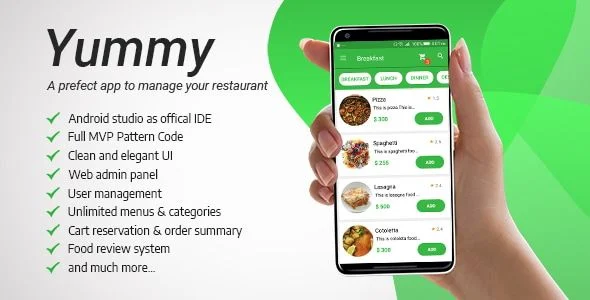
Yummy Restaurant is a native Android restaurant management application paired with a PHP server-side admin panel, engineered for restaurant operators and mobile developers who need a fully configurable ordering system without recompiling the client for every menu change. The architecture removes the core operational bottleneck of hardcoded menus by exposing restaurant name, logo, category structure, and food catalog as server-managed data that the Android client renders at runtime. Within an agency delivery pipeline, the package functions as a deployable end-to-end product: customers browse, order, favorite, and review food from the app, while staff administer the catalog, users, and order flow entirely through the web interface.
Technical Specifications & Deployment Matrix
| Engineering Metric | Deployment Specification |
|---|---|
| Base Technology / Framework | Native Android application (Java) with a Yii-framework PHP admin panel |
| Runtime / OS Requirements | Android 5.0, 5.1.x, 6.0, 7.1.x, and 7.2.x |
| Data Exchange / Communication | HTTP communication between the Android client and the PHP web backend |
| Front-End / Engine Dependencies | Material Design UI, MVP architectural pattern, JavaScript/CSS/HTML assets on the admin side |
| Database / Persistence Footprint | Server-side relational database shipped as a .db artifact alongside the full PHP codebase |
| Deliverable File Formats | .apk, .db, .java, .xml, JavaScript JS, CSS, PHP, HTML |
Admin-Driven Catalog Engine & Execution Pipeline
The core mechanism is a server-authoritative catalog: every food item, category, and user record lives in the backend database, and the Android client acts as a rendering and transaction layer.
Inbound operations follow a predictable path. A customer launches the app, registers or logs in, and the client requests the current catalog state from the PHP backend. Category structures such as breakfast, lunch, and dinner are parsed and displayed without any client-side rebuild, because the display hierarchy is generated from server data rather than static resources. When a user searches the list, opens a food detail view, or adds an item to the cart, the client recomputes totals dynamically as line items accumulate and allows removal of individual entries before checkout. Order placement terminates in one of two payment rails: cash on delivery, or a Braintree transaction supporting PayPal, credit card, and debit card processing. Feedback submitted against a food item is persisted server-side and rendered back to all clients viewing that item, and the food like plus favorite features let users flag preferred dishes for later retrieval.
Administrators operate the mirror-image pipeline. Through the web panel they add new foods, create new categories, remove items, manage user accounts, and update the restaurant profile, including the branding assets the app displays. The CSV import route allows bulk population of the food catalog instead of per-item manual entry, which materially reduces initial data-entry effort for large menus. The June 2020 update cycle added the food like feature, resolved an admin profile update defect, and refreshed the interface design.
Core Technical Capabilities of Yummy Restaurant
- Server-authoritative configuration: Restaurant identity, category taxonomy, and menu contents are mutated through the PHP admin panel and reflected in the client without recompiling or redeploying the APK.
- MVP-pattern Android codebase: The Java client is organized on the Model-View-Presenter pattern with commented source files, which separates presentation logic from data handling and simplifies feature modification.
- Dual payment rails: Checkout supports cash on delivery alongside Braintree-processed PayPal and card transactions, covering both unbanked and card-holding customer segments.
- Bulk catalog ingestion: A CSV upload path populates the food database in a single administrative operation rather than sequential form submissions.
- Interactive feedback loop: Users can favorite foods, like items, and submit reviews, with all feedback stored centrally and visible against the corresponding catalog entries.
Production Implementation & Operational Resilience
Deployment requires two coordinated halves: a hosted PHP environment running the admin panel and database, and the Android client pointed at that backend. The included .db artifact and full PHP source allow the server side to be provisioned and seeded on a standard LAMP-style host, after which administrators validate the end-to-end flow using the documented demo credentials before public rollout. Because catalog state, user accounts, and reviews all live server-side, a client update never risks orphaning transactional history, and the package ships with full documentation containing screenshots for both the web panel and the app to guide staging and configuration.
The codebase is written for modification. Comments throughout the Java and PHP files document intent, and the MVP separation means a developer adjusting cart logic or list rendering does not need to touch the persistence layer. This is an explicit design goal stated by the vendor: a person without technical background should be able to configure and operate the system after deployment, while developers retain a clean extension surface for custom behavior.
Operational boundaries worth planning around: the client targets Android 5.0 through 7.2.x, so devices running newer OS generations fall outside the documented compatibility matrix until the SDK configuration is raised and retested. Braintree processing also requires a properly configured merchant environment on the server side before live transactions can succeed, and cash on delivery remains the fallback rail where gateway setup is deferred.
For restaurants that additionally need a web storefront outside the Android runtime, Awebani – Restaurant WordPress Theme exists as an independent WordPress design path for cafes, bars, and bistros, with no shared codebase or backend coupling to this application. Agencies evaluating standalone multi-vendor alternatives on the mobile side can likewise assess Karenderia Mobile App Multi Restaurant as a separate native delivery-app implementation rather than an extension of this package. Teams that want to prototype additional Android screens before touching Java source may treat Material UIX – KOTLIN Material Design VER 1.3 as a reference UI kit aligned with the same Material Design language, implemented in a different language stack.
Frequently Asked Questions
Are the preview images included in the downloadable package?
No, the images shown in the preview exist for demonstration purposes only and are not part of the download file, so operators must supply their own food photography and branding assets before publishing the app.
Does the purchase include the server-side admin panel and its database?
Yes, the deliverables contain the full PHP code for the web admin interface, a developed server-side database shipped as a .db artifact, and documentation with screenshots covering both the panel and the Android app.
Can customers place orders without a card or online payment account?
Yes, cash on delivery functionality is implemented alongside Braintree processing, so orders can be completed offline at the point of delivery rather than requiring PayPal, credit card, or debit card credentials.
Is the Android source code readable enough for secondary development?
Yes, the client follows the MVP pattern with clean, well-commented code, and the PHP side is similarly documented, which reduces the ramp-up cost for developers modifying cart behavior, catalog rendering, or admin workflows.