Word Puzzle For Kids – HTML5 (Phaser 3, Typescript)
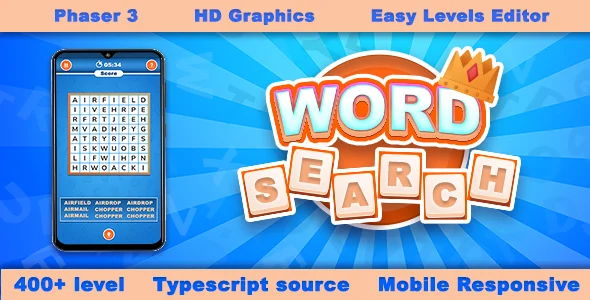
Word Puzzle For Kids Overview & Canvas-Based Word Search Engine
Word Puzzle For Kids is an HTML5 word search game built on Phaser 3.80.1 with a TypeScript source layer, engineered for game studios and indie developers to deploy vocabulary-building puzzle content across web and mobile channels. The package addresses the recurring production bottleneck of word-game delivery—level authoring, letter-grid rendering, and cross-platform packaging—by shipping a compiled build folder alongside typed, maintainable source. Within an agency pipeline, it operates as a drop-in browser title that can be embedded on client sites or wrapped for Play Store and App Store distribution without rewriting the game layer.
Technical Specifications & Deployment Matrix
| Engineering Metric | Deployment Specification |
|---|---|
| Base Engine / Framework | Phaser 3.80.1 (HTML5 game framework, Canvas/WebGL rendering) |
| Source Language | TypeScript compiled to JavaScript |
| Files Included | JavaScript JS, JSON, HTML, CSS |
| Platform Targets | Desktop, Mobile, Cross-platform browsers |
| Graphics Profile | High-resolution, hand-painted artwork by a professional artist |
| Persistence Footprint | Client-side JSON level definitions; no server database required |
| Deliverable Build | Pre-compiled dist folder (v0.0.3) ready for static hosting |
Level Data Pipeline & Rendering Execution Flow
The engine consumes JSON level definitions and renders each word board through the standard Phaser scene lifecycle: preload, create, and update phases.
At boot, the Phaser preloader pulls the hand-painted texture atlas and level configuration files into GPU-accessible memory before the first frame renders, preventing mid-session asset pop-in. Once the create phase initializes the board, the input system maps swipe gestures across the letter grid, validating each dragged path against the active word set loaded from JSON. Because level content lives in data files rather than hard-coded logic, the number of puzzles scales with the configuration you supply—there is no engine-level cap on level count. The update loop then handles frame-by-frame rendering, animation timing, and touch tracking across the responsive canvas, which rescales to fit desktop viewports and mobile screens alike. For studios assembling a broader catalog of letter-driven titles, Letters Typing – 2 HTML5 Games runs on the same browser runtime and serves as a parallel vocabulary and typing exercise for mixed game portals.
Core Technical Capabilities of Word Puzzle For Kids
- Data-driven level authoring: Puzzle content is defined in JSON files, so new levels are added by extending the data set rather than modifying engine code, keeping content iteration decoupled from the codebase.
- Mobile-responsive canvas rendering: The Phaser display layer scales the board and interface elements to the host viewport, allowing a single build to serve desktop browsers, tablets, and phones without separate layouts.
- Reskin and branding layer: All visuals are hand-painted source assets that can be swapped as a batch, enabling full rebranding of colors, letters, and UI art without touching gameplay logic.
- Store-ready build output: The compiled dist folder deploys to any static host or live server, and the same output can be wrapped in a WebView container for Google Play and App Store submission.
- Ad integration preparation: The codebase is structured so advertising SDK hooks can be wired into the game flow, letting monetization be added during packaging rather than requiring architectural changes.
Production Implementation & Operational Resilience
Deployment is intentionally minimal: the package includes a pre-built dist folder (version 0.0.3), and copying its contents to any static web server or CDN-backed host brings the game online with no backend service, no database connection, and no server-side runtime dependency. This static footprint removes common failure points such as API timeouts, session handling, and server-side error paths; the primary operational considerations shift to hosting configuration. Because asset requests are same-origin file fetches in the default deployment, serving the game from a single domain avoids cross-origin resource loading issues, and any relocation of asset paths must preserve the relative structure expected by the Phaser loader.
For secondary development, the TypeScript source is the intended modification surface: the typed codebase gives developers compile-time checks when adjusting board logic, input handling, or scoring behavior, which reduces regression risk compared to editing minified JavaScript directly. Reskinning operates on the art layer—replacing the painted textures and interface graphics—while branding adjustments cover the visible identity elements of the package. The package is versioned (tech version 0.1, build 0.0.3), so teams can track source revisions against deployed builds. An announced roadmap lists emoji reactions and an expanded win effect as upcoming additions, which signals where the presentation layer is headed; studios planning around those features should treat the current build as excluding them. For teams scaling toward a multi-title arcade portal on the same HTML5 runtime, Top 10 Best Seller HTML5 Game, Construct 3 offers an alternative bundled catalog for populating game sections alongside this word search title.
Frequently Asked Questions
Does the package ship with a pre-built version that can be deployed without compiling the source?
Yes. The download includes a build folder (version 0.0.3); copying the contents of the dist folder to a live server puts the playable game online without running a TypeScript build step.
Is the TypeScript source included, or only the compiled JavaScript output?
Yes. The full TypeScript source is part of the deliverable, and it is described as highly maintainable, giving developers a typed codebase for feature changes rather than only minified runtime files.
Are advertising SDKs already integrated into the current build?
No. The package is documented as ready to integrate ads, meaning the codebase is structured for ad SDK insertion, but the wiring of a specific ad network remains a development task during packaging.
Are the emoji reactions and immersive win effects already present in this version?
No. Both features are listed as upcoming additions on the product roadmap, so the current build should be evaluated without expecting those presentation elements to be active.