Wholesale – B2B Wholesale Pricing & Customer Groups for Botble E-commerce
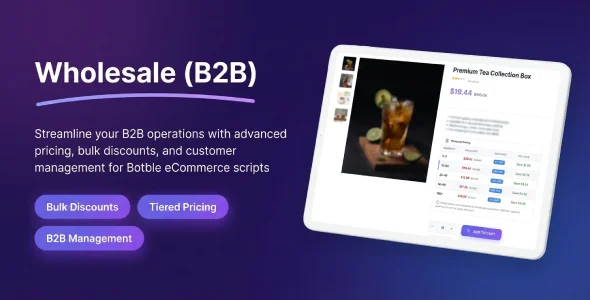
Wholesale for Botble E-commerce Overview & B2B Commerce Architecture
Wholesale for Botble E-commerce is a Laravel plugin package, engineered for store operators and agencies to convert a Botble storefront into a business-to-business sales channel. A stock Botble deployment prices every visitor identically and exposes the catalog publicly, which breaks tiered reseller agreements, minimum-order economics, and gated product distribution. The module installs into the platform/plugins/ecommerce-wholesale directory and attaches customer groups, quantity-based price rules, MOQ validation, and catalog gating directly onto the existing Ecommerce plugin runtime.
Technical Specifications & Deployment Matrix
| Engineering Metric | Deployment Specification |
|---|---|
| Base framework | Laravel package running on Botble CMS 7.6.0 or higher |
| Runtime requirements | PHP 8.2+ (PHP 8.x), MySQL 5.x or 8.x, Botble Ecommerce plugin installed and activated (mandatory) |
| Delivered artifacts | PHP source, JavaScript (JS/JSON), CSS, and Sass files |
| Data persistence | MySQL schema extensions applied through re-runnable package migrations |
| Front-end integration | Server-rendered product pages with injected quantity price tables; cart and checkout total recalculation |
Tiered Price Engine & Group-Based Execution Pipeline
The engine resolves wholesale prices by matching authenticated customers against scoped pricing rules. On each product request, the middleware checks whether the visitor carries an approved wholesale group assignment; guests fall back to retail display unless guest price visibility is explicitly enabled in settings. For authenticated buyers, the rule resolver walks three scope levels — product, category, and global — collecting every quantity-break definition that matches the customer’s group, then selects the lowest computed unit price for the requested cart quantity. That value replaces the retail figure across cart and checkout totals, while a price table rendered on the product page exposes each quantity threshold so buyers see exactly where per-unit costs drop.
Catalog access follows a parallel gate. Every product carries a visibility attribute — public, wholesale-only, or restricted to named groups — and the storefront query layer filters results before rendering, hiding gated SKUs from unqualified visitors. New wholesale accounts arrive through a registration workflow that captures company name, tax ID, and expected order volume; applications queue in the admin panel where operators approve them (assigning the default group) or reject them with a reason message. For identity verification requirements on separate WordPress deployments outside the Laravel runtime, KYC – Know Your Customer operates as an independent verification layer for that stack.
Architectural & Functional Highlights
- Customer group hierarchy: unlimited tiers (Bronze, Silver, Gold, Platinum) each carrying default percentage discounts, priority ordering, and per-group minimum order defaults that determine rule resolution order.
- Quantity-based rule engine: per-product rules accept a minimum quantity, discount type (percentage or fixed), and value, optionally bound to specific groups; the calculator picks the best available price automatically.
- MOQ enforcement: minimum order quantities validate per product and per group at checkout, with quantity increment stepping to block off-step cart quantities before order completion.
- Visibility control: a three-state attribute gates catalog exposure at the query level rather than the template level, keeping hidden products out of listings, not merely styled away.
- Multi-group resolution: a customer can hold memberships in several groups, and the engine selects the strongest discount outcome across all active assignments.
Production Implementation & Operational Resilience
Deployment follows the standard Botble plugin cycle: upload the extracted package to platform/plugins/ecommerce-wholesale, activate it from the admin Plugins screen, and manage it under Ecommerce > Wholesale. Minimum production parameters are Botble CMS 7.6.0, PHP 8.2, and a MySQL 5.x or 8.x instance. Since version 1.0.17, database migrations can be safely re-run when the package is reactivated, and activating, deactivating, or removing it no longer flushes the entire application cache — a meaningful boundary on shared hosting where a full cache clear degrades delivery for every tenant. Role-based permission flags let lead developers grant group, rule, and application management to specific admin roles without exposing the full panel. Failure surfaces concentrate in two places: checkout-side MOQ validation blocks order completion when quantity or order-value floors are unmet, and the application queue gives operators structured approve/reject actions with reason payloads. The package ships translation-ready with 30+ bundled languages, and administrators can override strings from the admin area without touching source files. Marketplace operators can additionally expose store-scoped rule management to individual vendors through the vendor dashboard setting. For teams maintaining parallel storefronts on a different Laravel commerce codebase, OTP add-on provides a separate authentication hardening path within the AmazCart system.
Frequently Asked Questions
Can this module operate on a Botble site that does not have the Ecommerce plugin installed?
No. The Ecommerce plugin is a mandatory dependency, and the package is built specifically for Botble ecommerce scripts; its activation path and data model expect the commerce layer to be present and active.
Can a single customer account hold membership in multiple wholesale groups simultaneously?
Yes. When multiple-group support is enabled, the engine resolves every group membership and automatically applies the best available discount during price calculation in the cart and checkout flows.
Can marketplace vendors manage their own wholesale price rules?
Yes. The vendor dashboard setting exposes store-scoped rule management, allowing each vendor storefront to define its own quantity breaks within the shared admin interface.
Are wholesale prices calculated correctly for products listed in a currency other than the store default?
Yes. Version 1.0.16 corrected the calculation routine so tiered and wholesale prices are computed properly for products priced in a non-default currency.
-
1.0.0 LatestOct 31, 2026