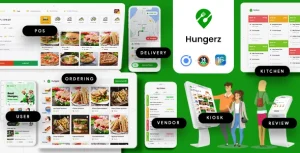
Whatsapp Ordering – Complete App with ionic 6 & Laravel Backend
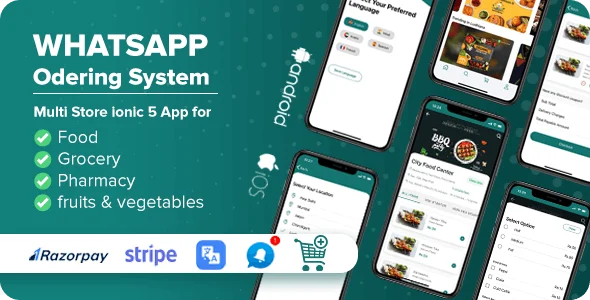
WhatsApp Ordering App Overview & Multi-Store Order Dispatch Architecture
WhatsApp Ordering App is an Ionic 6 cross-platform mobile application paired with a Laravel PHP backend, engineered for agencies and developers deploying multi-store food, grocery, pharmacy, and produce ordering systems. The architecture removes the operational bottleneck of dedicated order-management infrastructure by routing each customer order directly to the corresponding store’s WhatsApp number, while a parallel record persists inside the admin panel for reporting and manual processing. Within agency delivery pipelines it operates as a dispatch-ready codebase: store owners receive orders instantly, customers can browse a QR-accessible digital menu directly in a browser session, and administrators retain full order history oversight across every registered location.
Technical Specifications & Deployment Matrix
| Engineering Metric | Deployment Specification |
|---|---|
| Base Technology / Framework | Ionic 6 front end with Laravel PHP backend (MVC pattern) |
| Runtime / Language Requirements | PHP 7.x server runtime; JavaScript, Sass, PHP, and HTML source files included |
| Mobile Platform Targets | Android 9.0 minimum OS level; iOS 12 minimum deployment target |
| Data Exchange / Communication Protocols | REST-style JSON exchange between the Ionic client and Laravel endpoints; WhatsApp deep-link message dispatch for order delivery |
| Database / Persistence Footprint | Laravel-managed relational persistence for stores, digital menus, order history, and administrative records |
Multi-Store Order Dispatch & Execution Pipeline
The core mechanism is a multi-tenant ordering pipeline that terminates each transaction inside WhatsApp rather than a proprietary fulfillment console. When a customer completes a cart on the Ionic client, the application serializes the order payload, binds it to the selected store’s identifier, and hands the composed message to the WhatsApp messaging channel, which the store owner receives on their registered number. The Laravel backend simultaneously writes the same transaction into the administrative order history, guaranteeing that no order exists solely inside a chat thread. Because administrators can generate a digital menu per store, customers scanning the assigned QR code load the storefront in a mobile browser and complete the entire ordering cycle without installing the native app — a deployment mode that behaves as a PWA-style access path for walk-in and dine-in scenarios.
Core Technical Capabilities of WhatsApp Ordering App
- Multi-Store Location Isolation: Administrators register multiple stores mapped to distinct locations, and every inbound order carries the store binding so dispatch, menus, and reporting remain segmented per outlet without duplicating backend installations.
- WhatsApp Direct Order Dispatch: The finalized cart is converted into a structured WhatsApp message delivered to the store’s number, collapsing order latency to a single messaging transaction while the backend retains the duplicate record for manual processing.
- QR Code Digital Menu Access: Each store exposes a scannable digital menu; scanning opens a browser-based ordering session, removing the app-install barrier for first-time customers and reducing onboarding friction at physical locations.
- Administrative Order History & Reporting: Every transaction persists server-side, giving operators an auditable reporting trail that survives even if a chat message is deleted or lost on the store device.
- Engagement & Merchandising Layer: Push notifications, discount offers, and slider image slots are wired into the administrative surface, allowing campaign content to be injected without recompiling the client binary.
Production Implementation & Operational Resilience
Deployment requires a PHP 7.x-capable web server hosting the Laravel backend, with the Ionic 6 client compiled against an Android 9.0 minimum target and an iOS 12 minimum deployment target. The client communicates with the backend over REST-style JSON calls, so server-side CORS configuration must whitelist the domains and capacitor-origin schemes the mobile build will originate from, otherwise authenticated requests will fail at the preflight stage. Memory allocation on the hosting environment should accommodate Laravel’s framework bootstrapping per request, particularly when reporting endpoints aggregate multi-store order history. The August 2023 revision of the codebase resolved order-state issues, migrated the Ionic framework to the latest version, and corrected an automatic dark-theme state defect, which signals that theme state synchronization between the client’s light and dark palettes is now handled at the framework lifecycle level rather than through manual toggles.
For secondary development, the included JavaScript, Sass, PHP, and HTML sources allow agencies to restyle the customer-facing interface by overriding the Sass variable layers and swapping component templates. When a project demands that the storefront visually mirror conversational Material conventions consistent with the messaging channel itself, ChitChat supplies a prebuilt WhatsApp-style layout structure that can be adapted into the Ionic view hierarchy. On the operational side, merchants who later need to broadcast promotions or status updates across the same WhatsApp channel at volume can extend their messaging workflow with WhatsBox, which operates independently of the ordering pipeline and does not require modifications to the Laravel dispatch logic.
Frequently Asked Questions
Can customers place orders without installing the mobile app?
Yes. Each store can publish a QR code that opens the digital menu in a mobile browser session, allowing customers to browse, build a cart, and submit the order entirely on the web without any app installation.
Do stores receive orders directly inside WhatsApp?
Yes. The application composes the completed cart into a structured message and delivers it to the store’s registered WhatsApp number, while the Laravel backend stores a duplicate record for reporting and manual processing.
Can one backend installation manage stores across multiple locations?
Yes. The administrative panel supports creating multiple stores mapped to different locations, and each order payload is bound to its originating store so menus, dispatch targets, and reporting stay isolated per outlet.
Does the server environment require PHP 7.x?
Yes. The documented runtime requirement is PHP 7.x for the Laravel backend, so verify the hosting environment’s PHP version and enable the extensions Laravel needs before beginning the installation and configuration process.
Does the application support Android versions below 9.0 or iOS versions below 12?
No. The documented compatibility floor is Android 9.0 and iOS 12, so devices running older operating systems fall outside the verified target matrix and should be tested separately before any deployment commitment.
6 App Template| Online Medicine Ordering App| Medicine Delivery App| Pharmacy eCommerce| Pharmazone
Deleted Messages Recover Whatsapp – Recover All Deleted Messages – Message Recovery – Status Saver
Animated Stickers for whatsapp 100% Working with 300+ free stickers