Webifly AI – No Code Website & Landing Page Builder (SAAS)
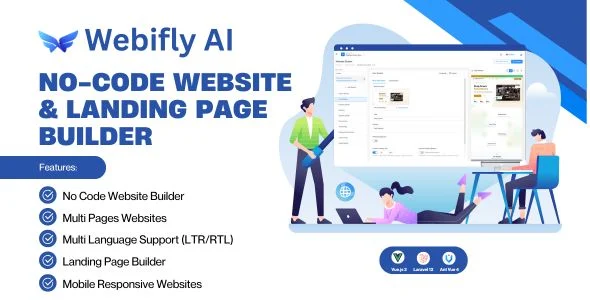
Webifly AI Overview & Self-Hosted Laravel SaaS Website Builder
Webifly AI is a Laravel 12-based SaaS website and landing page builder, engineered for agencies and developers to deliver multi-language client sites through a visual drag-and-drop editor instead of hand-written markup. The application removes the recurring bottleneck of rebuilding common page structures — hero, features, pricing, testimonials, team, FAQ, CTA, and footer blocks — by shipping 30+ pre-built section templates, each offering one to eight layout variants, all wired to a dynamic content schema that adapts form fields to the active section type. In production workflows it operates as a fully self-hosted platform where every website carries its own language set, theme colors, custom CSS/JS injections, and SEO metadata, making it a delivery vehicle for client work, SaaS products, and campaign landing pages alike.
Technical Specifications & Deployment Matrix
| Engineering Metric | Deployment Specification |
|---|---|
| Base Framework | Laravel 12 (latest), RESTful API architecture, Eloquent ORM |
| Runtime / Language Requirements | PHP 8.2+ (PHP 8.x compatible) |
| Database / Persistence Footprint | MySQL 8.0+ or MariaDB 10.3+ |
| Front-End / Engine Dependencies | Vue 3 (Composition API), Ant Design Vue 4.x, Vite build pipeline, Pinia state management, Vue Router, Axios, i18n |
| Async Processing Layer | Laravel Queue System, Laravel Notifications |
| AI Integration Endpoints | OpenAI (GPT-5.2 / GPT-4.1), Anthropic Claude, Perplexity, Ollama (self-hosted), OpenAI-compatible APIs |
| Included Source Files | JavaScript JS, CSS, LESS, PHP |
Drag-and-Drop Composition Engine & Execution Pipeline
The core mechanism is a Vue 3 composition-driven editor synchronized through Pinia stores and persisted over Axios calls to Laravel RESTful endpoints backed by Eloquent ORM. When a builder session starts, the editor loads the page’s section stack into state; every reorder, duplication, or single-click deletion mutates that store and renders an instant WYSIWYG preview, so the rendered DOM always reflects the persisted structure without a full page reload. Section templates are saved as reusable components and can be re-applied across pages, and theme-level customization — primary and secondary color pickers with live preview — cascades across all active sections. AI generation requests are dispatched through the Laravel Queue System, which keeps long-running content synthesis off the request cycle.
For decoupled implementations outside this Laravel runtime — where a pre-rendered marketing front end without server-side builder logic is preferred — Staco exists as an independent React landing page template; no shared codebase or runtime coupling applies between the two assets.
Core Technical Capabilities of Webifly AI
- Dynamic Content Schema: Smart forms automatically reshape their field structure according to section type, so a Testimonials block collects different inputs than a Pricing block, and the payload is validated and persisted against the matching schema rather than a fixed generic form.
- Website-Scoped Multi-Language System: Each website declares unlimited languages, assigns an emoji flag identifier, sets a default language with automatic fallback, and activates full right-to-left rendering for Arabic, Hebrew, Urdu, and Persian — isolation per site, not per install.
- AI Wizard with Multi-Provider Routing: One-click website generation accepts a business description and produces complete page structures (Home, About, Services, Contact) with contextual, SEO-oriented content; provider routing spans OpenAI, Claude, Perplexity, and self-hosted Ollama, with simultaneous multi-language output and live preview before content is applied.
- Per-Page SEO Metadata Layer: Title, description, and keyword meta tags, full Facebook Open Graph tags, Twitter Card metadata, and clean customizable slugs are managed per page, giving each rendered route a complete social and search payload.
Production Implementation & Operational Resilience
Deployment requires a PHP 8.2+ environment with MySQL 8.0+ or MariaDB 10.3+, and a configured queue worker to absorb AI generation jobs; Laravel Notifications handle event-driven messaging around those jobs. The most consequential resilience property is graceful degradation: the AI layer is entirely optional, and the package functions as a complete traditional website builder — 30+ sections, visual editor, multi-language engine — with no AI provider configured, so external API outages never block page assembly. Custom CSS and JS can be injected per website, giving advanced users an override channel without touching framework source, while LESS files remain part of the distribution for stylesheet-level modification. Content changes flow through payload validation at the REST layer before Eloquent writes, and the AI legal page generator (Privacy Policy, Terms of Service, Cookie Policy with GDPR and CCPA-oriented clauses) is dispatched through the same queue-backed pipeline. The documented browser compatibility matrix lists IE10 and IE11 alongside the Vite/Vue 3 stack, though modern evergreen browsers remain the practical target for the composition-API editor.
For teams evaluating parallel Laravel CMS implementations that pair content management with a live page builder, Bione stands as a separate Laravel-based alternative in the same stack family; the two codebases operate independently and cannot be merged into one deployment.
Frequently Asked Questions
Is an AI provider API key required to operate the builder?
No, the platform functions fully as a traditional drag-and-drop website builder using its 30+ pre-built sections and visual editor; AI features act as optional accelerators that activate only when a provider is configured.
Can AI generation run against a self-hosted LLM instead of a cloud provider?
Yes, Ollama support allows self-hosted model execution, and any OpenAI-compatible API endpoint can be registered, keeping AI content generation traffic entirely on infrastructure you control.
Does the AI legal page generator produce GDPR and CCPA-oriented policies?
Yes, the generator writes Privacy Policy, Terms of Service, and Cookie Policy pages containing compliance clauses and data protection language shaped by company and industry inputs, across every configured website language.
Which source file formats ship in the downloadable package?
The distribution contains JavaScript JS, CSS, LESS, and PHP files, corresponding to the Laravel 12 backend and the Vue 3 plus Vite frontend build chain compiled from the same package.