Votlie —Multi-Product Customer Feedback, Feature Voting & Roadmap for SaaS Businesses
Votlie Overview & Self-Hosted Feedback Platform Architecture
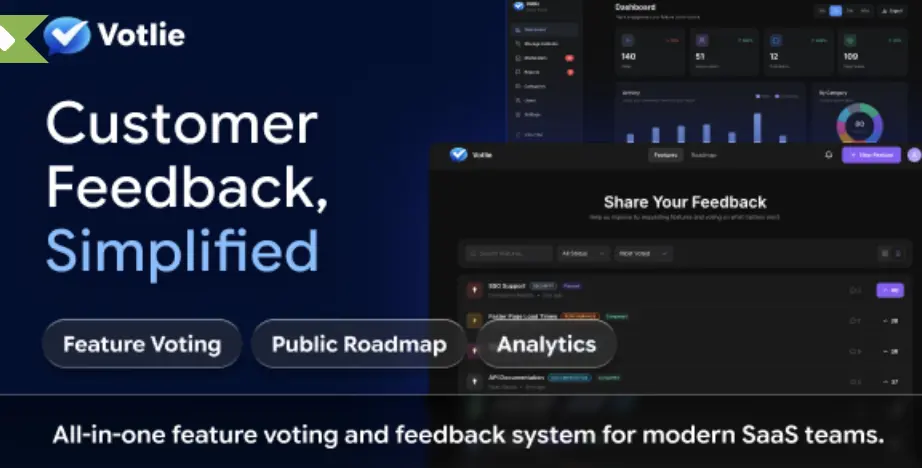
Votlie is a self-hosted Laravel 12 feedback platform, engineered for SaaS founders, product managers, and software teams to collect feature requests, run community voting, and publish public roadmaps. The application consolidates idea submission, threaded discussion, duplicate merging, and status-driven progress tracking into one workspace, removing the fragmentation that occurs when customer input is scattered across email threads, chat channels, and spreadsheets. Built with Laravel 12, Vue 3, and Inertia.js, the package ships with the complete PHP, JavaScript, HTML, and CSS source, giving operators direct control over hosting, the database, and business logic on their own infrastructure.
Technical Specifications & Deployment Matrix
| Engineering Metric | Deployment Specification |
|---|---|
| Base Framework | Laravel 12 monolith with Vue 3 and Inertia.js rendering the front end |
| Runtime Requirements | PHP 8.x with Composer-managed extensions; current demo deployment runs PHP 8.4 |
| Database Persistence | MySQL 8.x or SQLite, according to the downloaded release and deployment configuration |
| Web Server Layer | Apache or Nginx with correctly configured document root and writable application directories |
| Background Processing | Scheduled tasks and background workers for email delivery, trial lifecycles, and domain checks |
| Email Transport | SMTP credentials required; delivery logs are inspectable within the administrator workspace |
| Browser Compatibility | Chrome, Firefox, Safari, Edge, and Opera |
Feedback-to-Roadmap Pipeline & Execution Mechanics
The core mechanism is a moderated submission pipeline: inbound requests are validated, voted on, merged, and republished as roadmap entries. A feature request enters through the public board, where the server validates its title, description, category, and image attachments; when the optional moderation queue is active, the item is held for administrator review before it becomes publicly visible. Approved entries become votable, with per-user vote caps and anonymous voting enforced server-side. Administrators then organize the backlog with tags, pinned items, ETAs, and internal notes, while duplicate ideas are resolved through a merge operation that transfers accumulated votes onto the canonical entry. Status transitions—planned, in progress, completed, or custom statuses—dispatch notification events rendered through merge-field email templates, and per-status visibility flags control which columns appear on the public roadmap. Threaded comments, nested replies, likes, and highlighted official responses keep discussion attached to the originating request, and a follow mechanic pushes updates to interested users. Date-range analytics and activity feeds track voting, user, comment, and feedback events, with CSV export available for supported feature, analytics, and subscriber datasets.
Architectural & Functional Highlights
- Multi-tenant workspace layer (Extended edition): Tenants are provisioned manually or through customer signup, each supporting multiple boards governed by plan limits, with permission-controlled tenant impersonation rendered behind a visible indicator.
- Modular extension system: REST API access with API-key authentication, rate limits, outbound webhooks, and interactive documentation; widget embedding via iframe or a lightweight JavaScript SDK; and coupon management tied to Stripe.
- Update and migration engine: Pre-update checks, automatic backups, migration handling, rollback tools, and post-update health checks execute entirely within the application.
- Theme and branding system: Logos, brand colors, fonts, corner styles, light and dark appearance, theme presets, custom CSS, and installable theme packages operate without touching core templates.
- Moderation and abuse controls: Spam detection scans for blocked words, excessive links, and suspicious text patterns; reported content and users route through a review flow with warnings, bans, and clean unban records.
On the Extended edition, the platform layer adds tenant workspaces, recurring billing through Stripe alongside manual-payment and PayPal workflows, path-based or subdomain tenant routing, optional custom domains with DNS verification, and a separate platform-administration surface with team roles, audit logging, and scheduled announcements. For operators building parallel multi-tenant products on comparable self-hosted PHP runtimes, DirList delivers a standalone directory and listing platform as a separate codebase rather than an extension of this one.
Production Implementation & Operational Resilience
A guided web installer performs requirement checks, database configuration, and administrator account creation before first boot. Deployment targets include compatible cPanel accounts, VPS instances, and dedicated servers, provided the document root and writable directories are configured and scheduled tasks plus background workers are available for mail delivery, trial handling, and domain checks. Security controls span authentication, authorization, request validation, rate limiting, password hashing, and protections on upload and content flows; release 2.3.16 additionally restricted script execution so browsers only run scripts the application itself produced, sanitized every logo and icon upload against hidden payloads, and hardened comment rendering against injected code. Failure recovery is handled in-product: the update manager runs pre-update checks, generates backups, executes database migrations, exposes rollback tools, and reports health checks afterward, so a failed upgrade does not strand the deployment. Because the full source ships with the package, teams can modify interfaces, workflows, business logic, and integrations directly, or hand changes to a developer—the copyright in the codebase remains with its creator, and Envato’s terms continue to govern modifications. Operators should plan for separate hosting, domain, mail-delivery, and payment-processing costs, since this is self-hosted software rather than a hosted service. Where tenant billing on the Extended edition must coexist with dedicated back-office financial work, AccountGo runs as an independent accounting and billing application on its own stack.
Frequently Asked Questions
Can users sign in with Google, GitHub, Discord, or Slack accounts?
Yes, social sign-in is supported for all four providers. An administrator configures each provider in the settings workspace using their own provider credentials, after which the corresponding OAuth flows become available at the application login screens.
Are the REST API and widget embedding active on every installation by default?
No, these capabilities require compatible modules to be installed and enabled. Edition, plan, and service configuration also affect availability, so they should not be assumed active on any given deployment without verifying the module configuration first.
Can the public demo deployments be used to test data-changing operations?
No, most data-changing operations are disabled in the public demos. Both demos contain sample data and reset every 24 hours, and sample users, feedback, and platform metrics shown there are illustrative rather than representative of production behavior.
Must tenant custom domains on the Extended edition route through Cloudflare?
No, Cloudflare for SaaS is only one of the supported options. Manual DNS configuration and cPanel integration are available alternatives depending on the hosting setup, with domain verification, SSL provisioning, and domain health monitored where the chosen integration supports them.
-
1.1.0 LatestOct 22, 2026