Volport – Logistics Transport WordPress Theme
Volport Overview & Logistics Front-End Delivery Architecture
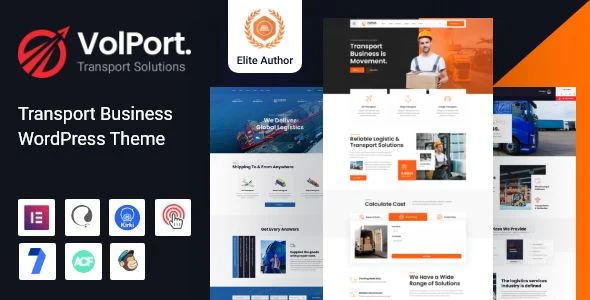
Volport is a WordPress theme engineered for logistics, trucking, shipping, and freight businesses to publish service-focused websites without writing custom PHP. The package addresses a concrete agency bottleneck: transport-sector presentations covering air freight, sea freight, road freight, warehousing, and cargo movement typically demand bespoke layout work, whereas this codebase ships those sector layouts as pre-structured Elementor documents. In production workflows, it functions as a drop-in delivery vehicle—install the theme, run the one-click demo importer, then swap textual and media content while the underlying grid, typography, and animation layers remain intact.
Technical Specifications & Deployment Matrix
| Engineering Metric | Deployment Specification |
|---|---|
| Base Technology / Framework | WordPress theme built on Bootstrap 5.x, HTML5, CSS3, and jQuery |
| Runtime / Language Requirements | WordPress 6.0.x through 7.1.x; PHP 7.4+ hosting meeting WordPress core minimums |
| Page Rendering Engine | Elementor drag-and-drop page builder with live editing; 35+ custom Elementor widgets |
| Front-End Dependencies | OWL Carousel, Slick, Magnific Popup, Google Fonts, Flat Icon set |
| Deliverable Footprint | PHP, HTML, CSS, and JS source files; widget-ready sidebars; RTL stylesheets; .pot translation templates |
| Browser Coverage | IE11, Firefox, Safari, Opera, Chrome, and Edge rendering engines |
Elementor Rendering Pipeline & Sector Layout Composition
Volport routes all page composition through the Elementor document engine, which renders each section as nested widget instances rather than hardcoded template fragments. When a visitor requests a page, WordPress resolves the template hierarchy, hands control to the Elementor document model, and that model serializes stored widget data into a DOM tree styled by the Bootstrap 5 grid framework. The 35+ custom widgets—covering service grids, sliders, icon boxes, post lists, and about blocks—register themselves within Elementor’s widget registry, so each drag-and-drop insertion emits validated, widget-scoped markup rather than unstructured shortcodes. Header and footer regions operate outside the page canvas: four header variations and two footer variations are switched through the WordPress Customizer, and the dynamic color plus typography settings emit CSS variable overrides at render time, eliminating manual stylesheet edits when a client’s brand palette changes.
Demo data replication follows the same pipeline in reverse. The one-click importer parses the bundled demo dataset, registers the three homepage layouts and eleven-plus inner pages, and populates media attachments so a staging site mirrors the reference presentation before any client content exists. Because every layout remains an editable Elementor document, restructuring a freight-service grid or reordering a warehouse feature list is a widget-level operation with no template-file surgery. For studios evaluating parallel theme implementations before committing to a rendering stack, Tranzix occupies a comparable logistics-focused position worth benchmarking against.
Architectural & Functional Highlights
- Widget-Scoped Rendering: 35+ purpose-built Elementor widgets map transport-sector content types—services, cargo categories, team, and post feeds—onto Bootstrap 5 grid columns, keeping DOM output predictable and inspectable.
- Tokenized Styling Layer: Dynamic color and typography settings generate runtime CSS overrides, so brand adjustments propagate across headers, footers, and page bodies without touching source CSS files.
- RTL Stylesheet Pairing: Right-to-left stylesheet support mirrors layout direction for Arabic and Hebrew deployments, with grid and navigation behavior re-oriented automatically.
- One-Click Demo Seeding: The bundled importer reconstructs the three homepages and inner-page set in a single operation, cutting staging setup from hours of manual block assembly to a single execution.
- Contact Form 7 Interoperability: Request-a-quote and freight-inquiry forms bind to the Contact Form 7 plugin architecture, allowing custom field validation and mail-pipeline configuration at the plugin layer.
Production Implementation & Operational Resilience
Deployment targets should run a WordPress version between 6.0.x and 7.1.x on hosting that satisfies core PHP and database minimums, since the Elementor engine and the importer both operate within standard WordPress memory constraints. Cross-browser verification is already factored into the stylesheet layer—the theme has been tested across Firefox, Chrome, Edge, Safari, Opera, and IE11 rendering paths, with responsive breakpoints verified on tablet and mobile viewports at retina pixel densities. Customization boundaries follow the child-theme contract: default template files can be overridden inside a child theme directory, which decouples presentation modifications from the parent package and permits future version updates without losing layered changes.
Internationalization runs through the bundled .pot language templates, so translators can generate .po and .mo files without modifying theme internals, and the RTL layer activates per-locale. Multilingual freight operators comparing layout densities may also benchmark Carryon as a parallel transport-sector theme before finalizing a stack decision. For teams that prefer working purely inside Elementor’s template-kit ecosystem rather than a full theme scaffold, Artic exists as an independent kit-based alternative, though it operates as a separate design system rather than an extension of this codebase.
Frequently Asked Questions
Can the complete demo layout set be replicated with a single import action?
Yes. The theme ships with a one-click demo importer that reconstructs the three homepage designs, eleven-plus inner pages, and associated widget content, producing a staging environment that mirrors the reference presentation before any custom content is added.
Does Volport support Contact Form 7 for custom freight inquiry forms?
Yes. The theme is built to operate alongside Contact Form 7, so agencies can construct custom request, quote, and booking forms with plugin-level field validation and mail routing instead of hardcoding form markup into templates.
Are translation files included for multilingual deployment?
Yes. The package is translation ready and includes .pot language templates within the theme and its bundled plugins, allowing translators to produce localized .po and .mo files without altering core source files.
-
3.0.1 LatestOct 31, 2026
-
1.1.2September 15, 2026