Urna Pro – All-in-one WooCommerce WordPress Theme
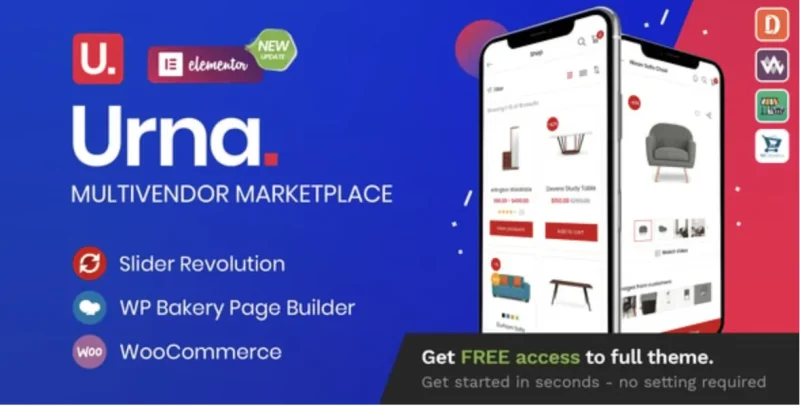
Urna Pro Overview & Multi-Vendor Storefront Architecture
Urna Pro is a multi-vendor WooCommerce WordPress theme engineered for agencies and store builders to launch fashion, electronics, and furniture storefronts on a single WordPress installation. It removes the bottleneck of hand-coding vendor dashboards, product filtering, and mobile navigation by shipping 29+ pre-built demos that deploy through a one-click content importer. In production workflows, it operates as the presentation layer above WooCommerce and four marketplace engines — Dokan, WC Marketplace, WCFM, and WC Vendors — allowing teams to deliver client stores without rebuilding template hierarchies from scratch.
Technical Specifications & Deployment Matrix
The theme targets a WordPress 6.5.x through 7.1.x runtime with WooCommerce 7.x.x through 11.2.x, and its release cadence tracks each WooCommerce minor version to keep overridden template files synchronized with core.
| Engineering Metric | Deployment Specification |
|---|---|
| Base Technology / Framework | WordPress 6.5.x – 7.1.x, WooCommerce 7.x.x – 11.2.x, Bootstrap 4.x, Redux framework |
| Runtime / Language Requirements | PHP 8.3 compatible; PHP template files within the WordPress theme hierarchy |
| Data Exchange / Communication Protocols | AJAX endpoints for product tabs, quick view, live product search, and cart counts; WPML translation registry |
| Front-End / Engine Dependencies | Elementor and Elementor Pro, WPBakery Page Builder 9.0.x, Slider Revolution 6.7.x, HUSKY Products Filter 3.3.x+ |
| Database / Persistence Footprint | Standard WordPress MySQL schema; transient caching for product queries with cache invalidation on product updates |
Template Hierarchy, Marketplace Engine & Execution Pipeline
Urna Pro renders storefront pages through WordPress template hierarchy overrides that sit above native WooCommerce markup. Files such as urna/woocommerce/cart/mini-cart.php, single-product/product-image.php, and loop/add-to-cart.php replace their WooCommerce counterparts, which is why every WooCommerce minor release in the changelog is followed by re-synced override files. Configuration state is persisted through the Redux framework into theme options, exposing over 300 importable pages, three mini-cart positions (left drawer, right drawer, popup), custom CSS/JS injection fields, and mega-menu construction directly from the admin panel. Storefront interactivity — quick view, wishlist, compare, AJAX search, and countdown timers — is dispatched through registered AJAX actions such as urna_get_products_tab_ajax, which fetch and render product tab partials without full page reloads.
Core Technical Capabilities of Urna Pro
- Four-Engine Multi-Vendor Compatibility: Dedicated marketplace demos map vendor storefronts, commission dashboards, and store lists onto Dokan, WC Marketplace, WCFM, and WC Vendors, so the vendor data model is delegated to the plugin rather than duplicated in theme code.
- AJAX Cart & Search Layer: Mini-cart drawers, SKU-aware product search, and live result rendering run through admin-ajax endpoints, reducing full-page reloads during the purchase path.
- One-Click Demo Import & Catalog Mode: Demo content, widgets, and theme option presets install as a single operation; catalog mode strips pricing and cart controls for quote-only or showcase deployments.
- Page Builder Dual-Track: Elementor and WPBakery 9.0.x are both supported, letting teams standardize on either editor while retaining the same WooCommerce override chain underneath.
Because Elementor governs layout composition on most demos, teams extending product-page content with interactive disclosure widgets can add the BWD accordion addon for elementor to render FAQ and specification blocks inside the same Elementor canvas without custom template registration.
Production Implementation & Operational Resilience
For agency staging and high-traffic client deployments, three operational boundaries deserve attention. First, the override-heavy architecture means every WooCommerce upgrade should be verified against the theme changelog; version 2.6.5, for example, re-synced cart.php and mini-cart.php after WooCommerce 11.2.x shipped. Second, the release history documents patched XSS and Local File Inclusion vectors in product tab AJAX actions and the header_mobile parameter, so sites running versions earlier than 2.6.3 should be treated as requiring an immediate upgrade path. Third, performance-sensitive deployments benefit from the version 2.5 query-load reduction and the removal of footer transients in 2.6.1, which cut redundant database reads on cached pages. Customization should flow through the theme settings panel’s custom CSS/JS fields or a child theme rather than editing override files directly, since core sync updates will overwrite modified templates. RTL language support, cross-browser coverage spanning Chrome, Firefox, Safari, Edge, Opera, and IE10/11, and WPML interoperability cover multilingual and regional deployments. For agencies evaluating a parallel WooCommerce storefront stack for a second client vertical, MoonCart | WordPress WooCommerce Theme exists as an independent alternative codebase on the same platform.
Frequently Asked Questions
Does Urna Pro require a marketplace plugin to activate the multi-vendor demos?
Yes. The four marketplace demos depend on Dokan, WC Marketplace, WCFM, or WC Vendors being installed separately, since the theme only supplies the presentation layer while each plugin handles vendor registration, commissions, and payout data.
Is Urna Pro optimized for the Gutenberg block editor?
No. The theme’s documented page composition engines are Elementor, Elementor Pro, and WPBakery Page Builder 9.0.x; Gutenberg is not listed as an optimization target, so layouts should be built through the supported builder track.
Can the mini cart be repositioned without template edits?
Yes. Theme options expose three positions — left drawer, right drawer, and popup — each driven by AJAX, so cart placement is a configuration toggle rather than a PHP override modification.
Does the theme support searching products by SKU?
Yes. SKU-based lookup is built into the AJAX product search implementation, returning matching stock-keeping units in the live results payload before a shopper submits the query form.
Is PHP 8.3 a validated runtime for this theme?
Yes. Version 2.6 explicitly added PHP 8.3 compatibility alongside code optimization passes, and subsequent releases continued testing against WordPress 7.x and WooCommerce 11.x environments.
-
2.6.6 LatestNov 8, 2026
-
2.4.8September 24, 2026