(Unity) Trivia Quiz Realtime Multiplayer + Server Code – Player.IO
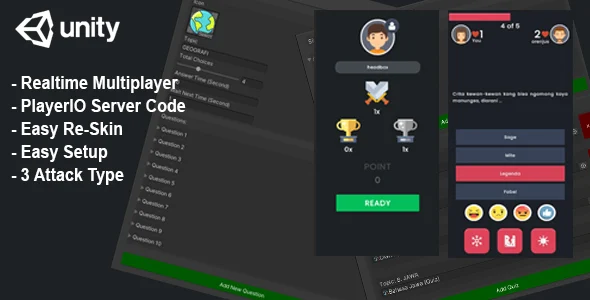
Unity Trivia Quiz Realtime Multiplayer Overview & Realtime Client-Server Match Architecture
Unity Trivia Quiz Realtime Multiplayer is a Unity-based game starter kit, engineered for indie studios and mobile publishers to deploy head-to-head trivia sessions across Android, iOS, and PC from a single codebase. The core engineering bottleneck it resolves is authoritative multiplayer state synchronization: instead of relying on peer-to-peer trust, the package ships with Player.IO server source code so question delivery, scoring, and player-versus-player attack events are adjudicated on a controlled backend. Within agency and production workflows, the kit functions as a deployment-ready foundation that supports rapid visual reskinning and question-bank expansion without rewriting the underlying match logic.
Technical Specifications & Deployment Matrix
| Engineering Metric | Deployment Specification |
|---|---|
| Base Technology / Framework | Unity 3D engine, editor version 2019.3.15f1 or higher |
| Backend / Server Layer | Player.IO multiplayer service with full server source code included |
| Runtime Targets | Android 4.0 through 9.0; iOS 5.0 through 12; desktop PC builds |
| Deliverable File Formats | Layered PSD interface sources, runnable Android .apk, server code, written documentation |
| Gameplay Feature Set | Realtime trivia matches, three attack types (Freeze, Shake, Blink), opponent emoji messaging |
Server-Authoritative Match Pipeline & Realtime Execution Flow
The engine routes every match through a Player.IO server room that acts as the authoritative arbiter for question dispatch, answer validation, and attack event distribution. When a client joins a room, the server-side code manages the question sequence and relays each player’s responses, while offensive actions travel the same realtime channel in the opposite direction. When a player triggers an attack, the backend broadcasts the event to the opponent’s client, where it is applied as a disruptive effect: Freeze halts interaction for a timed window, Shake destabilizes the visual interface, and Blink intermittently obscures on-screen content. This split between authoritative scoring and client-side effect rendering prevents a compromised client from fabricating correct answers, since the validation logic never leaves the server. Emoji messages follow the identical transport path, giving players a low-bandwidth taunting channel that consumes a negligible payload per message.
Core Technical Capabilities of Unity Trivia Quiz Realtime Multiplayer
- Included Player.IO Server Source Code: The backend logic ships as editable source, allowing engineers to inspect, modify, and redeploy room handlers, question flow, and scoring rules on the Player.IO infrastructure rather than accepting an opaque managed service.
- Three-Vector Attack System: Freeze, Shake, and Blink attacks are implemented as discrete event types dispatched through the realtime connection, each degrading the opponent’s input or rendering in a mechanically distinct way to create strategic depth.
- Decoupled Question Management: Quiz content is separated from the match pipeline, so adding or removing questions is a data-level operation that does not require touching the multiplayer transport or scoring code.
- Cross-Platform Build Output: A single Unity project compiles to Android, iOS, and PC targets, letting a studio validate one gameplay implementation across three distribution channels.
- Reskin-Ready Interface Layer: Layered PSD sources are bundled with the project, enabling designers to rework the entire visual identity externally and swap assets without editing scene structure.
For studios evaluating a standalone Unity project outside the trivia genre, Drop Helix (200 Levels Unity Game Template + Admob Ads + GDPR Consent) operates as an independent single-player template with 200 pre-built levels and ad-consent plumbing, offering a separate production path for hyper-casual portfolios.
Production Implementation & Operational Resilience
Deployment begins in Unity 2019.3.15f1 or a later editor release; earlier versions are outside the verified compatibility window and should not be assumed to compile the project. Because the included .apk can be sideloaded onto an Android device before any Unity work begins, teams can validate the attack mechanics, emoji signaling, and match pacing against real hardware first, then import the project into the editor for customization. The operational boundary that architects must plan around is the Player.IO dependency: multiplayer sessions function only when the included server code is deployed to a provisioned Player.IO backend, so the backend step is a prerequisite for any live release, staging environment, or client demonstration. The bundled documentation covers this server provisioning path alongside the client setup procedure.
Reskinning is intentionally constrained to the asset layer. The layered PSD files define the interface artwork, which means a rebrand can be executed by a designer without a developer modifying prefabs or UI hierarchy — an arrangement that reduces regression risk during visual overhauls. Question-bank growth follows the same low-risk pattern: content expansion stays at the data level while the validated match logic remains untouched. Teams that need a monetization-focused Unity deliverable for a different vertical can evaluate New Pinball Unity Game Android and iOS Project With Admob Ad as a self-contained arcade project with advertising already wired into the build configuration.
Frequently Asked Questions
Does the package include a runnable Android .apk for testing gameplay before opening Unity?
Yes. An Android .apk is bundled as a deliverable, allowing teams to sideload a working build onto a device and evaluate the trivia matches, attack mechanics, and emoji messaging prior to importing the project into the Unity editor for customization.
Can the quiz question bank be expanded without modifying the multiplayer logic?
Yes. The kit is documented as supporting easy addition and removal of quiz questions, meaning content updates operate at the data level and do not require engineering changes to the server-authoritative match pipeline or the Player.IO room handlers.
Are layered PSD sources included so interface reskinning can be handled by designers?
Yes. Layered PSD files ship with the project, so a full visual rebrand can be produced in an external image editor and swapped into the Unity build without structural changes to the UI hierarchy or gameplay scripts.
Must the Player.IO backend be deployed before multiplayer sessions will function?
Yes. The realtime multiplayer architecture depends on the included server source code running on the Player.IO service, so provisioning that backend is a required step before live matches, staging tests, or client demonstrations can execute.