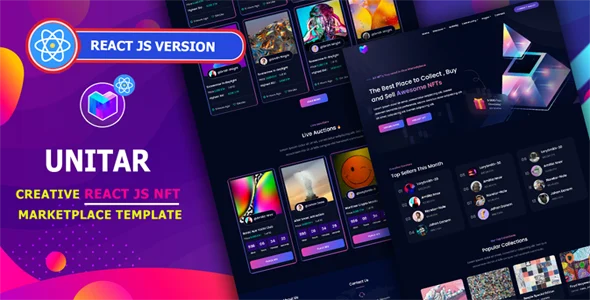
Unitar – React NFT Marketplace Template
Product Overview
Unitar, a specialized React NFT Marketplace Template, provides a robust frontend framework designed for individuals and developers looking to deploy custom digital asset platforms. It serves as a foundational base for creating marketplaces where users can mint, buy, sell, and manage non-fungible tokens, often requiring integration with smart contracts and a backend service. This template is ideal for entrepreneurs, blockchain project teams, or artists aiming to launch a dedicated space for their digital collections.
Interacting with the template reveals a highly modular, component-based structure. For instance, pages like the Explore grid for discovering NFTs or individual Item Detail views for specific assets load their content dynamically, typically fetching data from a connected blockchain network or a dedicated backend API. The layout demonstrates strong responsiveness; on smaller screens, the prominent filter sidebar found on desktop usually collapses into a clean overlay menu, activated by a standard hamburger icon in the header, ensuring full functionality without crowding the display. User profile sections present a clear, navigable dashboard, allowing owners to view their owned NFTs, track active bids, and manage their current listings with distinct tabs for each category.
Highlights & Value
The Unitar – React NFT Marketplace Template offers a pragmatic approach to deploying a functional NFT platform, focusing on development efficiency and user interaction. Key advantages become apparent during the setup and customization phases:
- Component-Based Architecture: Delving into the codebase reveals a well-organized structure of React components. This modularity means specific sections, such as the
Wallet Connectmodal, theNFT Carddisplay, or theBid Historytable, can be independently modified or extended. This approach significantly reduces the risk of unintended side effects across the application when making changes. - Responsive Design: The template handles varying screen sizes with predictable behavior. Observe how the
Discoverpage’s NFT grid intelligently adjusts its column count based on the viewport width; it transitions smoothly from a four-column layout on large monitors to two columns on tablets, and finally to a single, stacked column on mobile phones. This ensures that NFT details, pricing, and action buttons remain legible and easily tappable. - Interactive UI Elements: Features like the
Live Auctioncountdown timers, visible on active listings, or thePlace Bidpop-up windows provide immediate visual feedback to the user, enhancing engagement. The integrated search bar on theExplorepage typically offers real-time filtering as you type, narrowing down the displayed NFT results without requiring a page reload. - Customizable Theming: While the template ships with a default visual style, its aesthetic properties are generally managed through easily accessible CSS or SASS variables. This allows developers to quickly adjust color schemes, typography, and spacing to align with specific branding requirements or project identities, offering a high degree of visual flexibility.
Real-World Use Cases
This React NFT Marketplace Template proves effective for a range of specialized applications, beyond generic marketplaces:
- Niche Art Marketplaces: Develop a dedicated platform exclusively for specific art forms like generative art, photography NFTs, or digital sculpture. You can customize the
Mintingpage workflow to include unique metadata fields, such as "Art Medium" or "Generative Algorithm Seed," directly relevant to your art form, providing a curated experience. - Gaming Item Exchanges: Deploy a bespoke marketplace for in-game assets, enabling players to securely trade unique digital collectibles. The
Item Detailpage can be extended to display specific game statistics, item rarity, or even in-game utility details, enhancing the value proposition for gamers. - Digital Collectible Showcases: Launch a brand-specific portal for official digital merchandise, limited-edition collectibles, or fan tokens. The
Creator Profilepage can be tailored to prominently feature artist portfolios, verifiable achievement badges, and links to external social platforms, building trust and community. - Educational NFT Platforms: Construct a learning environment where verifiable achievements, course completions, or skill certifications are tokenized as NFTs. This provides a secure, immutable record of educational progress, allowing students to showcase their credentials publicly on their profile page.
Technical & Compatibility
Examining the Unitar codebase reveals a well-architected React application, typically leveraging modern JavaScript (ES6+ features) and often integrating state management solutions like Redux Toolkit or the Context API for predictable data flow. For blockchain interaction, it generally employs web3 libraries such as Web3.js or Ethers.js, handling wallet connections (supporting providers like MetaMask, WalletConnect, etc.) and direct smart contract calls from the frontend. The standard setup process involves navigating to the project directory in your terminal, running npm install (or yarn install) to fetch dependencies, and then npm start to launch a development server, usually accessible at localhost:3000. Deployment to production environments like Netlify or Vercel is streamlined after executing the build command for static assets.
This template functions primarily as a standalone frontend interface, meaning it necessitates a separate backend and deployed smart contracts to operate as a fully functional marketplace. It commonly includes placeholder logic or demonstrative integration patterns for connecting to various popular blockchain networks, including Ethereum, Polygon, or Binance Smart Chain. For example, clicking the Connect Wallet button in the header typically triggers a browser extension pop-up requesting wallet approval, after which the connected public address is displayed prominently in the UI. The project’s file structure is organized logically, with distinct directories for components, pages, services, and utilities, facilitating easy location and modification of specific UI elements or underlying blockchain interaction logic.