Travelin – Travel Tour Booking HTML Templates
Travelin Overview & Static Front-End Foundation for Travel Booking Sites
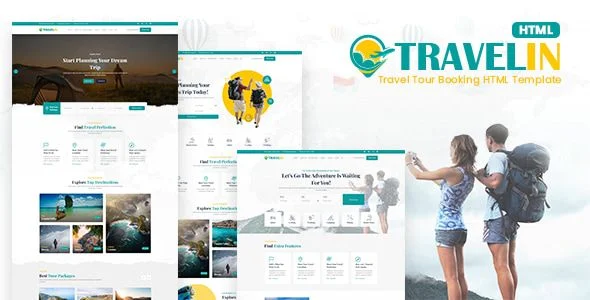
Travelin is a Bootstrap 5 travel tour booking HTML template engineered for travel agencies, tour operators, and destination brands to publish booking-focused marketing sites without any CMS dependency. The package removes the overhead of hand-building repeated tour grids, flight listings, cruise detail layouts, and customer dashboards by shipping 8 homepage variants plus roughly 47 prebuilt inner pages as static HTML5, SCSS, and PHP assets. Within an agency delivery pipeline, it operates as a front-end source bundle that developers drop onto any hosting stack, restyle through Sass variables, and connect to an existing reservation backend.
Technical Specifications & Deployment Matrix
| Engineering Metric | Deployment Specification |
|---|---|
| Base Technology / Framework | HTML5, CSS3, Bootstrap 5.x grid and component system |
| Runtime / Language Requirements | jQuery 3.5.1 for UI behavior; PHP-enabled hosting required for the contact form handler |
| Styling Pipeline | Sass / SCSS source files compiled to production CSS |
| Front-End Dependencies | Swiper slider instances, FontAwesome icon set, Google webfonts (Poppins and Playfair) |
| Browser Compatibility | Firefox, Safari, Opera, Chrome, and Edge |
| Database / Persistence Footprint | None — purely static file delivery; no server-side data store |
Multi-Vertical Page Library & Front-End Execution Pipeline
Travelin renders every route as a static HTML5 document styled by Bootstrap 5 output compiled from SCSS sources. Because no server-side templating engine or database layer participates in the request cycle, page delivery consists of the browser parsing semantic markup, applying the compiled stylesheet, and initializing JavaScript modules after DOM readiness. jQuery 3.5.1 acts as the runtime base; a bundled plugin.js file loads the third-party plugin set, while behavior is split across focused modules — main.js carries custom plugin wiring, custom-nav.js and custom-navscroll.js drive navigation state and scroll-triggered header behavior, per-page custom-swiper1.js and custom-swiper2.js files initialize each slider instance, and custom-accordian.js manages collapsible content groups. This per-feature file separation lets developers remove unused modules page by page rather than shipping one monolithic script.
Architectural & Functional Highlights
- Sass integration layer: Global colors, typography scales, and spacing tokens live in SCSS variables, so a single recompile re-skins the entire 50-page inventory without editing individual stylesheets.
- Multi-vertical page inventory: The bundle covers 8 homepages, 4 flight pages, 4 car pages, 4 cruise pages, 9 tour pages, 2 destination pages, 9 blog pages, full dashboard pages, and 15 additional inner pages — each variant reusable as a starting layout for a distinct client vertical.
- Swiper-driven content modules: Destination showcases, testimonials, and tour carousels run on Swiper instances with isolated custom configuration files, allowing per-section slide parameters to be tuned independently.
- Working PHP contact form: A functional PHP handler processes form submissions out of the box, provided the target server executes PHP — the only dynamic component in an otherwise static architecture.
- Responsive and retina-aware layout: Bootstrap 5 breakpoints govern adaptation across viewports, with imagery and typography prepared for high-density displays.
For studios that prefer a WordPress page-builder path over static markup for the same travel vertical, Travly exists as an independent Elementor template kit covering tour and travel agency layouts.
Production Implementation & Operational Resilience
Deployment requires only a web server capable of serving static assets, plus PHP execution wherever the contact form must transmit mail — Apache and Nginx configurations both satisfy this with no database provisioning, migration scripts, or build-server dependency. The SCSS toolchain is the primary customization surface: agencies override the variable layer, recompile, and produce client-specific palettes while leaving the Bootstrap component logic untouched, which keeps upgrade paths intact when the underlying framework revises its grid or utility classes. Content replacement follows the same boundary — every image in the demo builds originates from Pexels and ships for preview purposes only, so production rollouts must swap the referenced media paths for licensed client photography rather than expecting assets inside the download bundle.
Operational limits are worth stating plainly. The template carries no reservation engine, payment routing, inventory management, or authentication layer — booking flows are presentational and expect a separate backend to receive submitted data. Teams needing native transactional booking inside WordPress can evaluate Bookingo as a standalone plugin-side solution on that platform. Cross-browser behavior is verified against Firefox, Safari, Opera, Chrome, and Edge, and all source files are commented to ease handoff between developers. The changelog also shows active maintenance, including three additional homepages added in April 2025 and contact form submission fixes in December 2023.
Frequently Asked Questions
Are the demo images included in the downloaded package?
No. Every image shown across the preview pages comes from Pexels and is used for demonstration only. The download bundle contains the code files, so production deployments must reference their own licensed photography through the existing image paths.
Does the contact form function without writing a backend?
Yes. PHP files ship with the package and the form is wired to a working handler, so submissions process on any PHP-enabled host. No database or external mail service configuration is documented as required for standard operation.
Can this package be installed directly as a WordPress theme?
No. It is a static HTML template built on Bootstrap 5 and Sass, not a WordPress theme structure. Adapting it requires manual conversion into theme templates or using it as a design reference outside the CMS.