Traveler – Travel Trip Business Elementor Template Kit
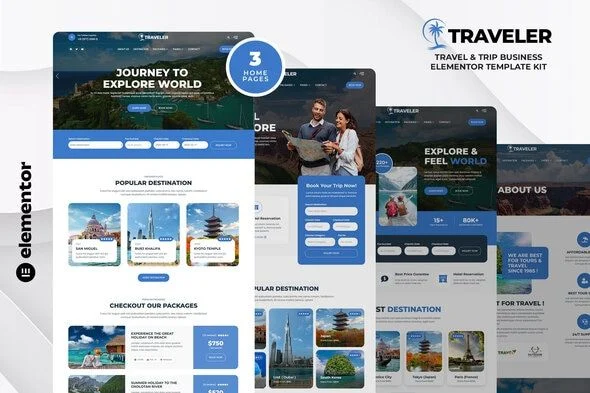
Traveler Template Kit Overview & Travel Agency Layout Architecture
Traveler Template Kit is an Elementor-based design package engineered for travel agencies, tour operators, and destination brands to launch booking-oriented websites without writing code. The package removes the blank-canvas bottleneck that slows agency delivery by shipping 18+ pre-structured page documents, including three homepage variants, destination and tour-package layouts, and six MetForm booking flows. Within a production workflow, it functions as an import-ready layout library: JSON template data is injected through the Envato Elements plugin, stored under Saved Templates, and edited visually inside the Elementor canvas.
Technical Specifications & Deployment Matrix
| Engineering Metric | Deployment Specification |
|---|---|
| Base Framework | Envato Template Kit targeting Elementor 3.8.x and 3.10.x |
| Import Runtime | WordPress with the Envato Elements plugin (Elements > Installed Kits) |
| Required Plugins | Elementor, ElementsKit Lite, MetForm, Jeg Elementor Kit, installed via the Install Requirements prompt |
| Data Exchange | JSON layout payloads imported per template; Global Kit Styles imported first |
| Persistence Footprint | No schema of its own; documents persist as Elementor Saved Templates and standard pages |
Template Import Pipeline & Layout Composition
The entire deliverable consists of JSON layout payloads that Elementor parses into native builder documents rather than executable theme code. Import begins at Elements > Installed Kits, where the orange Install Requirements banner loads the four companion plugins before any layout data is processed. The Global Kit Styles file must be imported first because it registers the shared typography and color tokens every page references; skipping this step leaves downstream documents reading fallback values. After that, each template is imported one at a time and appears under Templates > Saved Templates, from which new pages pull them through the My Templates tab with Elementor Full Width selected and the page title hidden.
Form architecture follows a two-stage pattern. MetForm block templates are imported as standalone documents, then a page template is imported, the Navigator is opened by right-clicking the canvas, the MetForm widget is selected, and the matching block is inserted via the Add Template folder icon before updating. Because everything is widget-based composition, agencies extending contact pages with operating schedules can layer HT Business Hour Widget for Elementor alongside the shipped sections without touching PHP.
Core Technical Capabilities of Traveler Template Kit
- Centralized design tokens: fonts and colors are defined once in Global Kit Styles, so a re-skin of all 18+ documents happens at a single control point instead of through per-widget edits.
- Three homepage architectures: separate Home, Home 2, and Home 3 documents let a client compare layout directions while every variant reads from the same token set.
- Six bound MetForm instances: two booking forms, a packages book form, a contact form, a career form, and a subscribe form cover the conversion surface of a tour operation.
- Theme-agnostic rendering: structural rules live in builder data rather than theme files, so the kit renders on most Elementor-compatible WordPress themes.
- Full editorial coverage: destination, tour packages, package offer and detail, services, career and career detail, tour guide, gallery, testimonial, blog archive and single, FAQ, contact, coming soon, and 404 documents round out the inventory.
Production Implementation & Operational Resilience
For agency staging environments, the primary constraint is PHP memory during JSON ingestion; keeping wp_memory_limit at or above 128 MB prevents partial imports when larger documents such as the homepages are processed. Importing one template at a time, as the documented procedure specifies, keeps each request payload small and makes a failed import recoverable by retrying that single document. The MetForm binding step is the most common failure point: if a form widget renders empty, the block template has not yet been inserted through the Navigator workflow, and re-running the Add Template insertion restores it. On the front end, layering WP Rocket in front of the rendered DOM adds static page caching and deferred JavaScript execution, which offsets the asset weight a widget-dense homepage carries. As a static kit, secondary development is bounded to style token overrides, widget reordering, and asset replacement; preview photography originates from Envato Elements and must be separately cleared for use or swapped for owned images before a client site goes live, and every image slot remains structurally intact during that substitution.
Frequently Asked Questions
Does Traveler Template Kit require Elementor Pro to run?
No. The documented dependency set is the free Elementor builder alongside ElementsKit Lite, MetForm, and Jeg Elementor Kit, all loaded through the Install Requirements prompt, so the free Elementor core is sufficient for the shipped layouts.
Can the demo images shipped in the kit be published directly on a client site?
No. Preview photography is sourced from Envato Elements and must be separately cleared for commercial use or replaced with owned assets before production deployment, while the layout’s image slots stay structurally intact during substitution.
Is the kit locked to one specific WordPress theme?
No. Layout data renders through Elementor on most WordPress themes, since structural rules are stored as builder documents rather than theme template files; an Elementor-compatible theme is the only prerequisite.
-
28 March 2022 LatestOctober 1, 2026