Transfers – Transport and Car Hire WordPress Theme
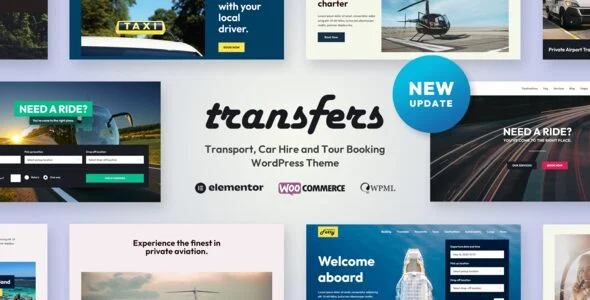
Transfers Transport and Car Hire WordPress Theme Overview & Booking Architecture
Transfers Transport and Car Hire WordPress Theme is a WordPress booking platform engineered for transport operators and agencies that sell airport shuttles, taxis, ferries, helicopters, trains, private jet charters, and guided tours online. The package targets one central engineering bottleneck: modeling point-to-point transfers—vehicle capacity, destination pairs, schedules, fare rules, and surcharges—inside a single administrative layer instead of stitching together disconnected plugins. In agency delivery, it functions as both the presentation layer and the reservation engine, feeding a front-end availability search into a WooCommerce-driven checkout pipeline.
Technical Specifications & Deployment Matrix
The deployment envelope below consolidates the verified v2.12 compatibility data:
| Engineering Metric | Deployment Specification |
|---|---|
| Base Technology / Framework | WordPress theme distributed as PHP, CSS, and JS source files (v2.12) |
| Runtime / Language Requirements | WordPress 4.9.x through 7.0.x |
| Browser Matrix | IE9, IE10, IE11, Edge, Chrome, Firefox, Safari, Opera |
| Commerce Layer | WooCommerce 6.x–10.x; PayPal, Stripe, direct bank transfer, cash on delivery, plus 75+ additional gateways |
| Builder & Plugin Compatibility | Elementor, Elementor Pro, Gutenberg block editor, Contact Form 7, WPML |
| Layout Attributes | Responsive high-resolution design, 4+ column layouts, widget-ready sidebars, built-in RTL stylesheets, translation-ready |
Transfer Modeling & Booking Execution Pipeline
Each bookable product is defined as a transfer between two destinations, constrained by transport-type capacity and schedule frequency. Administrators first register a transport type—car, van, helicopter, ferry, train, or jet—and declare its maximum passenger count and luggage allowance; these caps later gate the booking form and prevent over-subscription. The engine then binds that transport type to any destination pair and attaches a frequency rule: monthly, weekly, daily, or multiple departures per day. When a visitor submits a search, the availability checker validates the requested date and route against these stored settings and returns only bookable slots. Fares resolve through layered rules—per-vehicle or per-person rates for private or shared service, adjusted by seasonal calendars and by optional surcharges such as luggage fees or insurance, each with its own quantity ceiling and private/shared price split. At checkout, the cart either hands off to WooCommerce for gateway processing or falls back to reservation mode, which dispatches the booking record by email. A dedicated tours module extends the same pipeline to time-based tour products.
For decoupled implementations that require only logistics and cargo layouts without a PHP reservation backend, FastGo is available as an independent Elementor template kit outside this theme’s runtime.
Architectural & Functional Highlights
- Destination-pair scheduling engine: Transfers are constructed between sets of two destinations, with frequency rules configured per route. The availability checker reads these stored schedules on every search request and suppresses dates that fall outside configured departure windows.
- Dual rate modes with seasonal calendars: Operators set fares per vehicle or per person across private and shared services, then layer seasonal rate tables that adjust costs by calendar period, keeping quoted amounts current without manual edits per booking.
- Surcharge system with quantity ceilings: Extra items—luggage fees, insurance charges, accommodation costs—carry a maximum allowed quantity and separate private/shared prices, so the checkout total stays transparent and mathematically constrained.
- WooCommerce checkout bridge with email fallback: Confirmed bookings route into the WooCommerce cart, exposing 75+ gateways including PayPal, Stripe, direct bank transfer, and cash on delivery; when online payments are disabled, reservation mode emails the booking record instead.
- Destination content layer: Unlimited destination pages accept rich editorial content, which strengthens topical depth for search indexing while giving prospective passengers verifiable information about each service point.
Production Implementation & Operational Resilience
For staging and client handoff, the codebase remains accessible at the PHP, CSS, and JS level, while day-to-day layout work stays inside Elementor’s drag-and-drop canvas—no template file editing is required to restructure pages. Widget-ready sidebars and interchangeable page templates give maintainers swap-out composition units, and Gutenberg optimization keeps native block editing functional on builds where Elementor is not loaded. Multilingual rollouts are supported through translation-ready strings, built-in RTL stylesheets, and WPML compatibility for publishing the same inventory across locales. One operational boundary deserves emphasis: collecting payments online requires WooCommerce, since the booking engine delegates all gateway processing to that plugin; the email-based reservation mode exists for operators who settle payment offline. Rendering is responsive and high resolution, with the browser matrix reaching back to IE9 for legacy corporate environments, and the speed and SEO focus reduces friction on performance-conscious hosting configurations. Destination pages double as indexable content assets, adding crawlable depth that supports organic visibility beyond the transactional booking flow. Agencies running parallel client builds in adjacent verticals can standardize on Constro, a construction-sector WordPress theme built on a comparable template-and-widget customization model.
Frequently Asked Questions
Does the theme include importable demo websites for specific transport verticals?
Yes. Seven one-click demo imports cover airport shuttle vans and buses, helicopters, taxi and car hire, ferries, trains, private jet charters, and guided tours; imported layouts, styles, and content can be mixed or restyled afterward.
Can guided tours be sold alongside point-to-point transfers?
Yes. A dedicated tours module allows operators to publish and sell tour products on the same installation, adding a second revenue stream without maintaining a separate booking system or duplicating destination and vehicle data.
Does the deliverable include written technical documentation?
Yes. The package is well documented, with setup material covering transport types, destination management, availability rules, and payment configuration—enough for maintenance teams to onboard without reverse-engineering the booking model.
-
v2.12 LatestOct 24, 2026