The News – Blogger News App ( Android & Flutter ) 2.1
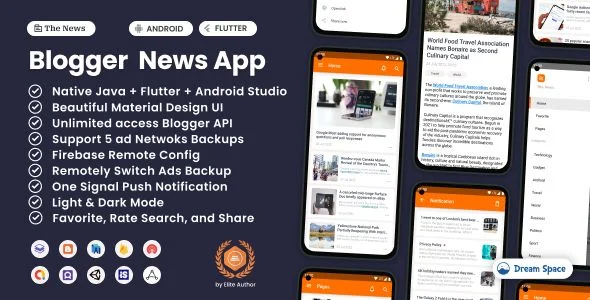
The News Blogger News App Overview & Mobile Content Delivery Architecture
The News Blogger News App is a native Java and Flutter mobile source template, engineered for Android developers and content agencies to publish Blogger-hosted editorial content as a store-ready application. The package eliminates the bottleneck of building a custom CMS backend by consuming the Blogger platform as its administration layer, exposing posts, static pages, and labels directly as in-app article feeds and category taxonomies. Within a production delivery workflow, it functions as a self-contained Android codebase whose editorial pipeline is operated entirely from a standard Blogger dashboard, with Firebase Remote Configuration supplying runtime parameters and OneSignal dispatching audience push campaigns.
Technical Specifications & Deployment Matrix
| Engineering Metric | Deployment Specification |
|---|---|
| Base Technology / Framework | Native Android (Java, Android Studio) plus an additional Flutter project delivered in version 2.0 |
| Runtime / Language Requirements | Java source files (.java, .dex, .xml) compiled against SDK 34; compatible with Android 9.0 through 12.0 and later builds |
| Data Exchange / Communication Protocols | Blogger API with an unlimited access quota, Firebase Remote Configuration, OneSignal push delivery |
| Front-End / Engine Dependencies | Material Design UI system, shimmer loading states, pull-to-refresh gesture handling, drawer and bottom-sheet navigation |
| Monetization / Persistence Footprint | Five ad networks: AdMob, Facebook Audience Network, Unity Ads, Applovin, and IronSource (added in 2.1), plus AdMob open-app ad units |
Blogger-Synchronized Content Pipeline & Execution Flow
The core mechanism is a REST-mediated sync between the Blogger API and the Android presentation layer. When the application launches, it requests the configured blog’s JSON feed, deserializes post and page payloads, and maps Blogger labels into category views rendered through Material Design components. Because the API access quota is unlimited, content retrieval scales with reader volume without per-request throttling concerns that typically constrain third-party feed proxies. State loading is handled through shimmer placeholder frames that occupy layout space while network payloads deserialize, which prevents visual collapse during slower connections. Pull-to-refresh dispatches a fresh API request against the visible feed, replacing the in-memory dataset once the response validates. Firebase Remote Configuration sits above this loop as a control channel, allowing operators to toggle parameters such as ad placement values without issuing a new binary to the store. OneSignal push notifications are wired into the same content identity, so a dispatch can route readers back into specific posts; on devices running Android 13 or above, the app now requests the runtime notification permission introduced by that platform revision.
Architectural & Functional Highlights
- Dual-build delivery: The repository ships a native Java implementation alongside a Flutter project (introduced in version 2.0), letting a team select the toolchain that matches its existing Android expertise while both consume the identical Blogger backend.
- Five-network ad mediation with backup routing: Version 2.1 added IronSource and an ad network backup mechanism, so when a primary network fails to return a fill, the request falls through to a secondary provider rather than rendering an empty slot.
- AdMob open-app format: Open-app ad units for AdMob monetize the app-launch transition point, a placement that captures impression inventory before the first feed renders.
- Theme-state duality: Light and dark mode operate as synchronized visual states across the Material UI surface, including the drawer menu and bottom-sheet containers.
- Taxonomy-native navigation: Blogger labels are surfaced as categories, and static pages are fetched through the same API contract, so the site’s information architecture carries through to the mobile client without a mapping layer.
Production Implementation & Operational Resilience
For an agency deploying this codebase against client properties, the practical staging sequence is: register the blog through the Blogger API, provision Firebase and OneSignal projects, then bind ad network identifiers for each monetization provider before generating a signed release build. The SDK 34 target required by version 2.1 aligns the binary with current Google Play submission expectations, and the notification-permission flow on Android 13+ must be tested explicitly, since deliveries to devices that deny the permission will silently drop at the OS layer rather than inside OneSignal. Error handling centers on graceful degradation: the ad backup chain covers monetization failures, and shimmer placeholders cover feed latency. For developers evaluating standalone native Android templates that consume an external CMS feed as their backend, My Kitchen represents an independent production reference built on a comparable decoupled pattern. Secondary development is straightforward because the codebase is structured as modular Java and XML layers; teams replacing UI resources, ad identifiers, or feed endpoints work against isolated configuration points rather than scattered logic. Flutter adoption can also proceed independently once the Dart project is wired to the same Blogger endpoints, and for monetization comparisons the AdMob-driven pattern in Notify offers a parallel implementation reference for open-app and banner unit sequencing in a separate productivity vertical.
Frequently Asked Questions
Does the package include both a native Java build and a Flutter project?
Yes. Version 2.0 introduced a Flutter project into the repository while retaining the original native Java Android Studio implementation, giving developers two toolchains that read from the same Blogger API backend.
Is the IronSource ad network included in this release?
Yes. The version 2.1 changelog explicitly lists IronSource as a newly added ad network, joining AdMob, Facebook Audience Network, Unity Ads, and Applovin, alongside an ad networks backup mechanism.
Does the app handle the Android 13 notification permission requirement?
Yes. Version 2.1 implemented the notification permission flow for devices running Android 13 or above, allowing OneSignal push deliveries to request runtime consent instead of failing silently.
Are AdMob open-app ads supported?
Yes. The version 2.1 update added open-app ad support for AdMob, enabling monetization at the application launch transition before the Blogger feed finishes loading.