Team11 – Fantasy Cricket App
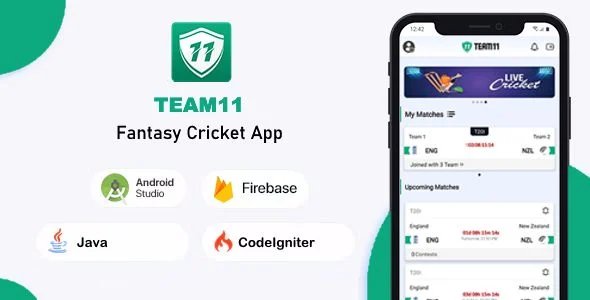
Team11 Fantasy Cricket App Overview & Native Contest Platform Architecture
Team11 Fantasy Cricket App is a native Android application source package paired with a PHP-driven administration layer, engineered for studios and independent developers who need to launch fantasy cricket tournament platforms without assembling the stack from zero. The package resolves the operational bottleneck of orchestrating contests, player rosters, match records, user accounts, and per-tournament earnings arithmetic across a distributed player base. Within an agency delivery pipeline, the codebase functions as the deployable foundation for a commercial fantasy league product: the Android client carries user-facing team assembly, while the server layer centralizes tournament data, administration, and revenue tracking.
Technical Specifications & Deployment Matrix
| Engineering Metric | Deployment Specification |
|---|---|
| Base Technology / Framework | Native Android client (Java + XML); CodeIgniter PHP framework on the server side |
| Runtime / Language Requirements | PHP 7.2.30; Android 9.0, 10.0, 11.0, and 12.0 target runtimes; Nginx or Apache web server |
| Data Exchange / Communication Protocols | HTTP-based request/response flow between the Android client and the PHP backend, with JavaScript, CSS, and HTML powering the admin surface |
| Front-End / Engine Dependencies | Java activity code, XML layout resources, and browser-rendered admin views |
| Database / Persistence Footprint | Relational database with a .db deliverable; shipped files include .apk, .java, .xml, PHP, JavaScript, CSS, and HTML |
Fantasy Tournament Engine & Execution Pipeline
The engine runs on a client-server split in which the native Android client renders contests while the PHP backend owns tournament state, validation, and reporting. When a user opens the app, the client dispatches requests to CodeIgniter-routed endpoints; the server queries the relational store and returns structured data that Java code binds into XML-defined views. Roster construction happens on the device, and each completed team submission travels back through the same HTTP channel, where the backend persists it against the active tournament record. Administrators operate the mirrored surface: the browser-based panel manages matches, leagues, and user accounts, and it derives earnings figures from the volume of tournament players participating in each contest.
Studios that also maintain a WordPress content site for fixture coverage can adopt Cricket Craze as a separate, decoupled plugin path for live scores and predictions; it executes inside the WordPress runtime and shares no code with the Android package. The two serve parallel audiences rather than a merged deployment.
Core Technical Capabilities of Team11
- Native Android client layer: Java classes and XML layout resources target Android 9.0 through 12.0, keeping rendering on the platform’s native view system with no cross-platform bridge in the execution path.
- CodeIgniter administration backbone: The PHP 7.2.30 server layer routes user, match, and league management through MVC-structured controllers served by Nginx or Apache, giving operators a single point of control over platform data.
- Predictable data contract: The client and backend exchange structured payloads over HTTP, so team submissions and tournament updates follow an inspectable request/response pattern that simplifies debugging and logging.
- Participation-based earnings reporting: Revenue calculation keys off tournament player quantity, letting operators audit per-contest income directly from the administrative surface rather than reconstructing it from raw records.
- Shippable evaluation artifacts: The bundle includes an installable .apk alongside raw .java and .xml sources, allowing QA on a physical device before any rebranding or store build work begins.
Production Implementation & Operational Resilience
Deployment begins on the server side: the host must run PHP 7.2.30 under Nginx or Apache, and the included .db file provides the persistence baseline to import before pointing the Android client at the endpoint. Because the admin panel and the app share one backend, configuration drift between the two surfaces is eliminated by design; a change to tournament data propagates to every client on its next request cycle. The codebase arrives documented as detailed in its parts and structured for readability, which defines the practical boundary of secondary development: developers can modify Java screens, XML layouts, and PHP controllers as discrete units, rebrand visuals through asset replacement, and adjust contest logic inside the server layer before rebuilding the APK for store release. Resilience in this architecture comes from its separation of concerns; when a client-side rendering fault appears, the tournament state on the server remains intact and recoverable. Post-release, the changelog discipline (1.0.0 through 1.0.2) demonstrates an iteration pattern driven by user-reported feedback, so operators deploying the current build inherit accumulated defect corrections. For teams still weighing scope in the cricket vertical, Triumph Cricket exists as an independent live cricket and sports app package with its own runtime and no shared dependencies; it functions as a standalone comparison point rather than an extension of this codebase.
Frequently Asked Questions
Is a live demo environment available for evaluating both the admin panel and the Android client before deployment?
Yes, a hosted demo exists for each surface. The admin panel and the Android application both run against a demonstration deployment, so prospective operators can walk through tournament management and roster flows prior to any server provisioning.
Do the demo credentials differ between the admin panel and the Android application?
Yes, the demo uses one shared email address with two distinct passwords: the administrative password opens the panel, while a separate password authenticates the app. Testers should record both values before beginning an evaluation session.
Has the codebase received revision releases since its initial launch?
Yes, the changelog documents version 1.0.1, which corrected typing mistakes, and version 1.0.2, which resolved bugs. Both revisions followed the initial 1.0.0 release and were shaped by feedback submitted by existing users of the app.