Taskora – Project Management Tailwind CSS Next JS Admin Dashboard Template
Taskora Overview & Front-End Project Management Dashboard Architecture
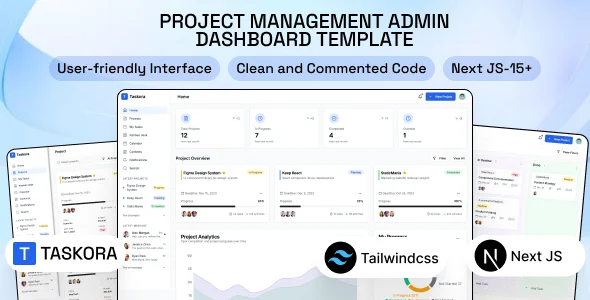
Taskora is a Next.js 15.3.2 and Tailwind CSS admin dashboard template, engineered for development teams and agencies that must ship project, task, and team management interfaces without rebuilding foundational UI. The package addresses the recurring bottleneck of assembling kanban boards, calendars, analytics panels, and form-driven workflows from scratch by supplying pre-built React 19 components wired into a modular, utility-styled architecture. Within agency delivery pipelines, it operates as the presentation layer that developers extend with their own API endpoints and business logic, compressing front-end build time for SaaS panels, sprint planners, and OKR trackers.
Technical Specifications & Deployment Matrix
| Engineering Metric | Deployment Specification |
|---|---|
| Base Framework | Next.js 15.3.2 running the React 19 component runtime |
| Styling Engine | Tailwind CSS augmented by tailwind-merge and tailwindcss-animate utilities |
| Form & Validation Layer | react-hook-form state capture with Zod schema enforcement |
| Visualization & Interaction | Recharts for chart rendering; react-dnd for drag-and-drop task handling |
| Browser Compatibility | IE10, IE11, Firefox, Safari, Opera, Chrome, and Edge |
| Persistence Footprint | Client-rendered UI layer; no bundled database, API server, or CMS backend |
Component Composition & Task Orchestration Pipeline
The execution pipeline routes every screen through a component tree in which Next.js compiles page routes, mounts React 19 components, and hydrates interactive modules on the client. Task board interactions begin when react-dnd registers draggable sources and drop targets; pointer events dispatch drag lifecycle callbacks that mutate component state, and the reordered collection re-renders through Tailwind-styled list nodes without a page reload. Data entry follows a parallel path: react-hook-form binds inputs to a controlled form store, Zod schemas parse each payload field before submission state commits, and Sonner dispatches toast notifications in response to completed actions. Date-driven views rely on react-day-picker and date-fns to parse, format, and localize calendar ranges, while Recharts transforms numeric props into SVG chart geometry for dashboard analytics. Command palettes built on CMDK intercept keyboard input to surface navigation targets, and Vaul-powered drawers plus react-resizable-panels handle overlay and layout state transitions. For delivery teams comparing standalone Next.js dashboard foundations before committing to a codebase, Fuse React exists as an independent Vite-based alternative occupying a similar architectural slot.
Architectural & Functional Highlights
- Theming via Next Themes: A class-based dark/light toggle swaps CSS custom property scopes at the document root, persisting user preference across sessions without layout shifts.
- Drag-and-Drop Task Handling: react-dnd registers typed drag sources and drop targets, enabling board column reassignment through pointer events that update component state synchronously.
- Schema-Validated Forms: react-hook-form coupled with Zod enforces payload constraints at the client boundary, blocking malformed input before it reaches downstream handlers.
- Keyboard-First Navigation: CMDK command menus expose route targets through keyboard interception, reducing pointer dependency for power users inside dense dashboard views.
- Modular Component Reuse: Each UI element ships as an isolated module with Tailwind-merged class composition, allowing prop-level overrides without forking base styles.
Production Implementation & Operational Resilience
Deployment requires a Node.js build environment capable of compiling the Next.js pipeline, after which the output deploys to any static or server-rendered hosting target; the included source covers CSS, SCSS, and JS deliverables alongside the full application tree. Resilience characteristics stem from the dependency strategy rather than runtime hardening: the library set remains minimal, so bundle weight and upgrade surface stay contained, and tailwind-merge resolves conflicting utility classes deterministically during composition. Theme state synchronization runs through Next Themes, which applies the persisted mode class before paint to prevent the flash-of-wrong-theme artifact common in client-only theming approaches. Error and validation boundaries are handled at the form layer through Zod parse results, which gate state transitions and drive Sonner feedback channels. Customization boundaries are explicit: styling changes route through Tailwind configuration and component-level class overrides, structural changes through the modular component tree, and data binding through prop injection into the pre-built pages. Because the package contains no server-side persistence, teams connecting real workloads must implement their own API layer. Demo imagery ships as placeholders rather than licensed assets, so production builds require asset replacement before client handoff. For agencies whose project scope expands into reservation flows outside dashboard administration, Chisfis stands as a separate Next.js React template addressing that booking vertical.
Frequently Asked Questions
Can this template be installed as a WordPress or Shopify theme?
No, the package is built exclusively with Next.js and Tailwind CSS as a standalone front-end codebase. It contains no PHP templates, Liquid files, or CMS plugin structure, so it cannot be activated inside WordPress or Shopify installations.
Are the images and videos shown in the live preview included in the download?
No, preview media serves demonstration purposes only. The download package ships with placeholder images instead, meaning teams must supply their own licensed visual assets before deploying the interface to a client production environment.
Does the package include a working backend with database persistence?
No, the deliverable is the front-end source code, reusable components, layouts, and pre-built pages. No API server, database layer, or authentication backend is bundled, so data persistence must be implemented by the integrating development team.
Does the interface support switching between dark and light modes?
Yes, theme toggling is implemented through Next Themes with class-based switching. The selected mode persists across sessions, and both appearances are covered across the dashboard, calendar, and task board views.