Tanago – Green Renewable Energy Elementor Pro Template Kit
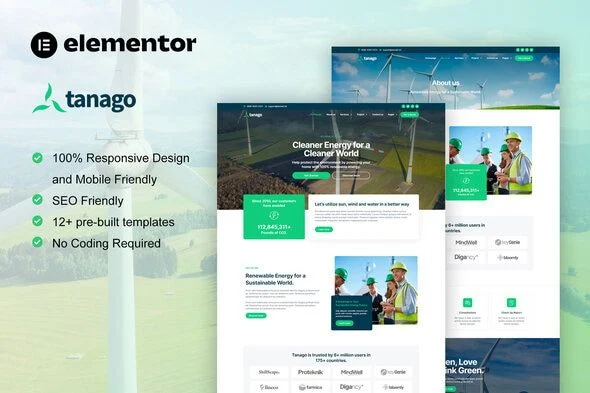
Tanago Green Renewable Energy Template Kit Overview & Layout Delivery Architecture
Tanago Green Renewable Energy Template Kit is an Elementor Pro layout package engineered for renewable energy companies, solar panel providers, and eco technology businesses to publish a complete website without designing each page from a blank canvas. Its twelve pre-built templates arrive as importable Elementor layout data rather than theme files, covering Homepage, About Us, Contact, FAQ, Our Team, Projects, Services, single and archive views for projects and services, Single Post, and an Error 404 page. Within agency delivery workflows, the package functions as a drop-in content layer that compresses build timelines for green energy client projects while keeping every layout editable through the standard Elementor canvas.
Technical Specifications & Deployment Matrix
| Engineering Metric | Deployment Specification |
|---|---|
| Base Layout Engine | Elementor Pro Flexbox Container builder |
| Host Theme Environment | Optimized for Hello Elementor; portable to most themes supporting Elementor |
| Premium Dependency | Elementor Pro, required for some templates and features, not bundled |
| Bundled Plugin | ElementsKit Lite |
| Import Transport | Template Kit Import plugin processing the kit zip via Tools > Template Kit |
| Persistence Footprint | No custom database tables; layouts stored as Elementor Saved Templates |
| Responsive Behavior | 100% responsive and mobile-friendly container layouts |
Flexbox Container Pipeline & Template Import Execution
The import pipeline transports the kit’s layout data through the Template Kit Import plugin into the Elementor template library. Installation begins at Plugins > Add New, where the importer is activated before the unzipped kit archive is uploaded via Tools > Template Kit. An orange banner flags missing dependencies, and clicking Install Requirements loads ElementsKit Lite automatically. The Global Kit Styles file must be imported first, because it registers the typography and color variables every subsequent template references. Individual templates are then imported one at a time and stored under Templates > Saved Templates, keeping the library deterministic and auditable.
Page assembly follows a standardized sequence: a new page is created and opened in Edit with Elementor mode, the gear icon at the lower-left opens page settings where Elementor Full Width is selected and the page title hidden, and the gray folder icon opens the My Templates tab for inserting an imported layout. The homepage is assigned through Settings > Reading by selecting a static front page. Headers and footers are managed under Templates > Theme Builder, where Elementor Pro overrides the host theme’s native chrome. Skyboot settings must have all icon libraries toggled on to guarantee icon rendering across imported layouts. Agencies running parallel client verticals apply the same sequence to kits such as Botch – Business Coaching Elementor Template Kit, since the import workflow stays standardized across Elementor kit deliverables.
Core Technical Capabilities of Tanago
- Flexbox Container Architecture: Layouts are constructed with Elementor Pro Flexbox Containers rather than legacy section and column widgets, which reduces wrapper nesting and keeps responsive behavior consistent across breakpoints without per-device overrides.
- Global Design Token System: The imported Global Kit Styles centralize typography and color definitions, so adjusting a single token propagates the change across all twelve templates instead of requiring per-page edits.
- Theme Builder Header and Footer Control: With Elementor Pro active, global headers and footers are edited through the Theme Builder, replacing the host theme’s default output across every URL.
- Full View Coverage: The set spans single and archive views for projects and services, an Error 404 page, and a single post template, eliminating blank default screens on deep-linked content.
Production Implementation & Operational Resilience
Before uploading the kit archive, the WordPress environment should carry adequate PHP memory headroom (wp_memory_limit), because the importer parses the full zip payload in a single request and can exhaust the allocated memory on constrained shared hosting. Running the import on a staging instance first lets the team verify plugin activation, template counts, and icon rendering before the production cutover.
Customization boundaries matter here: the deliverable is a pure layout package, so extension happens through style overriding and asset replacement rather than code. Global tokens recolor and retype the site, widgets are edited visually in the canvas, and demo imagery sourced from Envato Elements must be separately acquired or swapped for the client’s own photography before launch.
Once pages render, layering WP Rocket – Speed Plugin at the WordPress runtime adds static page caching, deferred JavaScript execution, and automated CSS optimization, which directly benefits the image-heavy project galleries typical of solar portfolio sites.
The bundled Error 404 template provides a designed fallback for broken deep links, and the responsive container structure holds layout integrity on mobile viewports without building separate mobile variants.
For teams weighing a theme-based foundation instead of a kit-based content layer, Soltech – Solar Renewable Energy WordPress Theme stands as a decoupled implementation path outside the Elementor template-kit workflow, serving the same green energy vertical.
Frequently Asked Questions
Is the Elementor Pro upgrade mandatory for using this kit?
Yes — the layouts are built with Elementor Pro Flexbox Containers, and the Pro plugin is required for some templates and features; it is not included in the package and must be obtained and activated separately.
Can the demo images be used on a live production site without further steps?
No — the preview imagery is sourced from Envato Elements, so each asset must be acquired from that platform under its own terms before deployment, or replaced with the company’s own photography to remain compliant.
Does installing the kit replace or modify the active WordPress theme’s files?
No — this is not a WordPress theme; the deliverable contains Elementor page content stored as Saved Templates, while the host theme, optimized for Hello Elementor, continues to govern the site’s underlying structure.