Takeout – Fast Food Delivery Cafe WordPress Theme
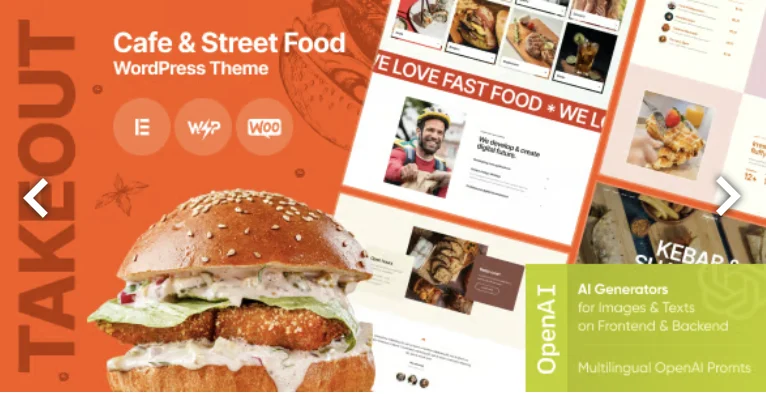
Takeout Fast Food Delivery WordPress Theme Overview & Architectural Role
Takeout Fast Food Delivery WordPress Theme is an Elementor-driven WordPress theme engineered for restaurant groups, delivery startups, and digital agencies that need to deploy food-ordering sites without rebuilding menu, shop, and reservation templates from scratch. The package addresses a recurring bottleneck in food-sector web delivery: wiring a WooCommerce product catalog, an Ajax-driven menu presentation, and seven switchable skin layouts into one installable codebase. Within production workflows it operates as the drop-in presentation and commerce layer, ready after one-click demo import and editable through Elementor page, header, and footer builders.
Technical Specifications & Deployment Matrix
| Engineering Metric | Deployment Specification |
|---|---|
| Base Technology / Framework | WordPress 4.9.x – 7.0.x; HTML5 and CSS3 source; delivered as PHP, CSS, and JS files |
| Page Builder Engine | Elementor and Elementor Pro, with ThemeREX Addons widget layer |
| Commerce Runtime | WooCommerce 5.x – 8.x, plus WPC Smart Quick View and TI WooCommerce Wishlist |
| Localization Protocol | WPML compatibility for multilingual menu and product content |
| Front-End Delivery | Responsive 4+ column layouts, retina image support, Slider Revolution and Swiper, Firefox / Safari / Opera / Chrome / Edge rendering |
| Persistence Footprint | Standard WordPress database schema extended via custom post types, custom widget sets, and the ThemeREX options panel |
Menu Rendering, Skin System & Elementor Execution Pipeline
The engine routes every inbound request through the standard WordPress template hierarchy, then applies skin-level overrides before HTML serialization. A default skin (currently at version 1.5) defines base layouts, while the setting inheritance and override system lets any page, category, or custom post type inherit global options from the 750+ option Customizer pool and then locally override only the parameters that differ, keeping the options database footprint small and predictable.
One-click demo installation pulls the seven premade layouts, restaurant menu structures, about, team, products, and shortcode pages into the database, and the import routine clears the Elementor file cache afterward so regenerated assets never serve stale CSS. Headers and footers are ordinary Elementor layout documents, which means navigation, cart widgets with hideable zero-counters, and login modules are edited visually rather than through PHP template files. For agencies comparing parallel dining-sector implementations before committing to a stack, Drew – Restaurant WordPress Theme represents an independent alternative built for classic restaurant branding rather than delivery-first ordering flows.
Core Technical Capabilities of Takeout
- Skin Inheritance Architecture: A layered override system propagates global settings downward through the template hierarchy, allowing per-page exceptions without duplicating configuration across hundreds of Customizer entries.
- Elementor Layout Documents: Header, footer, and popup containers are rendered as editable Elementor documents, with responsive panel sizing, overlay styling, and close-button controls exposed through the Layouts widget.
- Interactive Ajax Search: Front-end queries execute over asynchronous endpoints, returning menu and product matches without full page reloads, which protects Largest Contentful Paint during browsing sessions.
- WooCommerce Widget Layer: Product filters gain searchable fields for attribute lists exceeding fifteen items, scrollable sidebar attribute lists, and faster attribute auto-detection for large catalogs.
- AI Content Pipeline: An integrated AI Helper exposes ChatGPT-based content generation, text-to-speech prompt dictation, and image model support directly inside shortcode generators in the WordPress admin.
Blog infrastructure follows the same inheritance model: multiple blog styles, twenty-plus post entry animations, customizable feeds filtered by post type or category, view counters, likes, sharing buttons, and a related-posts section. Culinary publishers running editorial arms alongside their storefront can study Recipes – WordPress Theme as a standalone path specialized for recipe-sharing communities.
Production Implementation & Operational Resilience
Recent releases hardened the runtime considerably. Security fixes closed a potential SSRF vector in SVG images loaded by URL and in the AI Helper upload path, stored XSS in Elementor Background text, presets, and the Instagram widget, object injection inside settings decoding, and a local file inclusion risk during pagination. AJAX handlers received additional validation checks, and PHP 8 through 8.5 compatibility work removed string/integer operation warnings that surface on modern hosting stacks.
Asset handling is engineered for constrained hosts: CSS and JS minification was rewritten to survive edge cases such as comments inside regular expressions, merged JS files are separated safely, and a grab_output_allowed option disables output buffering on managed platforms like WordPress.com. Administrators can also choose whether editor styles load into Gutenberg via add_editor_style or enqueue_style, and hyphenation is forced off on mobile viewports to prevent layout shifts in CLS measurements. For delivery operations that settle orders in cash or bank transfer rather than card processing, activating Offline Payment Gateway Plugin at the WooCommerce checkout layer extends settlement options without custom PHP. Secondary development stays inside supported boundaries: Elementor templates, child themes, the ThemeREX Addons API filters (including hooks that disable selected WooCommerce components so third-party plugins register conflict-free), and custom presets stored as JSON all provide sanctioned extension points, so core files never need direct modification.
Frequently Asked Questions
Are the images shown in the live preview included in the download package?
No. All preview imagery is copyrighted to its respective owners across stock and icon providers, and the images serve demonstration purposes only. The package ships with PHP, CSS, and JS theme files plus documentation, not the preview photographs.
Does the theme function with the free version of Elementor, or is Elementor Pro mandatory?
No, Elementor Pro is not mandatory. The theme declares compatibility with both the free Elementor builder and Elementor Pro; the Pro version simply unlocks additional widgets such as custom-cart selectors and advanced product tabs where those are used.
Can content still be edited in the Gutenberg block editor alongside Elementor?
Yes. The theme is explicitly Gutenberg-optimized, and recent updates rewrote the editor styles context, fixed font and icon loading inside the block editor, and added a selectable style-loading method for full WordPress 7.0 compatibility.
-
v1.3 LatestOct 22, 2026