Sunic – Street Style Fashion WooCommerce Theme
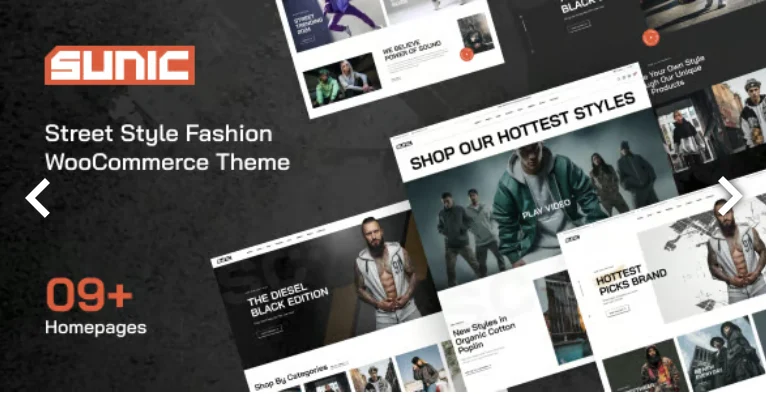
Sunic Street Style Fashion WooCommerce Theme Overview & Storefront Rendering Architecture
Sunic Street Style Fashion WooCommerce Theme is a PHP, CSS, and JS WordPress theme package engineered for streetwear retailers and agencies launching apparel, clothing, and jewelry storefronts on WooCommerce. The package eliminates the template authoring workload normally attached to high-SKU fashion catalogs by shipping 9+ prebuilt homepage designs, multiple shop page layouts, and configurable product thumbnail presentations that render through the standard WordPress template hierarchy. Within production delivery workflows, it operates as a deployment-ready foundation: a one-click demo importer provisions content and layouts, while the Elementor page builder governs downstream page composition without direct template file edits.
Technical Specifications & Deployment Matrix
| Engineering Metric | Deployment Specification |
|---|---|
| Base Technology / Framework | WordPress theme built on HTML5 and CSS3, packaged as PHP, CSS, and JS files |
| Runtime / CMS Requirements | WordPress 6.0.x through 7.0.x (tested and approved) |
| Commerce Layer Compatibility | WooCommerce 5.x.x through 10.x.x |
| Page Builder Engine | Elementor drag-and-drop editor (Gutenberg optimization not included) |
| Plugin Interoperability | Contact Form 7 plus additional popular WordPress plugin support |
| Browser & Display Matrix | IE11, Chrome, Firefox, Safari, Opera; responsive, high-resolution layout |
| Persistence Footprint | Standard WordPress database schema; widget-ready sidebar regions |
Template Hierarchy, Elementor Pipeline & Commerce Execution Flow
The theme operates by overriding native WordPress and WooCommerce template files within the template hierarchy, intercepting storefront rendering before default markup is emitted. Each inbound request resolves through the standard hierarchy, and Sunic’s override layer supplies its own versions of commerce-critical templates — the change log documents maintained overrides for mini-cart.php, form-checkout.php, content-product.php, quantity-input.php, pagination.php, form-login.php, cross-sells.php, related.php, up-sells.php, tabs.php, and single-product-reviews.php. Because WooCommerce continuously revises these templates between major versions, the developer has issued successive parity updates (v1.0.11 and v1.0.13 refreshed outdated WooCommerce 10.x and 10.3.x files), which is the mechanism that keeps the storefront aligned with current WooCommerce releases.
On the presentation side, layout composition is delegated to the Elementor engine rather than block editor primitives. When Elementor 3.26.0 and 3.26.3 shipped breaking changes, versions 1.0.5 and 1.0.6 of the package patched Swiper stylesheet loading and editor behavior accordingly, demonstrating that widget carousels and slider modules depend on the Elementor asset pipeline. Demo provisioning runs through a one-click import tool that copies homepage structures, shop layouts, and inner pages — About Us, Contact, and FAQ templates — directly into the database as editable content. For agencies running parallel non-commerce engagements on the same WordPress runtime, Prisma covers the startup and app-landing segment as a separate theme deployment, keeping each client property on a purpose-built layout system.
Architectural & Functional Highlights
- WooCommerce template override layer: Native commerce templates for cart, checkout, product loops, and reviews are replaced with theme-specific versions, giving full DOM control over product grids, thumbnails, and mini-cart markup while remaining updateable as WooCommerce evolves.
- One-click demo provisioning engine: All 9+ homepage variants, 3+ blog layouts, and inner pages import in a single operation, collapsing initial staging time from manual block assembly to an automated content seed that remains editable in Elementor.
- Elementor-driven composition pipeline: Every page region is assembled through drag-and-drop containers, removing PHP template surgery from routine layout changes and allowing non-developer staff to modify structure safely.
- Cross-browser and responsive rendering: The CSS3 codebase is validated against IE11, Chrome, Firefox, Safari, and Opera, with viewport-adaptive grids that reflow product columns and sidebar variants across device widths.
- Contact Form 7 form handling: Inquiry and contact workflows bind to the Contact Form 7 plugin API rather than custom form processors, standardizing validation and mail dispatch.
Production Implementation & Operational Resilience
Deploying the package in a staging or client environment follows conventional theme installation: upload the PHP/CSS/JS bundle, activate it, then run the demo importer before swapping licensed imagery. Two operational boundaries deserve attention before launch. First, the sample photography shipped in the live preview serves demonstration purposes only and must be replaced with properly licensed assets — a compliance step that protects the end product. Second, certain demos rely on Adobe Fonts (formerly Typekit); when those typefaces are unavailable on the target environment, the codebase substitutes default fonts or Google Fonts, so typographic QA should verify fallback rendering rather than assuming pixel parity with the preview.
Performance behavior is environment-dependent. The published page speed figures are reference values shaped by the selected demo, theme configuration, server tuning, and content weight; feature-heavy homepage variants can pull measured scores downward, so agencies should profile LCP and CLS after real catalog data is loaded rather than trusting preview metrics. Resilience also depends on keeping the theme current: because the override layer sits inside WooCommerce’s template version matrix, deferring updates risks deprecated template warnings after WooCommerce major releases. Elementor version pinning matters equally, as the 3.26.x patch history shows. Teams that also maintain general-purpose corporate or portfolio properties on the same WordPress infrastructure often deploy Hook for those engagements, isolating each client site on a theme matched to its content model. Secondary development is open-ended by design — Elementor templates, sidebar variations, and widget regions are all editable surfaces, and the structured codebase supports child-theme overrides for persistent customizations that survive parent updates.
Frequently Asked Questions
Is Sunic compatible with WooCommerce 10.x releases?
Yes. The compatibility matrix spans WooCommerce 5.x through 10.x, and change log entries for versions 1.0.11 and 1.0.13 specifically refreshed outdated WooCommerce 10.x and 10.3.x template files to maintain storefront parity.
Can the theme be edited with the Gutenberg block editor instead of Elementor?
No. The package is explicitly listed as not Gutenberg optimized; all page composition runs through the Elementor drag-and-drop builder, and layout customization workflows assume that engine rather than core block editor primitives.
Are the demo images shown in the preview included in the delivered files?
No. Preview imagery is for demonstration only and must be replaced with the customer’s own licensed images in the end product, while Adobe Fonts dependencies fall back to default or Google Fonts when unavailable.
-
1.0.2 LatestSeptember 19, 2026