Sugar Rush 100 – Sweet Arcade Game Built with HTML5, CSS3, JavaScript in Android Studio
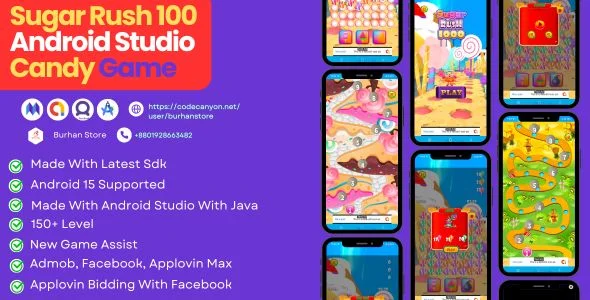
Sugar Rush 100 Overview & Mobile Arcade Monetization Template
Sugar Rush 100 is an HTML5, CSS3, and JavaScript match-3 arcade codebase, engineered for indie developers and mobile publishers to ship a fully monetized puzzle title on Android without a heavyweight game engine. The package removes the engine dependency entirely: Canvas-driven match logic runs inside a Java WebView wrapper built in Android Studio, so the installed footprint stays small while native Java retains ownership of the advertising layer. Within a production workflow it operates as a reskin-ready template — layered PSD and PNG artwork, editable Stylus-compiled styles, and documented ad-unit configuration move a small team from project import to Play Store submission in a single cycle.
Technical Specifications & Deployment Matrix
| Engineering Metric | Deployment Specification |
|---|---|
| Base Technology / Framework | HTML5 Canvas game core with CSS3 (authored in Stylus) and JavaScript, wrapped natively in Android Studio using Java |
| Runtime / Language Requirements | Android Studio (Java); platform compatibility listed up to Android 15.0 |
| Data Exchange / Communication Protocols | AdMob plus AppLovin MAX mediation, with adapters for Facebook Audience Network, Unity Ads, and AdColony |
| Front-End / Engine Dependencies | None — no Unity or Cocos2d runtime is required; rendering is direct Canvas and DOM work |
| Database / Persistence Footprint | Client-side casual game state; no server-side database component ships with the project |
Match-3 Execution Pipeline & Mediation Architecture
The gameplay core executes a swap-validate-clear-refill loop inside the HTML5 Canvas render cycle. When a player taps two adjacent candies, the WebView dispatches the touch event to the JavaScript input handler, which verifies adjacency and swaps the sprite coordinates. The matching algorithm then scans rows and columns for color sequences of three or more, clears validated clusters, and applies a gravity-based refill so cascading combinations resolve within the animation frame budget. CSS3 — compiled from Stylus sources — governs interface styling and transitions, keeping presentation rules separate from game logic so rebrands do not risk the core loop.
Monetization is handled at the native layer rather than in JavaScript. The Java wrapper instantiates AdMob banner, interstitial, and rewarded ad objects and routes fill requests through AppLovin MAX mediation, which arbitrates demand across Facebook Audience Network, Unity Ads, and AdColony adapters. This split keeps ad lifecycle callbacks — including rewarded completion credits — inside the native bridge, where WebView reloads cannot orphan them. For teams that also deploy browser-based arcade titles outside this Android wrapper, Pac-Rat exists as a separate standalone HTML5 arcade codebase intended for direct website embedding.
Architectural & Functional Highlights
- Engine-free Canvas rendering: Match detection, sprite drawing, and animation run through direct HTML5 Canvas and JavaScript calls, eliminating Unity or Cocos2d runtime overhead and keeping the compiled APK lightweight.
- Native mediation bridge: Java-side AdMob integration exposes banner, interstitial, and rewarded formats through AppLovin MAX, with multiple network adapters competing for each impression to improve fill rates.
- Reskin-ready asset chain: Layered PSD and PNG sources plus Stylus-compiled stylesheets allow complete visual rebranding — palettes, characters, and candy sprites — without rewriting gameplay logic.
- Responsive input handling: Touch listeners normalize tap coordinates against viewport dimensions, so boards scale across the range of Android device sizes targeted by the wrapper.
Production Implementation & Operational Resilience
Deployment begins by importing the Android Studio project, which compiles the Java wrapper against platform versions up to Android 15.0. Before a store submission, developers must configure their own AdMob and AppLovin identifiers — the included documentation walks through this step — because shipping with placeholder ad unit IDs produces unfilled requests and zero revenue. The package also ships a prebuilt APK, letting a team verify gameplay on physical hardware before undertaking the first custom build, which shortens the verification loop considerably.
Resilience in the advertising layer comes from mediation itself: when a banner or interstitial request fails to fill on one network, AppLovin MAX forwards the request down the waterfall to the remaining adapters, reducing blank impressions during traffic spikes. On the presentation side, customization boundaries are clearly drawn — asset replacement and Stylus variable adjustments cover visual rebrands, while changes to board size or match rules require editing the JavaScript core directly. For studios weighing parallel native alternatives rather than WebView-based delivery, Puzzle Block Jewel V3 represents an independent Android Studio path with its own AdMob and GDPR wiring.
Frequently Asked Questions
Does the project require a game engine such as Unity or Cocos2d to compile?
No — the codebase runs on plain HTML5, CSS3, and JavaScript inside a Java WebView wrapper, so no engine installation is involved; the documentation cites this lightweight logic as a reason builds remain fast and small.
Can the candy theme be reskinned without editing the JavaScript gameplay logic?
Yes — layered PSD and layered PNG source files ship in the package, and styling is managed through CSS authored in Stylus, so sprites and color palettes can be replaced without touching the match-3 logic.
Is an installable APK included alongside the source files?
Yes — deliverables include a ready .apk for direct device testing together with .java and .xml wrapper sources, JavaScript, CSS, Stylus, and HTML files, plus the layered artwork needed for full rebranding.
Do I need active AdMob and AppLovin accounts before monetization works?
Yes — the requirements list both an AdMob account and an AppLovin account as prerequisites; their ad unit identifiers must be configured in the Android wrapper before banner, interstitial, and rewarded inventory can serve paid impressions.