StreamBox – IPTV Player for Android, TV, Mobile, Tablets, Firestick & Chromebook
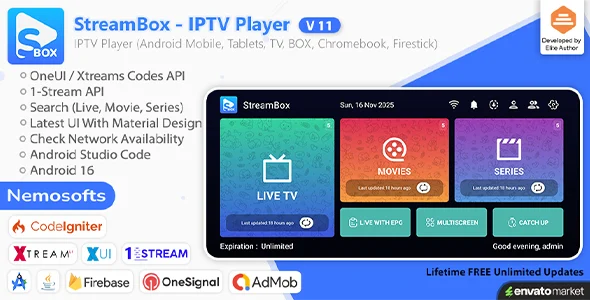
StreamBox IPTV Player Overview & Multi-Device Playback Architecture
StreamBox IPTV Player is an Android application source package, engineered for IPTV service providers and independent developers to deploy a branded playback client across phones, tablets, Android TV, Firestick, and Chromebook. The package targets a structural bottleneck in IPTV delivery: subscribers otherwise juggle fragmented players that cannot reconcile multiple playlists, EPG schedules, and parental restrictions inside one interface. Within agency delivery pipelines it operates as a white-label client shell that a provider rebrands and distributes, consolidating live TV, movie, and series access under a single navigable surface.
Technical Specifications & Deployment Matrix
| Engineering Metric | Deployment Specification |
|---|---|
| Base Technology / Framework | Android application codebase adaptable to phone, tablet, and TV form factors |
| Runtime / Device Targets | Android OS environments including Android TV, Firestick, and Chromebook |
| Data Exchange / Communication Protocols | HTTP-based playlist loading, configurable DNS profiles, EPG schedule data ingestion |
| Front-End / Engine Dependencies | Integrated media player engine; no external player application required |
| Database / Persistence Footprint | Local storage for playlists, DNS settings, favorites, and parental control state |
Multi-Playlist Ingestion & Playback Execution Pipeline
The pipeline is organized around user-supplied content sources rather than bundled media. Subscribers register playlists and DNS configurations, and the application ingests, parses, and validates these inputs before rendering channel catalogs, on-demand categories, and schedule data into its interface. The engine dispatches playback requests through its integrated media players, which decode a wide range of formats internally so that streams render without routing through third-party player software. This self-contained execution path is what allows a single codebase to behave consistently across handheld and television form factors.
State management follows a content-first pattern: favorites, playlist profiles, and parental restrictions persist locally, so a subscriber returning to the app resumes an organized view instead of re-authenticating every source. The EPG layer maps program schedule data onto the channel grid, letting users read broadcast timelines while the universal search layer indexes across live and on-demand inventories. For delivery studios evaluating standalone Android application paths outside the IPTV streaming domain, the Birthday Video Maker Clone exists as an independent SDK 34 codebase rather than an extension of this playback stack.
Core Technical Capabilities of StreamBox
- Multiple Playlist & DNS Management: The client accepts several content sources simultaneously and stores per-source DNS profiles, letting operators and subscribers switch providers without wiping existing configuration state.
- Integrated Playback Engine: Built-in media players handle format decoding in-process, removing the dependency on externally installed players and shortening the path from channel selection to stream start.
- EPG Scheduling Layer: The Electronic Program Guide attaches schedule metadata to the channel catalog, so users can plan viewing around broadcast timelines instead of blind channel hopping.
- Parental Control Gating: Content restriction mechanisms run at the interface layer, giving households a way to wall off unsuitable channels before playback is ever dispatched.
- Universal Search & Favorites: A single query surface spans live and on-demand inventories, while favorites state is persisted locally for rapid re-entry into preferred channels and titles.
Production Implementation & Operational Resilience
Because this is a client-side player, its production behavior is bounded by the quality of the playlists and network conditions feeding it. The package ships no media of its own; every deployment presumes valid, reachable playlist and EPG sources, and playback stability correlates directly with upstream provider infrastructure. Interface loading and channel-list navigation are engineered for rapid response, which matters most when catalogs span thousands of entries on lower-spec television hardware such as Firestick units.
For rebranding workflows, the deliverable functions as a turnkey shell: agencies apply their own identity assets and distribute the resulting client to subscribers as a branded product rather than a generic utility. This model shifts the operator’s engineering effort away from building a player from scratch and toward configuration, listing curation, and support. Operational boundaries are equally explicit: parental controls require deliberate configuration by the household, multi-language UI coverage depends on the deployed language set, and DNS profiles must match the provider’s delivery requirements. Teams diversifying client portfolios across platforms can treat QuickDate IOS as a separate iOS social application codebase, decoupled entirely from this Android runtime rather than merged into it.
Frequently Asked Questions
Does StreamBox require an external media player application to be installed on the device?
No, the application contains integrated media players that decode supported formats internally. Playback executes within the app process, so subscribers do not need third-party player software installed to watch live channels or on-demand titles.
Does the package include streaming content or channels out of the box?
No, the deliverable is a player client only. Users and providers supply their own playlists, DNS settings, and subscriptions; the application renders and organizes those sources but bundles no channels, movies, or series of its own.
Can the interface language be adjusted for non-English subscriber bases?
Yes, the application includes multi-language support within its interface layer. This allows providers serving international audiences to deploy the same client codebase without rebuilding the UI for each linguistic market.
Is a single subscription interface available for households managing several IPTV providers?
Yes, the client supports multiple playlists within one organized interface. Subscribers can register several content sources and switch between them, consolidating what would otherwise require separate per-provider applications.