Strata – Professional Multi-Purpose Theme
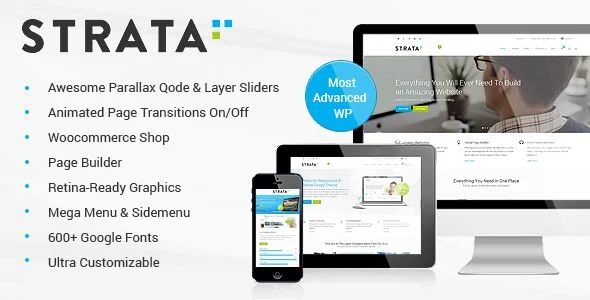
Strata Professional Multi-Purpose Theme Overview & Agency-Grade WordPress Foundation
The Strata Professional Multi-Purpose Theme is a WordPress theme package engineered for agencies and freelance developers to deploy corporate, portfolio, and e-commerce sites from one customizable codebase. It removes the overhead of hand-coding layout variations by bundling WPBakery Page Builder, LayerSlider, and the proprietary Qode Slider engine, so teams compose page structures, mega menus, and parallax sections through a backend options interface rather than template edits. In production workflows, the package functions as a deliverable-ready foundation: one-click demo import seeds client staging environments, while per-page header, menu, and slider configuration keeps runtime customization decoupled from the parent theme files.
Technical Specifications & Deployment Matrix
| Engineering Metric | Deployment Specification |
|---|---|
| Base Technology / Framework | WordPress theme built on HTML5, CSS3, and jQuery; ships as PHP, CSS, and JS files with the Strata Core plugin (v1.1.1) |
| Runtime / Language Requirements | WordPress 5.8.x through 6.9.x; PHP 8 compatibility confirmed in release 3.4 |
| Communication / Localization Protocols | WPML plugin compatibility; translation via standard po and mo files for any language |
| Front-End / Engine Dependencies | WPBakery Page Builder 6.7.0 ($46 value), LayerSlider 7.0.5 ($25 value), Qode Slider, Qode Carousel, Font Awesome icon set |
| Persistence / Asset Footprint | Standard WordPress database via options and post meta; v3.0 generates static CSS and JS files instead of PHP-driven dynamic stylesheets |
Qode Slider Engine & Front-End Rendering Pipeline
The core mechanism is a shortcode-driven rendering pipeline: WordPress template hierarchy requests are intercepted by theme templates, which dispatch modular shortcodes and WPBakery layout containers to the browser as composed DOM trees. Page transitions run through an optional AJAX layer offering four fluid animated routes between pages, or the module can be switched off entirely for a classic full-reload behavior when client caching layers or analytics scripts conflict with partial page replacement. The v3.0 architecture rework replaced style_dynamic.php and default_dynamic.php with static generated CSS and JS files, moving asset delivery off PHP execution and reducing server-side work per request.
Header behavior is configured per page: fixed headers shrink on scroll, sticky headers appear after a defined scroll threshold (or at slider height when a slider is present), and a separate variant places the menu at the bottom of the sticky header. Distinct logos load for initial versus sticky states and for dark versus light color schemas. Section-level video backgrounds scale to fit their containing row, with per-section pattern overlays available for contrast control.
Architectural & Functional Highlights
- Qode Slider: Full-screen or fixed-height image and video slides with parallax and fade in/out element animations, per-slide dark or light header schema, selectable graphic animation modes, per-slide typography control (size, color, font, line-height, weight, shadow), custom navigation colors, and per-video overlay patterns.
- Per-Page Header Overrides: Each page can declare its own header height, background image with parallax or zoom-out effect, title text alignment, subtitle and breadcrumb toggles, title animation direction, and independent title and hover colors — all stored as page-level meta rather than global state.
- Mega Menu & Navigation System: Wide and normal submenus coexist, wide layouts accept widget columns, a side menu widget area with invisible scroller closes automatically after a set scroll distance, and anchor links enable one-page site construction. For teams needing filterable, AJAX-driven post grids beyond the bundled Qode Carousel, JPS Ajax Post Layout – Addon For WPBakery Page Builder operates within the same WPBakery runtime as an extended layout layer.
- Portfolio & Blog Engines: Six portfolio single layouts and three list layouts combine with variable column counts; blog output supports masonry arrangement plus six custom post formats (Standard, Gallery, Link, Quote, Video, Audio).
- Interactive Shortcode Set: Counters, pie charts, horizontal progress bars, icon progress bars, graph charts, and animation-triggered elements compose data-visualization sections without custom scripting.
Production Implementation & Operational Resilience
For agency delivery, the v3.0 security hardening carries direct deployment weight: all variables and text domains are escaped, functions and hooks were renamed to unique identifiers to prevent collisions with plugin namespaces, and the removed custom_css.php and custom_js.php files were replaced with inline code injection. A dummy child theme ships in the package, giving teams an override-level upgrade path that preserves parent templates across version bumps — the child starter itself was updated to 1.0.1 in release 3.4. Google Maps embedding on the modular contact page requires an API key entered through the theme options panel; v3.0 added logic that prevents script errors when the key is absent, so staging environments without credentials still render the page shell.
Operational boundaries worth noting before launch: demo imagery serves presentational purposes only and must be replaced with properly licensed assets on client sites. Unlimited custom sidebars can be assigned globally or per post and page, and per-page meta keywords and descriptions feed the integrated SEO fields for indexation control. For studios evaluating narrower corporate or minimal-portfolio starting points as parallel options, Success – Business and Professional Services WordPress Theme and Zugan – Minimal Portfolio WordPress Theme represent alternative single-purpose WordPress foundations within the same ecosystem. Smooth scroll and AJAX animation toggles let developers dial back motion effects where Core Web Vitals budgets demand it, and the four-column, unfold-capable footer widget system supports up to four widget areas with AJAX behavior.
Frequently Asked Questions
Does the Strata package include a child theme for safe secondary development?
Yes. A dummy child theme ships inside the package and was refreshed to version 1.0.1 in release 3.4, allowing template and function overrides without touching parent files, so customizations survive routine theme updates.
Is a Google Maps API key required for the contact page map?
Yes. A dedicated options field for the API key was introduced in version 2.3, and version 3.0 hardened the map script so pages render without errors when the key is missing, keeping staging environments stable before credentials are configured.
Can demo images from the Strata preview be published on a live client site?
No. The documentation states that demo images are used for presentational purposes only and remain under third-party copyright, so production deployments require separately licensed stock assets before those visuals go live.
-
3.4 LatestSeptember 25, 2026