Speaker Cleaner & Water Eject+ | Abdroid App | Admob Ads
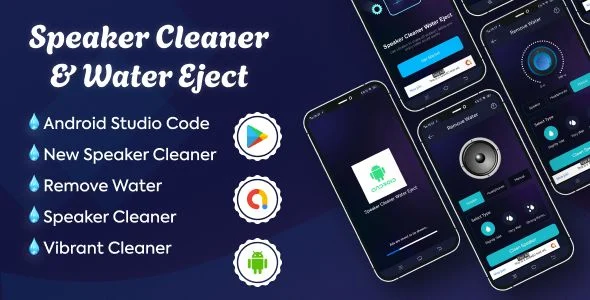
Speaker Cleaner Water Eject Overview & On-Device Audio Restoration Engine
Speaker Cleaner Water Eject is a native Java Android utility application, engineered for mobile publishers and app agencies to restore phone speaker performance by ejecting trapped water, dust, and debris through targeted sound frequencies. The codebase attacks a hardware-level bottleneck: particulate and moisture accumulation inside speaker enclosures, which degrades audio output and, left untreated, risks lasting driver damage. Within a production release workflow, the package functions as a deployable, monetizable utility asset that can be imported, rebranded, and shipped to the Google Play store with limited engineering overhead.
Technical Specifications & Deployment Matrix
| Engineering Metric | Deployment Specification |
|---|---|
| Base Technology / Framework | Native Android development in Java |
| Runtime / OS Compatibility | Android 9.0 through Android 15.0 |
| Deliverable Package | Compiled .apk binary plus editable .java source files |
| Monetization Layer | Google AdMob ad network integration |
| Persistence / Backend Footprint | On-device execution; no external server dependency documented |
Acoustic Cleaning Pipeline & Functional Execution Flow
The core mechanism restores speaker output entirely on-device by driving the hardware speaker with calibrated sound-wave frequencies. When a user selects a mode, the application dispatches a sequence of audio frequencies through the device audio driver; water ejection cycles generate low-frequency pressure pulses that physically push trapped moisture out of the speaker grille, while cleaning cycles target dry particles such as dust and lint. Each cycle is wrapped in the interactive animation layer, so the interface renders live visual feedback synchronized with the acoustic playback, giving the user a perceptible indication that the process is running rather than a silent background task.
State transitions between the three primary modules — water ejection, particle cleaning, and clear sound boost — are handled by the interface controller, which swaps the active frequency profile and animation set without restarting the application. The clear sound boost module follows the physical cleaning stages, restoring full audio clarity by removing the obstructions the preceding cycles dislodged. A preventive dimension is built into the architecture: running maintenance cycles on a schedule helps protect the speaker hardware from repeated moisture and debris buildup rather than reacting only after audio quality has already dropped.
For studios assembling a parallel catalog of audio-focused Android utilities, this codebase exists alongside independent release artifacts such as Floating Media Player, each maintained as a separate store listing with its own build pipeline.
Core Technical Capabilities of Speaker Cleaner Water Eject
- Water Ejection Engine: Generates frequency-driven pressure pulses through the speaker hardware to displace trapped moisture, addressing the most common post-exposure failure mode for phone audio components.
- Particle Cleaning Cycle: Runs targeted tone sequences that dislodge dust and dry debris from the speaker enclosure, improving audio output without physical intervention or disassembly.
- Clear Sound Boost Module: Follows the physical cleaning stages to restore full output clarity once obstructions have been cleared from the audio path.
- Themed Animation Layer: Ships with a collection of themes and backgrounds tied to the interactive cleaning animations, allowing visual reskinning of the playback experience without altering the acoustic logic.
- Engagement & Monetization Blocks: Bundles rate-app, share-app, and more-app screens alongside AdMob ad placements, giving publishers built-in retention loops and revenue points at the interface level.
Production Implementation & Operational Resilience
Deployment begins by importing the .java source tree into Android Studio and producing a Gradle build targeting devices from Android 9.0 up through Android 15.0. Before a store submission, publishers must replace the placeholder AdMob identifiers with their own ad unit credentials, since shipping with default values routes impressions to the wrong account. Because the application manipulates physical hardware, emulator validation is insufficient: tone generation and ejection behavior must be verified on physical devices, ideally across several form factors, since speaker enclosure geometry varies between manufacturers and directly influences how effectively pressure pulses displace moisture.
The package runs entirely on-device with no documented backend dependency, which removes network payload handling, CORS configuration, and API failure states from the operational surface. Resilience therefore concentrates on the presentation layer: themes and background assets can be swapped for rebranding purposes while the frequency-based cleaning logic remains untouched, and the included documentation with screenshots walks developers through import, build configuration, and asset replacement step by step. Publishers marketing the released application outside the Android runtime can build a decoupled showcase page with Binmp as an independent HTML template path, keeping the marketing surface fully separate from the Java codebase. All device compatibility work is handled at the application layer, since the utility targets the full supported OS range through standard Android audio APIs.
Frequently Asked Questions
Does the package ship with both a compiled binary and editable source files?
Yes. The deliverable includes a ready-to-install .apk for immediate device testing alongside the complete .java source, letting developers audit every module, adjust the theme layer, and recompile custom release builds directly inside Android Studio.
Can I test the water ejection feature on an Android emulator?
No. The ejection mechanism depends on physical speaker hardware producing actual pressure pulses, so emulated audio output cannot validate cleaning behavior; verification requires installation of the .apk on a real device.
Is visual setup documentation included with the source code?
Yes. A full document with screenshots accompanies the package, covering project import, build configuration, and the reskinning workflow so developers can reach a release build without relying on external tutorials.
Does the app support modern Android 15 devices?
Yes. Compatibility is declared across Android 9.0, 10.0, 11.0, 12.0, and 15.0, covering both older installed bases and current-generation hardware within a single build configuration.