Sort Colored Balls – HTML5 Mobile Game
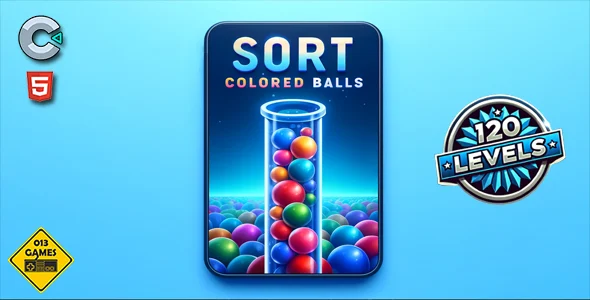
Sort Colored Balls Overview & Mobile Puzzle Engine Architecture
Sort Colored Balls is a Construct 3 HTML5 puzzle game source package, engineered for web studios and mobile publishers to deploy a 120-level ball-sorting casual title across browsers and native app channels. The package removes the pipeline cost of engineering a touch-driven sorting mechanic from zero by shipping a complete event-based runtime built from 62 events distributed across 4 event sheets. Within production workflows it operates as a self-contained playable asset: embed it into a client site as static HTML5 output, or push the same project through Construct 3 exporters toward Android and iOS builds.
Technical Specifications & Deployment Matrix
The matrix below consolidates the verifiable runtime parameters extracted from the shipped deliverables.
| Engineering Metric | Deployment Specification |
|---|---|
| Base Technology / Framework | Construct 3 event-sheet engine, canvas-rendered HTML5 runtime |
| Runtime / Language Requirements | JavaScript, HTML, CSS — static client-side delivery, no server backend |
| Display Resolution | 1080×1920 portrait (9:16), scaled to fit a full device-oriented screen |
| Input Protocols | Touch, mouse, and keyboard event capture |
| Browser Compatibility | IE11, Firefox, Safari, Opera, Chrome, Edge |
| Logic Footprint | 62 events organized across 4 event sheets, commented source |
| Persistence Footprint | None required — board state lives inside the client-side game session |
Tap-Based Sorting Logic & Execution Pipeline
The gameplay loop runs on a tap-to-move rule engine that validates color equality and tube capacity before any transfer executes. When a pointer event lands on a tube, the runtime reads the ball currently exposed at the top of that stack and awaits the destination selection. The receiving tube is then checked against two hard constraints: it must either be empty or expose a ball of identical color, and it must retain enough space for the incoming ball. Only when both conditions pass does the engine commit the transfer and animate the ball into its new position; rejected moves never mutate the board, which keeps the 120 shipped levels consistent and blocks illegal states at the validation gate. Because the entire rule set lives inside Construct 3’s event-sheet system rather than external scripts, behavior adjustments remain visual and editor-based rather than hand-coded.
Architectural & Functional Highlights
- Commented event-sheet logic: 62 events across 4 sheets ship fully commented, so every transfer rule, level transition, and validation branch can be traced and modified inside the Construct 3 editor without touching raw JavaScript.
- Portrait scaling pipeline: the 1080×1920 (9:16) stage scales to occupy the full device-oriented screen, producing consistent geometry from phone-class viewports up to desktop browsers.
- Tri-channel input dispatch: touch, mouse, and keyboard events feed the same interaction layer, allowing a single build to serve mobile web, desktop web, and wrapped native contexts.
- Asset replacement workflow: skins, ball sprites, and branding graphics can be swapped through a simple image-replacement process with no coding required, and the full source is included for deeper structural edits.
- Bundled audio layer: sound effects are packaged with the build and wired into the event sheets.
Studios assembling a broader casual catalog on the same engine generation can position Garden Match Saga HTML5 Game Construct 3 as a parallel match-3 title occupying a distinct genre slot, since both packages follow the identical Construct 3 to HTML5 export path.
Production Implementation & Operational Resilience
Deployment reduces to static file hosting. The ZIP package contains the finished HTML5 build (JavaScript, HTML, CSS), and the included documentation walks through adding it to a website; since the game issues no server-side requests, it runs from any static host or CDN directory without database provisioning, API keys, or cross-origin configuration. The browser matrix extends back to IE11, which indicates the runtime avoids modern-only JavaScript APIs and behaves predictably on legacy enterprise browsers still present in client environments.
For native distribution, the same Construct 3 project feeds the Android and iOS export targets, so the 62-event logic base carries into store builds without a rewrite. Resilience at the logic layer comes from the validation gate: illegal moves are rejected before state mutation, keeping content data separate from the transfer rules that govern it. Customization is explicitly supported end to end — skins and branding are replaceable without code, and the complete source opens deeper modification for teams that need it. Teams requiring additional genres on an identical delivery pipeline can evaluate Find The 3 Difference as an independent spot-the-difference build outside this codebase. One operational boundary is fixed: the 9:16 portrait stage is mobile-first, so landscape placements rely on the built-in scaling or require layout work inside the source project.
Frequently Asked Questions
Does the download include the editable Construct 3 project file?
Yes. The package contains the Construct 3 source with commented code, the compiled HTML5 build ready to install, and documentation describing how to add the game to a website, so behavioral edits happen directly in the editor rather than in minified output.
Can the game be exported to Android and iOS without rewriting the gameplay logic?
Yes. Construct 3 provides native export targets for both platforms, and the complete sorting logic resides in the included project, so the same event sheets feed mobile store builds without code-level reimplementation.
Is the Construct 3 editor required just to run the game in a browser?
No. The compiled HTML5 output runs directly in any compatible browser from static hosting; the Construct 3 editor is only needed when modifying the included source project or triggering native exports.