SnapCart – Mobile-Focused Laravel eCommerce System
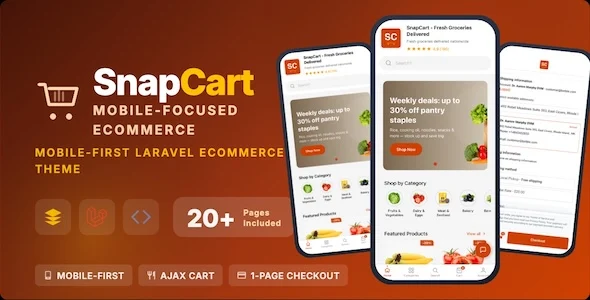
SnapCart Laravel eCommerce System Overview & Functional Engine
SnapCart is a Laravel 12 eCommerce application built on the Botble CMS framework, engineered for store owners and development agencies launching storefronts optimized for smartphone shoppers. The system addresses a measurable operational bottleneck: desktop-first commerce themes force administrators to populate hero banners and content blocks designed for large screens, even though more than 70% of online sales now originate on mobile devices. Within a production workflow, the package operates as a self-hosted commerce engine covering catalog management, checkout, payment capture, order fulfillment, and affiliate commission tracking from one admin panel.
Technical Specifications & Deployment Matrix
| Engineering Metric | Deployment Specification |
|---|---|
| Base Technology / Framework | Laravel 12 on Botble CMS; PHP server-side codebase with JavaScript, Sass, CSS, and SQL seed files included |
| Runtime / Language Requirements | PHP 8.3+ with PDO, OpenSSL, Mbstring, Exif, Fileinfo, XML, Ctype, JSON, and Tokenizer extensions; mod_rewrite and PHP cURL enabled |
| Database / Persistence Footprint | MySQL 5.7+ or MariaDB 10.2+; media offload supported to Amazon S3, BunnyCDN, or Wasabi |
| Data Exchange / Communication Protocols | REST API endpoints for headless and mobile app consumption; webhooks dispatching real-time event notifications to external services |
| Compatible Browsers | IE11, Firefox, Safari, Opera, Chrome, Edge |
Commerce Execution Pipeline & Core Capabilities
Storefront requests render through a mobile-first view layer tuned for 480px viewports, while cart mutations execute as AJAX calls that update an inline popup and a sticky footer bar without page reloads.
Architectural & Functional Highlights
- One-Page Checkout Engine: Address entry, shipping selection, and payment authorization combine on a single screen, with a delivery time picker that lets customers reserve date and time slots while configurable peak-hour delivery rates adjust totals. Version 1.0.9 hardened this pipeline against duplicate orders from overlapping submissions and orders reused across browser tabs.
- Payment Gateway Abstraction: PayPal, Stripe, Razorpay, Paystack, Mollie, SSLCommerz, cash on delivery, and bank transfer operate behind a unified gateway layer. The current release corrected Stripe charging a fee different from the quoted amount and Razorpay captured payments being lost or overwritten, keeping transaction records aligned with checkout quotes.
- Localization & RTL Pipeline: 24 language packs ship with the codebase, and full right-to-left layouts activate for Arabic, Persian, and Hebrew, so locale switching requires no template duplication. Checkout validation field names translate correctly following recent fixes.
- Affiliate Commission Tracking: A built-in affiliate module records referral attribution, exposes per-affiliate dashboards, and manages withdrawal requests from the admin area. Version 1.0.9 added external product fields to import/export and linked external stores for affiliate products.
- Promotion & Conversion Layer: Flash sales render countdown timers with sold-count indicators, Buy Together bundles drive cross-sell logic, and sale popups broadcast recent purchase notifications. Ad banner slots distribute promotional creatives across the store, and newsletter capture feeds a subscriber management module.
For storefronts that outgrow internal banner slots and require a dedicated advertising network with its own campaign, user, and earnings accounting, Solid PTC operates as an independent pay-per-click platform rather than an extension of this codebase.
Production Deployment & Implementation Considerations
Deployment targets Apache, Nginx, or another compatible web server meeting the PHP 8.3+ and MySQL 5.7+/MariaDB 10.2+ thresholds, and a browser-based installer provisions the schema without command-line access. That installer now validates the database connection before persisting settings and preserves passwords containing special characters, two failure modes corrected in the current release. Localization support covers grocery, quick commerce, and same-day delivery scenarios because the delivery scheduler, flash sale engine, and floating contact buttons (WhatsApp, Zalo, Messenger, or Telegram, up to three per page) were all designed against phone-screen constraints first.
Customization operates through more than 50 theme options exposed in the admin UI — colors, feature toggles, delivery configuration, and contact channels — alongside 8 homepage shortcodes (hero carousel, featured products, categories, flash sale, reviews, brands, blog, ecommerce categories) and 6 widget classes for layout composition. Styling compiles from the included Sass sources, and a marketplace of community plugins extends functionality through the Admin > Plugins screen. Operational boundaries remain: demo imagery ships outside the package, analytics instrumentation covers Google Analytics, Facebook Pixel, and Google Tag Manager, and GDPR handling relies on the built-in cookie consent notice, which no longer reappears after rejection. For agencies planning multi-vendor monetization on a separate platform instead of a single-store catalog, Martvill provides a standalone seller subscription add-on for its own ecosystem.
Frequently Asked Questions
Can a native mobile app or headless frontend consume store data through an API?
Yes. The system exposes REST API endpoints intended for headless and mobile app integration, and webhooks push real-time event notifications to external services, enabling decoupled frontends to synchronize orders, catalog data, and customer state without screen scraping.
Does the installer require SSH or command-line access to provision the database?
No. A browser-based installation wizard handles setup end to end, validates the database connection before saving configuration, and correctly processes credentials containing special characters, so shared hosting environments without shell access remain fully supported.
Is bulk catalog migration possible without writing manual SQL queries?
Yes. CSV and Excel import/export handle product data at scale, including external product fields added in version 1.0.9, letting merchants migrate large inventories with variations, specifications, and options mapped through the admin interface rather than database edits.
Can media files be stored outside the origin web server?
Yes. The media layer supports Amazon S3, BunnyCDN, and Wasabi as storage backends, allowing product imagery to be served from object storage or a CDN while the primary server handles application logic and database operations.
-
v1.0.0 Latest
Workzone – Freelancer Marketplace for Service & Job Posting Laravel Script + Mobile App (Bundle)
Bank King – Laravel Banking Website and Mobile Apps Bundle

Minico – Responsive Multipurpose Mobile Template