Snake Game – HTML5 Game
Snake Game Overview & Canvas Arcade Architecture
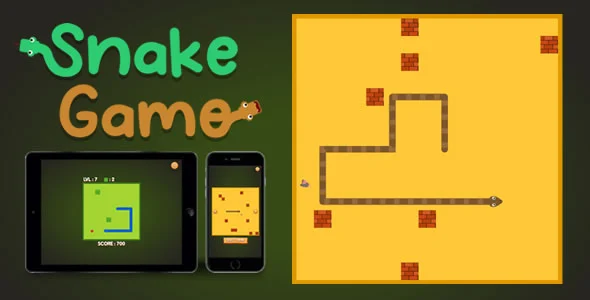
Snake Game is an HTML5 arcade title built on CreateJS, engineered for developers and agencies deploying browser-native entertainment across desktop and mobile channels. The package resolves viewport fragmentation by shipping two render targets—1280×768 landscape and 768×1024 portrait—that scale proportionally, with devicePixelRatio-aware logic added in version 1.5 keeping sprites sharp on high-density screens. Within production delivery pipelines, it functions as a self-contained, reskinnable module that drops onto static hosting and accepts keyboard, mouse, and touch input without platform-specific builds.
Technical Specifications & Deployment Matrix
| Engineering Metric | Deployment Specification |
|---|---|
| Base Technology / Framework | CreateJS over HTML5 Canvas |
| Runtime / Language Requirements | Client-side JavaScript; HTML, CSS, and PHP files included in package |
| Rendering Resolutions | 1280×768 and 768×1024, proportional auto-resize for landscape and portrait |
| Input Layer | Keyboard, mouse, touch swipe, and on-screen controls |
| Persistence Footprint | No database dependency; static hosting compatible |
| Design Assets | Layered Photoshop PSD source file plus HTML5 source and documentation |
Game Loop Mechanics & Execution Pipeline
The engine drives a grid-based loop in which the snake consumes feed pellets, grows one segment per pellet, and terminates the run on wall collision or tail contact. Each movement step is scheduled through the CreateJS ticker, while the speed parameter inside Game Settings—configured alongside score and level thresholds—determines the interval between frames. Input arrives through three parallel dispatch paths: native keyboard listeners for desktop sessions, mouse handlers for pointer-driven play, and a touch layer introduced in version 1.4 that maps swipe gestures to directional vectors, supplemented by on-screen controls for devices without physical keys.
Two modes govern topology generation. Classic mode runs the conventional open grid, whereas adventure mode reads Adventure Options—map size, wall placement, and brick layout—to construct obstacle configurations before a session starts. Because walls and bricks are declared as configuration data rather than hard-coded geometry, deployment teams can produce distinct level designs by editing settings entries instead of rewriting collision logic.
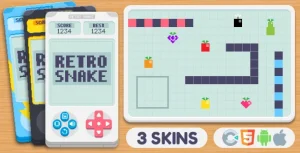
Reskinning operates entirely at the asset layer. Theme Settings expose wall and floor color values plus snake, feed, and brick image slots, and seven prebuilt themes ship in the package; a layered PSD file lets designers export replacement sprites that drop into the same filename structure. Text display and image assets are likewise configurable, so localization or brand substitution requires no JavaScript edits. For studios evaluating additional standalone browser titles on the same portal, Pupper Jones: Temple of Treats exists as an independent Construct 3 source package outside this codebase.
Core Technical Capabilities of Snake Game
- Dual-Orientation Responsive Canvas: The 1280×768 and 768×1024 targets scale proportionally to the current screen device, with devicePixelRatio handling added in v1.5 preserving sprite fidelity on high-density displays in both orientations.
- Configuration-Driven Level Topology: Adventure Options for size, wall, and brick placement feed the map constructor, so obstacle layouts are defined as data rather than hard-coded geometry.
- Tri-Channel Input Dispatch: Keyboard, mouse, and touch/swipe handlers route into a single direction state, allowing one control schema to serve both PC and mobile sessions.
- Session State Operations: Enter FullScreen, Mute Sound, and Exit Game are exposed as first-class runtime actions, handling teardown without page reloads.
Production Implementation & Operational Resilience
Deployment requires only static file hosting: the ZIP contains HTML, CSS, JavaScript, and PHP files, with no database layer or build step in the delivery path. When embedded inside portals via iframe, the engine prevents iframe scrolling—explicitly addressed in version 1.3 of the changelog—keeping host page scroll behavior intact during touch play. Browsers lacking required HTML5 support receive a dedicated fallback page rather than a broken canvas.
Runtime session management flows through the options layer, where fullscreen entry, audio muting, and game exit operate as discrete state transitions. The changelog record—canvas and fullscreen fixes in v1.1, sound function updates in v1.2, a rebuilt template with improved scaling in v1.5, social share fixes in v1.6, and the 2026 template update in v1.7—documents an ongoing maintenance cadence against browser and template deprecations.
For secondary development, the customization surface is deliberately data-oriented. Game Settings for speed, score, and level, all display text, and all image assets can be replaced before deployment, and the leaderboard add-on extends the base package with score submission plus Top 10 ranking views where retention metrics justify the extra layer. Studios assembling a multi-title casual section can deploy this codebase next to a standalone alternative such as Block Puzzle for portal variety, treating each entry as an independent drop-in module since no shared runtime couples them.
Frequently Asked Questions
Does the download include editable Photoshop source files for reskinning?
Yes. The ZIP package ships with a layered Photoshop PSD file next to the HTML5 source, allowing designers to modify sprite assets—snake, feed, and brick images—without editing any game logic.
Is the Top 10 leaderboard bundled with the base download?
No. The leaderboard system—player score submission plus Top 10 rankings—is distributed as a separate add-on that requires this base game to function; the core package contains only the standalone game itself.
Can players publish their scores to social networks from inside the game?
Yes. A share-score routine distributes results to six networks—Facebook, Twitter, WhatsApp, Telegram, Reddit, and LinkedIn—directly from the game, with the share implementation corrected in version 1.6.
Does the engine run on legacy Internet Explorer 9?
Yes. Documented browser support extends from Internet Explorer 9, 10, and 11 through Firefox, Safari, Opera, Chrome, and Edge; unsupported environments receive a dedicated fallback page instead of a blank canvas.