Shradhanjali Card Maker – RIP Post Maker – Tribute Post Maker – Funeral Card Maker – Condolence Card
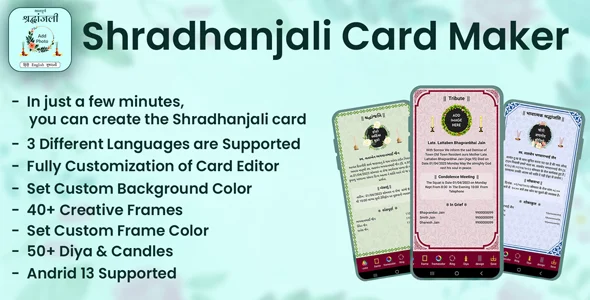
Shradhanjali Card Maker Overview & Android Card Generation Engine
Shradhanjali Card Maker is a native Android application source code, engineered for mobile developers and agencies to produce tribute, RIP, condolence, and funeral card applications without rebuilding the rendering pipeline from scratch. The package addresses the operational bottleneck of generating culturally formatted memorial notices in English, Gujarati, and Hindi, where typography, candle and floral overlays, and structured biography fields must compose into a shareable image within minutes. In production workflows, it functions as a deployable white-label foundation: developers compile the included Java and XML source, attach their own AdMob publisher identifiers, rebrand the UI, and publish a fully functional card generator to Google Play.
Technical Specifications & Deployment Matrix
| Engineering Metric | Deployment Specification |
|---|---|
| Base Technology / Framework | Native Android application written in Java, with XML layout resources |
| Runtime / Language Requirements | Android 9.0, 10.0, 11.0, and 12.0 (plus additional compatible versions) |
| Data Exchange / Communication Protocols | AdMob ad network integration for banner and interstitial monetization requests |
| Front-End / Engine Dependencies | Android SDK toolchain, Gradle build system, device Gallery and camera-roll access |
| Database / Persistence Footprint | Local device storage; finished cards exported to the device Gallery and shared via Android share intents |
Template Composition Pipeline & Execution Flow
The application operates on a staged image-composition pipeline: user inputs, photo selections, and template assets converge into a single rendered card bitmap. A session begins when the operator selects a RIP or tribute theme from the catalog, which loads the corresponding frame, background, and decorative overlay set into the active editing context. Photo ingestion flows through the Android gallery picker, after which an embedded crop utility normalizes the image to the frame’s target aspect ratio before compositing. Structured detail fields—deceased person’s name, place, date of death, place of death, and free-text notes—are bound to localized text views, with string resources switching between English, Gujarati, and Hindi dictionaries. The final render is written to the device Gallery, and an Android share intent dispatches the bitmap directly to installed social applications, allowing relatives to be notified without a server round trip. For developers extending comparable photo-composition products, pairing this pipeline with Baby Photo Editor demonstrates how the same frame-overlay-crop pattern scales across adjacent app categories.
Core Technical Capabilities of Shradhanjali Card Maker
- Multilingual Resource Layer: English, Gujarati, and Hindi localizations are handled through Android string resources, so language switching requires no code changes—only a locale selection that rebinds template text without regenerating layouts.
- Theme and Overlay Catalog: Multiple RIP themes, candle graphics, floral elements, and photo frames ship as packaged drawable assets, enabling reskinning through direct asset replacement in the resource directories.
- Gallery-to-Card Pipeline: Photos enter via the system picker, pass through the crop utility for aspect normalization, and composite onto the selected frame, producing a Gallery-saved output ready for distribution.
- AdMob Monetization Hooks: AdMob integration points are already wired into the codebase, requiring publisher ID configuration during the build rather than new SDK implementation work.
- Direct Social Distribution: Share intents pass the rendered card to WhatsApp, Facebook, and other installed applications natively, eliminating dependency on any external upload service.
Production Implementation & Operational Resilience
Deployment follows the standard native Android path: import the project into Android Studio, resolve Gradle dependencies, point the AdMob configuration at the developer’s own ad unit identifiers, and generate a signed release APK or App Bundle for store submission. A demonstration APK is distributed with the package, allowing QA teams to validate rendering behavior, theme selection, and the multilingual switcher on physical devices before a store build is produced. Because the deliverables are .java and .xml source files rather than a compiled binary, every screen, string, and drawable remains editable—agencies can rebrand colors, replace tribute artwork, or extend the detail form fields directly in the layout XML.
Operational boundaries are dictated by the target runtime. The codebase is verified against Android 9 through 12, so teams shipping to newer API levels should budget time for targetSdk migration testing, permission model review, and scoped storage compliance for Gallery writes. Runtime resilience depends on the Android framework’s process lifecycle; unsaved editing state is not persisted server-side, so finishing the render before backgrounding the app is the expected operating pattern. On devices with restricted storage permissions, Gallery export fails at the system boundary, which makes runtime permission prompting a pre-deployment verification item. Developers monetizing additional family-oriented utilities can study how Unicorn Coloring Book For Kid’s with Admob + GDPR handles newer API-level targets, and teams building broader status and quote generation suites can extend the same share-intent distribution model seen in Status Maker and creator app to compound their portfolio.
Frequently Asked Questions
Does Shradhanjali Card Maker support card creation in Gujarati and Hindi in addition to English?
Yes, the application ships with three localizations—English, Gujarati, and Hindi—implemented through Android string resources, so operators can generate fully translated tribute cards by switching the in-app language selection.
Is an iOS or Flutter build included in the source package?
No, the deliverable contains native Android .java and .xml files plus an APK, so cross-platform deployment would require a separate rewrite using a shared framework rather than direct code reuse from this package.
Can finished tribute cards be saved to the device Gallery?
Yes, every rendered card is written directly to the device Gallery storage, and the Android share intent additionally dispatches the output to installed social applications for immediate distribution to relatives and community groups.
Is AdMob already integrated, or must developers wire the SDK manually?
Yes, AdMob integration is included in the source code; the remaining implementation step is configuring your own publisher and ad unit identifiers during the Gradle build before submitting the signed release artifact to the store.
Does the package include documentation to guide the build process?
Yes, a full document with screenshots accompanies the source code, walking developers through project import, configuration, and deployment steps so the app can be compiled and published without reverse-engineering the codebase.

Business Card Maker – Android Native App

BidKing Pro – Best Value Auction Script with Analytics, Tax Settings & Buyer Insights

Dairy Products, Grocery, Daily Milk Delivery Mobile App with Subscription | Customer & Delivery App