Sellzy – Multivendor eCommerce Dashboard Tailwind CSS Next.js Template
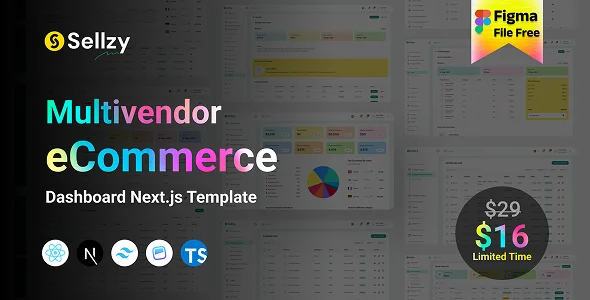
Sellzy Multivendor eCommerce Dashboard Overview & Marketplace Control Layer
Sellzy Multivendor eCommerce Dashboard is a Next.js and Tailwind CSS admin interface package, engineered for development teams building multi-seller marketplace backends. It addresses the operational sprawl of marketplace administration by consolidating product, order, finance, promotion, user, and content management into a componentized structure spanning more than 150 pre-built page layouts. Within an agency delivery pipeline, the package operates as the presentation and interaction layer that teams bind to their own commerce APIs before a production release.
Technical Specifications & Deployment Matrix
| Engineering Metric | Deployment Specification |
|---|---|
| Base Technology / Framework | Next.js application shell styled with Tailwind CSS utility classes |
| Runtime / Language Requirements | React runtime, documented compatibility with ReactJS and TypeScript |
| Front-End / Engine Dependencies | Headless UI primitives, ApexCharts visualization library |
| Typography & Iconography | Public Sans typeface, Material Symbols and Hugeicons icon sets |
| Browser Support Envelope | Responsive layout verified across Chrome, Edge, Firefox, Safari, Opera, and IE6–IE11 |
| Database / Persistence Footprint | None — front-end template only; the data layer is supplied by the adopting team |
Multivendor Administration Modules & Execution Pipeline
Sellzy organizes marketplace operations into two role-based route trees rendered through Next.js components. The master admin tree carries global marketplace control — total orders, returns and refunds, transactions, tax, seller performance reports, and pending seller approvals — while a parallel seller tree exposes the subsets each vendor needs: product publishing, stock additions, order requests, earnings, withdrawals, and coupon management. Both trees draw from a shared library of reusable components, so a data table, summary card, or confirmation dialog behaves identically regardless of which role renders it.
Execution flows through a structured sidebar taxonomy covering products, orders, finance, analytics, content, and settings. Chart components consume data bindings that the implementing team maps to live endpoints, displaying revenue trends, order status breakdowns, and fulfillment rates once real payloads replace the preview data. The 3rd-party setup screens — payment method configuration, Firebase credentials, and marketing tool panels — exist as interface shells awaiting concrete API wiring. For teams running a decoupled architecture where the customer-facing storefront lives separately from this control layer, Ciseco – Shop eCommerce NextJs Template can be assessed as an independent front-of-house option on the same runtime.
Core Technical Capabilities of Sellzy
- Dual-role dashboard architecture: Master admin and seller route trees ship together, covering 150+ documented page states from sign-in through seller inbox, eliminating the need to author vendor-facing screens from scratch.
- ApexCharts visualization layer: Revenue trend lines, order status breakdowns, fulfillment rates, and geographic sales distribution render through a single charting dependency, keeping the bundle predictable and swappable.
- Inventory and order state monitoring: Categorized low-stock indicators, new order request approval or cancellation actions, abandoned cart tracking, and transaction ledgers provide the operational surfaces marketplace operators query daily.
- Promotions module set: Create, edit, and detail screens for coupons, flash sales, featured deals, and clearance deals map promotion lifecycles directly to route-level UI states.
- Authentication-ready page set: Sign-in, sign-up, reset password, and set-new-password layouts are prebuilt, letting teams attach their chosen auth provider without redesigning the entry flow.
Production Implementation & Operational Resilience
Because the deliverables are CSS and JS files with no server, database, or persistence engine, resilience in staging depends on the boundaries teams establish at wiring time. Inbound API responses feeding the chart and table components should be validated before render, and any cross-origin requests to separate commerce services require CORS headers configured at the API gateway rather than inside the template. Error and confirmation states are already modeled — confirmation dialogs and popups appear throughout the page inventory — so teams map server failures onto these existing UI patterns instead of authoring new ones.
Styling overrides stay contained within the Tailwind configuration layer, where the Public Sans typeface, color tokens, and spacing scales can be redefined per client brand without touching component internals. Asset replacement has one hard boundary: all stock imagery shown in the preview originates from Freepik and Shutterstock and is licensed for demonstration only, so agencies must substitute licensed or original media before any client handover. Teams comparing dashboard shells on non-React runtimes can evaluate Nazox – Ajax Admin & Dashboard Template as a parallel, independently architected option rather than an extension of this codebase.
Frequently Asked Questions
Does the download package include the original Figma design files?
Yes. The documentation lists Figma as the software version of record, meaning the design source accompanies the CSS and JS deliverables and can be referenced for layout modifications and design handoff during client projects.
Are the preview images from Freepik and Shutterstock shipped inside the package?
No. The documentation states that all stock images serve preview purposes only and are excluded from the download, so teams must source and license replacement media before deploying any screen to a client environment.
Can this template operate a functioning marketplace without additional back-end work?
No. It is a front-end interface package; the payment method, Firebase, and marketing tool screens are configuration interfaces, and no database, server runtime, or persistence layer is included in the deliverables.
Are both the master admin panel and the seller panel included in a single purchase?
Yes. The page inventory contains a complete master admin tree plus a dedicated Seller_ route series covering products, inventory, orders, earnings, withdrawals, coupons, and inbox screens for vendor-facing deployments.