Sectox – CCTV & Security WordPress Theme
Sectox Overview & Security-Industry Site Foundation
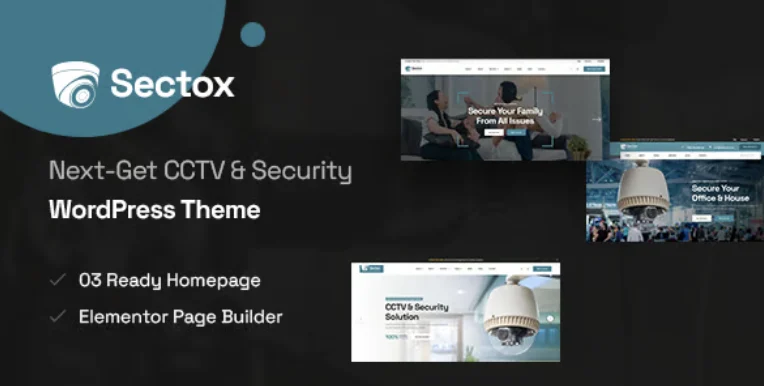
Sectox is a Bootstrap 5-based WordPress theme engineered for security firms, CCTV integrators, and surveillance service providers to deploy niche business websites without custom front-end development. The package resolves the bottleneck of building security-sector layouts from scratch by shipping three homepage demos, 35+ custom Elementor widgets, and roughly 35 pre-built inner pages composed on a 1290px grid. Within agency delivery pipelines, it operates as a ready-to-configure foundation: demo content installs through a one-click importer, and all page composition runs through Elementor’s drag-and-drop editor with zero hand-written markup required.
Technical Specifications & Deployment Matrix
| Engineering Metric | Deployment Specification |
|---|---|
| Base Framework | Bootstrap 5.x, HTML5, CSS3, jQuery |
| CMS Runtime | WordPress 6.0.x through 7.0.x |
| Page Builder Engine | Elementor (drag-and-drop, live editing); Gutenberg optimization not implemented |
| Commerce Layer | WooCommerce 8.x.x and 9.x.x, with newer builds tracked in the changelog |
| Deliverable Files | PHP, HTML, CSS, SCSS, JS, and layered PSD sources |
| Localization | WPML compatible, translation-ready string architecture |
| Browser Matrix | IE11, Chrome, Firefox, Safari, Opera, Edge |
Elementor-Driven Rendering & Template Execution Pipeline
Every page rendered by this theme passes through Elementor’s rendering engine rather than static PHP templates. When a visitor requests a URL, WordPress resolves the template hierarchy, and the builder’s stored layout data is parsed into DOM sections, populated by the 35+ custom widgets registered through the bundled companion plugin. A changelog entry from v1.1.1 confirms the Tp Core plugin handles widget registration, and subsequent releases patched widget rendering defects and added widget style variants, indicating the widget layer is actively maintained as the primary output surface.
Header and footer regions follow a parallel pattern: three-plus header variations and three-plus footer variations ship as importable layouts, and the WordPress Customizer exposes header and footer settings alongside dynamic color pickers and typography controls that write to CSS custom properties at render time. Because SCSS source files are included, an agency can recompile the Bootstrap 5 layer with modified variables instead of appending override stylesheets, keeping the asset footprint fragmented only by the widgets actually placed on a page. Contact Form 7 compatibility means form markup is generated by that plugin’s shortcode handler and injected into builder sections without theme-level conflicts.
Architectural & Functional Highlights
- Custom Widget Library (35+): Purpose-built Elementor widgets output security-industry components—service grids, camera product blocks, team sections—so layout assembly requires no shortcode registration or manual HTML injection.
- One-Click Demo Import: The importer provisions three homepage demos and roughly 35 inner pages with placeholder media, giving staging environments a populated DOM tree for immediate content substitution; a demo import defect was identified and patched in v1.1.3.
- WooCommerce Commerce Layer: Product archives, single-product views, and cart flows run against WooCommerce 8.x–9.x, enabling surveillance hardware catalogs (cameras, alarm kits, access-control units) to be merchandised without custom post-type engineering.
- WPML String Registration: Theme strings and widget labels are registered for translation, allowing multilingual deployments where each rendered language inherits the same template hierarchy and widget configuration.
Production Implementation & Operational Resilience
In client staging environments, the recommended sequence is a fresh WordPress install, theme upload via FTP or the admin uploader, plugin activation, and demo import—after which real content replaces placeholder nodes. Child theme compatibility is the central resilience mechanism: default template files can be overridden in a child directory, so parent updates applied across a client portfolio do not destroy customized templates. The package has been exercised against WordPress 6.0 through 7.0 and successive WooCommerce generations, with version-gated releases documenting each compatibility pass, which reduces regression risk on scheduled core updates.
Where a project demands header or footer layouts beyond the bundled variations, integrating Elementor Header Footer Builder – Addon allows developers to compose those regions visually inside the same builder workflow instead of editing PHP partials. Retina-ready imagery and touch-optimized navigation behavior are handled at the stylesheet level, and the responsive breakpoints inherit Bootstrap 5’s mobile-first scale. For decoupled implementations outside the WordPress theme layer—cybersecurity presentations built purely from kit layouts—Codex exists as an independent template-kit design path that bypasses theme-level overrides entirely, useful when a studio wants design iteration isolated from PHP template ownership.
Frequently Asked Questions
Are layered design source files included in the download package?
Yes. The deliverables contain PHP, HTML, CSS, SCSS, and JS files plus original PSD documents, so designers can re-export imagery and developers can recompile the stylesheet layer rather than patching compiled CSS.
Can the theme be edited with the native Gutenberg block editor?
No. The architecture is built around Elementor as its page builder engine, and the specification explicitly lists Gutenberg optimization as not implemented; block-editor workflows are outside the intended editing path.
Does the package support multilingual deployments out of the box?
Yes. The codebase is WPML compatible and translation-ready, meaning theme strings and widget labels are registered for translation so a single widget configuration can render across multiple language instances of the site.
-
1.0.7 LatestSeptember 29, 2026