School Bus Tracker Android
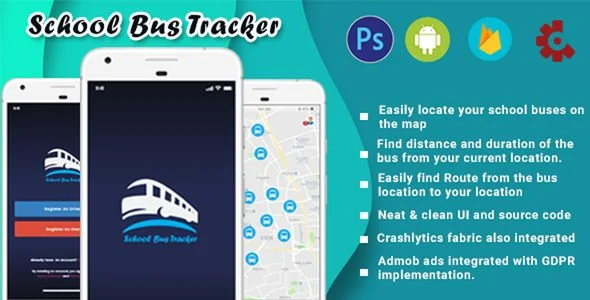
School Bus Tracker Overview & Real-Time GPS Monitoring Architecture
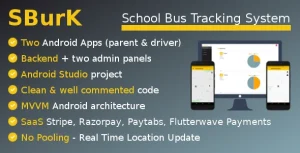
School Bus Tracker is a native Android GPS tracking application, engineered for mobile developers and education-service agencies to deploy real-time student transport monitoring. The package resolves a persistent visibility gap in school and college transport operations: parents and students historically had no mechanism to determine a van’s live position, its direction of travel, or its estimated arrival duration. In production delivery workflows, the codebase functions as a deploy-and-brand foundation for transport fleets, letting a single driver broadcast location coordinates while many parent clients consume that stream simultaneously on their own devices.
Technical Specifications & Deployment Matrix
| Engineering Metric | Deployment Specification |
|---|---|
| Base Technology / Framework | Native Android application written in Java with XML layout resources |
| Runtime / Language Requirements | Android 4.3.x through Android 9.0 (covering 4.4.x, 5.0, 5.1.x, 6.0, 7.1.x, 8.0, 8.1) |
| Data Exchange / Communication Protocols | GPS coordinate broadcast from driver sessions to subscriber clients, rendered in real time on map views |
| Front-End / Engine Dependencies | Android map rendering components, push notification delivery channel, AdMob ad serving with GDPR consent handling |
| Database / Persistence Footprint | No local database schema is documented; position data is consumed live from the driver broadcast rather than stored client-side |
| Deliverable File Formats | Installable .apk binary plus editable .java and .xml source files |
Driver-to-Parent Location Pipeline & Execution Flow
The engine runs on a publisher-subscriber location model: driver clients broadcast, parent clients render. After a driver completes the registration flow and activates location sharing, the application transmits positional updates from the device’s GPS receiver to the tracking layer, which distributes those coordinates to every user session subscribed to that vehicle. On the consuming side, each parent or student client parses the incoming position and plots it on a live map view, so multiple households observe the same bus moving without manually refreshing anything. Because transmission scales from one driver to many subscribers, a single van activation can serve an entire route’s parent group at once.
Complementing the live feed, the application computes route geometry and distance from the user’s current location, translating raw coordinates into an actionable answer about where the bus is and how long the remaining journey should take. Push notifications extend this pipeline beyond the map screen, delivering arrival-relevant alerts directly to student devices without requiring the app to remain foregrounded.
Architectural & Functional Highlights
- Real-Time Multi-Bus Map Rendering: The map layer displays multiple tracked vehicles simultaneously, letting a household with children on different routes monitor each bus from one screen while position updates arrive continuously.
- Distance and Route Computation: The engine calculates the route and remaining distance between the user’s current location and the tracked vehicle, giving parents direction and duration context rather than a bare coordinate pin.
- Push Notification Dispatch: Alert messages are pushed to student devices, decoupling time-critical updates from active map usage and keeping families informed when the app is not open.
- AdMob Monetization with GDPR Consent Handling: Ad serving is wired through AdMob with GDPR-compliant consent logic, allowing European deployments to gate ad requests behind user consent before any impression is requested.
- Structured Codebase Organization: The Java and XML sources follow a structured coding style, so developers can locate registration logic, tracking logic, and UI resources in predictable modules during modification.
For teams weighing parallel monetized Android codebases on a similar native toolchain, Ball Slider illustrates the same Android Studio plus AdMob deployment pattern applied to a gaming vertical.
Production Implementation & Operational Resilience
Deployment begins with the included .apk for immediate device testing, followed by importing the .java and .xml sources into an Android development environment for rebranding and recompilation. The supported runtime window spans Android 4.3.x through Android 9.0, which covers a large installed base of legacy handsets but means teams targeting Android 10 or later must budget for compatibility verification and potential dependency updates before store submission. This OS ceiling is the primary operational boundary documented for the package.
Resilience considerations center on GPS signal quality and notification delivery: position accuracy depends on the driver device’s location receiver, and households in low-coverage corridors should expect temporary gaps in the live feed rather than fabricated positions. The GDPR consent flow guards the monetization layer against unauthorized ad requests in European jurisdictions, and the structured source organization keeps secondary development predictable — registration flows, map rendering, and ad configuration can be modified in isolation without unwinding unrelated modules. For agencies running unrelated Android product lines through the same build pipeline, Photo Editor demonstrates an equivalent Android Studio source deliverable in the photo-editing vertical, useful when one team maintains several app assets under a shared release process.
Frequently Asked Questions
Does the deliverable include both a compiled binary and editable source files?
Yes — the package ships with an installable .apk alongside .java and .xml source files, so teams can validate the reference build on a physical device first, then recompile modified source through their own Android toolchain for production.
Can stakeholders evaluate the running application before compiling the source?
Yes — a public demo build is published on Google Play under the developer’s listing, allowing decision-makers to test registration, live map tracking, and notification behavior on real hardware before committing engineering effort to the source package.
Do drivers and parents pass through the same registration flow inside the app?
No — the application implements two separate registration paths. Drivers register to activate location broadcasting, while students and parents register as subscribers, a separation that prevents standard users from ever enabling coordinate transmission on a vehicle.
Does the source package include an iOS build for Apple devices?
No — the deliverable targets the Android platform exclusively, and no Swift or iOS project files are included. Covering Apple hardware would require an independently developed client built on a separate codebase and release pipeline.