Sasup – Sass Landing WordPress Theme
Sasup SaaS Landing WordPress Theme Overview & Conversion-Focused Front-End Architecture
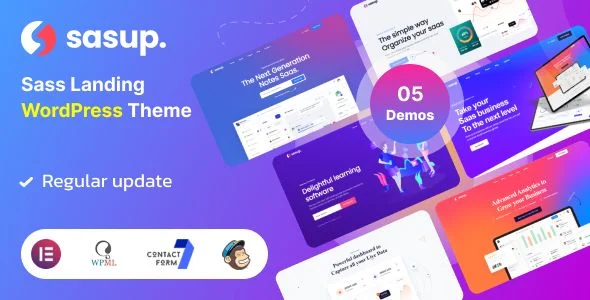
Sasup SaaS Landing WordPress Theme is an Elementor-driven WordPress theme engineered for SaaS vendors, app marketers, and delivery agencies to ship product landing pages without hand-coding templates. The package targets the recurring bottleneck of assembling hero, pricing, feature, and FAQ sections from scratch by bundling 5+ prebuilt homepages, 10+ inner pages, and 55+ custom Elementor widgets into a single installable codebase. Within production workflows it operates as the presentation layer of a marketing site: the WordPress template hierarchy governs document structure, the Elementor engine composes section-level layouts, and Bootstrap 5.x controls grid behavior from the 1170px desktop container down to mobile viewports.
Technical Specifications & Deployment Matrix
| Engineering Metric | Deployment Specification |
|---|---|
| Base Framework | WordPress theme built on Bootstrap 5.x (responsive, mobile-first grid) |
| Runtime / Compatibility Range | WordPress 5.5.x through 7.1.x; PHP, HTML, CSS, Sass/SCSS, Stylus, and JS source files included |
| Page Builder Engine | Elementor drag-and-drop editor with live front-end and back-end editing |
| Localization Layer | WPML compatible, RTL-ready, translation-ready string structure |
| Widget & Layout Footprint | 55+ custom Elementor widgets, 7+ custom widgets, 4+ header variations, 3+ footer variations, widget-ready regions |
Elementor Widget Pipeline & Template Execution Flow
Every page render follows a predictable pipeline: WordPress resolves the queried template, Sasup delegates body composition to Elementor, and registered custom widgets emit validated HTML5 markup scoped by Bootstrap 5.x classes. Header and footer regions are managed through the WP Customizer, where Kirki-based controls expose dynamic color and typography settings that propagate site-wide design tokens without stylesheet edits. Because section content lives in Elementor data structures rather than hardcoded PHP templates, marketing teams rearrange pricing tables, app showcase blocks, and team sections through the visual editor while the underlying markup contract stays intact. Agencies evaluating a multipurpose alternative within the same Elementor runtime can benchmark Pintex when a broader SaaS, app, and software landing scope is required across multiple client verticals.
Core Technical Capabilities of Sasup
- 55+ Custom Elementor Widgets: Purpose-built widgets for hero sections, sliders, pricing, team, and app showcase blocks inject structured markup directly into the Elementor render cycle, replacing generic free widgets with niche-specific output.
- One-Click Demo Import: The installer loads demo content and widget configuration in a single pass, provisioning a working 5-homepage site skeleton that content editors overwrite with production copy.
- Dynamic Color & Typography Controls: Customizer-driven design tokens recolor headings, body text, and accent elements across every template, eliminating per-page CSS overrides during rebrand cycles.
- RTL & WPML Alignment: Right-to-left layout logic and translation-ready strings allow the same codebase to serve Arabic, Hebrew, and other bidirectional locales alongside WPML-managed multilingual page trees.
Production Implementation & Operational Resilience
Deployment in agency staging follows the standard WordPress theme lifecycle: upload via WordPress admin or FTP, activate, then execute the one-click demo importer before replacing placeholder media. Form handling is delegated to Contact Form 7, whose shortcode-driven markup slots into any Elementor section, keeping lead-capture logic decoupled from theme templates. For safe iteration across future releases, the codebase ships child-theme compatibility, so template overrides and function modifications live in the child layer while parent files remain patchable during updates. This separation is the primary resilience mechanism: changelog history shows iterative fixes to header logo width, breadcrumb output, and Customizer header/footer settings, and each patch lands without forcing rework of customized child assets.
Cross-browser verification covers IE10, IE11, Firefox, Safari, Opera, Chrome, and Edge, and the responsive layout was tested across desktop, laptop, tablet, and mobile breakpoints. Because the theme is not Gutenberg-optimized, content production should remain inside Elementor; attempts to rebuild complex sections in the block editor will bypass the custom widget layer. When landing fragments must render outside standard page content—inside headers, footers, or archival templates—AnyWhere Elementor Pro extends where Elementor templates can be injected, letting teams reuse Sasup-designed sections across non-page locations without duplicating markup. Widget-ready sidebars and a 1170px Bootstrap grid keep third-party plugin output aligned with the base layout system during extension work.
Frequently Asked Questions
Can Sasup be customized without modifying parent theme files?
Yes. The theme ships with child-theme compatibility, allowing developers to override default template files from a child layer so parent updates apply cleanly without destroying customized headers, footers, or function logic.
Does Sasup include pre-built pricing and FAQ page layouts?
Yes. Version 1.1.4 added Price 01, Price 02, About 02, Service 02, and FAQ page layouts, bringing the inner-page count to 10+, all importable through the one-click demo data pipeline.
Is Sasup ready for right-to-left language deployments?
Yes. RTL support was introduced in version 1.0.1, and version 1.1.4 shipped responsive and RTL fixes, confirming bidirectional layout output works alongside the WPML translation workflow.