SalesERP – AI Powered Business ERP for Sales, Billing, Inventory, Accounting And HR
SalesERP Overview & AI-Integrated Business Management Architecture
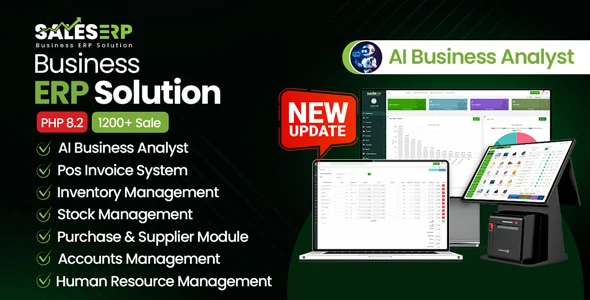
SalesERP is a CodeIgniter-based business ERP application, engineered for developers and agencies deploying self-hosted sales, billing, and accounting platforms for SMB clients. The package consolidates POS billing, inventory control, purchase management, double-entry-style accounting, HRM with payroll, and an AI analysis module into a single HMVC-structured PHP codebase, replacing the fragmented toolchains that force merchants to reconcile data across disconnected spreadsheets. In production workflows, it functions as the central operational database of record: sales clerks settle POS transactions, accountants post vouchers and supplier payments, and managers query the AI module for business analyst reports drawn from live transactional data.
Technical Specifications & Deployment Matrix
| Engineering Metric | Deployment Specification |
|---|---|
| Base Framework | CodeIgniter, restructured from MVC to HMVC module organization |
| Runtime Requirements | PHP 8.x with MySQL 8.x (migrated from PHP 7.4 to 8.2) |
| Deliverable Files | JavaScript, HTML, CSS, PHP, SQL installation scripts |
| Browser Compatibility | IE10, IE11, Firefox, Safari, Opera, Chrome, Edge |
| Persistence Layer | MySQL relational schema covering products, ledger accounts, HR, and reporting tables |
| Delivery Modes | Online and offline operation, with QR-scannable dynamic invoices |
POS, Ledger & AI Analysis Execution Pipeline
The execution pipeline routes every transaction through a single modular controller chain. Inbound POS and manual sale requests are validated at the form layer, priced against product and service records with VAT, discount, and multi-tax rules applied, then written to the MySQL schema where inventory decrements, ledger postings, and customer balances are committed in one pass. Batch-wise purchase entries feed the stock engine, while the accounting module generates transactional vouchers—cash book, credit vouchers, supplier subledgers—that keep the chart of accounts synchronized with every billing event. The AI module, integrated in the July 2025 release, sits above this transactional core and lets operators interrogate business data conversationally rather than assembling manual spreadsheet reports.
Core Technical Capabilities of SalesERP
- GUI POS with Draft Orders and Multi-Payment Settlement: The redesigned 2025 POS front-end supports draft order persistence, multiple concurrent payment methods per transaction, and quick settlement flows, with image-based product grids accelerating clerk throughput at the counter.
- Accounting Core with Supplier Subledgers: Supplier payment tracking, cash book ledger balancing, and voucher generation are handled natively; recent changelogs document supplier subledger rendering fixes and optimized customer/supplier balance queries after removing redundant balance computations.
- AI Business Analyst Reporting: An integrated AI module analyzes accumulated transactional data and returns analyst-grade answers, layering automated insight over the reporting suite that spans opening/closing, daily sales, user-wise sales, product-wise profit, VAT and tax, stock, and wastage reports.
- Role-Based Access and Multi-Entity Data Model: Role permission assignment governs module exposure per user, while customer and supplier records carry VAT and CR numbers that propagate directly into POS, mini, and large invoice layouts.
- Quotation, Service Billing, and HRM Modules: Quotation-to-sale conversion, service billing with due payment collection in the accounts module, and HRM payroll management extend the engine beyond retail into service-sector deployments.
Production Implementation & Operational Resilience
Deployment targets a standard LAMP environment: PHP 8.x, MySQL 8.x, and Apache with rewrite rules enabled. The changelog history documents a concrete operational boundary—on GoDaddy shared hosting, the provided .htaccess rewrite directives (routing all non-file, non-directory requests to index.php) must be applied verbatim to restore controller routing. Installation ships with a SQL schema plus an installer folder whose DataTable Essential settings were adjusted in the 2025 releases, so fresh deployments should verify those settings initialize correctly before go-live. Numerical resilience has been hardened over multiple iterations: VAT, discount, grand total, and due amounts are now fixed to two decimal places after calculation, resolving the fraction and rounding defects reported in earlier versions.
Error handling is pragmatic rather than abstract—documented defect fixes cover credit voucher generation failures, cash book ledger imbalances, and customer due-list queries that returned duplicate invoices, all resolved through targeted changelog patches. Query optimization passes in mid-2025 reduced unnecessary balance computations on customer and supplier tables, which matters for catalogs with large entity counts. For organizations needing a separate recruitment or hiring platform outside this ERP runtime, deploying JobClass as an independent web application avoids forcing non-commerce workflows into the accounting schema. Similarly, connectivity offerings such as eSIM operate as standalone purchase platforms and should not be merged into this codebase. Extension points within the package itself include the add-on system introduced during the HMVC migration, an Android app distributed as an external add-on, Nexmo SMS gateway configuration, and autoupdate tooling—each allowing secondary development without modifying core controller logic.
Frequently Asked Questions
Does SalesERP support QR code scanning on invoices?
Yes. Since the May 2025 update, online invoices expose a QR code that dynamically renders the invoice when scanned, extending the earlier QR support for sales, purchase, service, and quotation documents controlled via application settings.
Can a product be purchased from any supplier, or is it restricted per supplier?
Any supplier. The July 2025 changelog removed the supplier-wise product selection restriction, so products can now be purchased from any supplier, and supplier assignment was made optional during product insertion.
Is the POS limited to a single payment method per transaction?
No. The May 2025 GUI POS redesign added multiple payment options, complementing the multiple payment system already available across sales, purchase, service, and quotation due payments.
Does the package include a mobile application within the core files?
No. Android apps are distributed as external add-ons rather than bundled core deliverables; the included files cover JavaScript, HTML, CSS, PHP, and SQL for the web application only.
-
v10.0 LatestOct 23, 2026