RISKY ROOMS
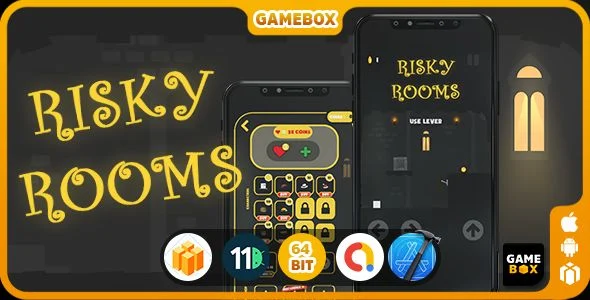
Risky Rooms Overview & Cross-Platform Buildbox Game Architecture
Risky Rooms is a Buildbox 2 Classic puzzle game source code, engineered for indie developers and mobile studios to ship a dungeon-escape title on Android and iOS without hand-writing native gameplay logic. The package removes the heaviest production bottleneck in casual game delivery: authoring collision handling, trap triggers, and level-gating mechanics, all of which are configured visually inside the Buildbox 2 editor instead of programmed from scratch. Within an agency or solo production pipeline, it functions as a re-skin-ready asset whose 64-bit, API 31-aligned builds compile in Android Studio and can be submitted to Google Play after asset and identifier replacement.
Technical Specifications & Deployment Matrix
| Engineering Metric | Deployment Specification |
|---|---|
| Base Technology / Framework | Buildbox 2 Classic (2D engine; not Buildbox 3D) |
| Runtime / Language Requirements | Android Studio 2021.3.1 or above; Java JRE 7 or above |
| SDK / API Targets | Android API level 31; 64-bit binaries; validated on Android 4.0 through 11.0 |
| Monetization / Communication Layer | AdMob banner, interstitial, and rewarded video; In-app Billing 5.1.0 |
| Deliverable Files | .apk, .java, .xml, Layered PSD, Layered PNG, JavaScript JS |
| Device / Persistence Footprint | Universal phone and tablet layouts; local coin and unlock state |
Dungeon Puzzle Mechanics & Execution Pipeline
The full game loop executes through the Buildbox 2 Classic runtime, which dispatches player input, collision events, and object triggers without scripted gameplay code. Each of the twenty-plus levels is structured as a dungeon room whose exit stays locked behind a key pickup; when the hero character collides with the key, the engine advances the scene to the next stage. Environmental hazards, including deadly spikes and booby traps, emit death events that reset the character in an explosion, enforcing a deliberate, strategy-driven pace. Physics-enabled crates act as traversal objects, letting players jump onto them to reach elevated platforms and hidden levers. Coin pickups accumulate into a wallet that feeds the in-game shop, where a dozen characters, daily gifts, and coin packs are obtained through play or purchase, while classical background music and a sound on/off toggle complete the runtime. For teams evaluating a native production route outside this engine, the Basketball Shoot Game Android Studio Project with AdMob Ads represents an independent Android Studio codebase that carries no Buildbox dependency.
Core Technical Capabilities of Risky Rooms
- Key-Gated Level Progression: Room exits remain locked until the runtime registers a key collision, so pacing and difficulty curves are tuned per-scene inside the Buildbox editor rather than in code.
- Physics-Driven Puzzle Objects: Crates respond to the engine’s physics simulation, enabling vertical platforming solutions such as reaching concealed levers on higher ground.
- Triple-Format AdMob Pipeline: Banner, interstitial, and rewarded video placements ship pre-wired into the flow, with unit identifiers swapped during configuration.
- In-App Billing 5.1.0 Economy: Coin packs, a remove-ads option, and shop unlocks route through Google Play Billing at SDK version 5.1.0, keeping purchase flows compliant with current store requirements.
- Universal Device Rendering: Layouts adapt across phone and tablet form factors, and the audio toggle allows silent-mode deployment scenarios.
Production Implementation & Operational Resilience
Deployment begins inside Buildbox 2, where the bundled layered PSD and layered PNG files allow complete character and environment re-skins without modifying gameplay logic. A step-by-step video guide documents the entire re-skin procedure, so the workflow remains executable by non-programmers. The edited project then compiles in Android Studio 2021.3.1 or later on Java JRE 7 or above, producing 64-bit APKs aligned with API level 31; AdMob unit identifiers and billing SKUs are the primary configuration points before store submission.
Operational boundaries are equally explicit. The project opens exclusively in Buildbox 2 Classic, not Buildbox 3D, so all level editing and export activity must stay inside that toolchain, and studios planning version migrations should treat this as a hard constraint. Runtime behavior was validated on physical devices spanning Android 4.0 through 11.0, which anchors the supported hardware envelope for QA passes. For studios assembling a seasonal publishing catalog, Christmas Gifts Android Game with AdMob stands as a separate, standalone holiday-themed title built on the same monetization pattern.
Retention layers, including daily gifts, coin packs, and twelve unlockable characters, provide the engagement loop that monetization depends on, and the sound toggle covers audio-restricted contexts. When a broader multi-title roadmap calls for a different cross-platform stack, the 6 in 1 Combo Flutter Games Bundle offers a parallel Flutter-based portfolio route that operates entirely decoupled from the Buildbox toolchain.
Frequently Asked Questions
Are layered design source files included for a full artwork re-skin?
Yes. Layered PSD and layered PNG files ship alongside the .java, .xml, and JavaScript assets, so character and environment artwork can be replaced directly without rebuilding graphics from zero.
Can the project be opened and edited in Buildbox 3?
No. The codebase is compatible exclusively with Buildbox 2 Classic; Buildbox 3D uses a different project architecture, so all level editing and export steps must occur inside Buildbox 2.
Does the package include a compiled APK for immediate hardware testing?
Yes. An .apk file is part of the deliverables, allowing runtime behavior to be verified on a physical device before any re-skin or recompile cycle begins.
Is prior programming knowledge required to complete a re-skin?
No. A step-by-step video guide walks through the entire process, meaning a person without programming experience can replace assets, ad identifiers, and billing SKUs to produce a publishable build.