Rion – Elegant MultiPurpose Shopify Theme
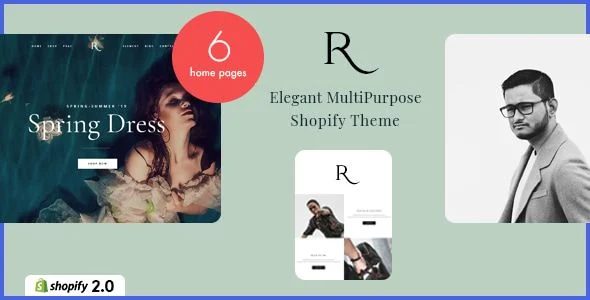
Rion Overview & Shopify Online Store 2.0 Storefront Architecture
Rion is a multipurpose Shopify theme built on the Online Store 2.0 architecture, engineered for merchants and agency delivery teams that need to assemble category-driven storefronts across fashion, electronics, cosmetics, furniture, jewelry, food, medical, kids, sport, and organic retail verticals. The package tackles the core bottleneck of storefront assembly by replacing hard-coded template editing with drag-and-drop, section-based layouts, allowing operators to restructure home, collection, and product pages through the Shopify theme editor rather than source files. In production workflows it operates as the presentation layer for Shopify-hosted catalogs, with Bootstrap 4.x and 5.x utilities governing grid behavior, spacing, and responsive breakpoints across Firefox, Safari, Opera, Chrome, and Edge.
Technical Specifications & Deployment Matrix
| Engineering Metric | Deployment Specification |
|---|---|
| Base Platform | Shopify Online Store 2.0 with section-based JSON templates |
| Front-End Framework | Bootstrap 4.x / 5.x toolkit, responsive and high-resolution layout |
| Delivered Source Assets | HTML, CSS, LESS, Sass, SCSS, and JavaScript files |
| Browser Compatibility | Firefox, Safari, Opera, Chrome, Edge |
| Persistence Footprint | Shopify-managed store data; no external database layer |
| Markup Standard | Validated HTML5 with Animate CSS and Font Awesome icon sets |
Liquid Section Rendering & Storefront Execution Pipeline
Rion renders storefronts through Shopify Online Store 2.0 JSON templates and modular Liquid sections. Each page region — banner sliders, top-selling product carousels, lookbook blocks, and category grids — is declared as a section carrying its own schema, which the theme editor reads to expose reordering, content, and settings controls. When a merchant saves changes, the platform writes the resulting configuration into the JSON template layer instead of mutating Liquid source, so layout state survives editor sessions without code drift.
Collection browsing runs through a filter pipeline that shoppers constrain by category, tag, brand, price band, size, and color attribute swatches. These queries travel as AJAX requests, so the product grid re-renders from returned payloads without a full document reload. The same asynchronous pattern drives the predictive AJAX search field, the sidebar cart drawer, and infinity scroll pagination, which fetches subsequent result pages as the viewport descends. Media delivery is deferred through lazy loading, keeping off-screen imagery out of the initial request waterfall, while shop grid and list view switching lets shoppers toggle presentation density on demand.
Merchants weighing minimal storefront approaches on the same Shopify 2.0 runtime frequently evaluate Oreo Minimal Clean Shopify Theme as a parallel package when the priority shifts toward stripped-down catalog presentation rather than multi-vertical filtering depth.
Core Technical Capabilities of Rion
- Drag-and-drop section architecture: Section schemas expose editor controls whose output persists to JSON templates, letting operators reorder homepage and collection components without editing Liquid files.
- Unlimited AJAX filter system: Client-side query construction spans categories, tags, brands, prices, sizes, color swatches, and custom specifications, with grid re-rendering handled through payload injection rather than page navigation.
- Synchronized cart and checkout state: An AJAX sidebar cart, dynamic checkout buttons, and a sticky add-to-cart bar keep purchase actions persistent while shoppers continue browsing filtered result sets.
- Deferred media and motion pipeline: Lazy loading and AJAX content loading shrink the initial payload, while parallax backgrounds and Animate CSS transitions execute on the client without additional plugin dependencies.
Production Implementation & Operational Resilience
Deployment happens entirely inside Shopify’s managed runtime: there is no server provisioning, no reverse proxy configuration, and no external database, since catalog, order, and customer data persist within the merchant’s Shopify store. The deliverable ships with HTML, CSS, LESS, Sass, SCSS, and JavaScript files, so a front-end team can recompile color tokens, typography scales, and layout variables from source rather than stacking overrides on compiled stylesheets. That recompilation path is the mechanism behind the advertised unlimited colors and layouts, which sit alongside header and footer variants, sub-collection page templates, blog grid and list layouts, and a mobile toolbar tuned for small-viewport navigation.
Client-facing compliance and conversion tooling lives at the template level: GDPR cookie consent handling, a size guide table, trust and sale badges, a product booster sale module, recently viewed product tracking, and social sharing hooks. A Coming Soon mode lets teams publish a holding page while catalog structure and checkout configuration mature behind the scenes. The principal operational boundary is platform sovereignty — every render cycle depends on Shopify’s infrastructure, and app interoperability extends functionality only through apps valid on the Shopify App Store. Furniture retailers who want a vertical-specialized skin on the same foundation can treat Fusta – Furniture Shopify Theme as a separate, category-focused package rather than an extension of this codebase.
Frequently Asked Questions
Does Rion allow layout restructuring without directly editing Liquid template files?
Yes. Because the codebase targets Shopify Online Store 2.0, sections expose drag-and-drop controls inside the theme editor, and layout state persists into JSON templates, so operators reorder homepage and collection components without touching the underlying Liquid source.
Are stylesheet source files such as SCSS and LESS shipped inside the package?
Yes. The deliverable includes HTML, CSS, LESS, Sass, SCSS, and JavaScript files, giving front-end developers the raw variable layers needed to recompile color tokens and typography scales rather than overriding compiled CSS by hand.
Can the storefront show a holding page to visitors while the shop is still being configured?
Yes. A built-in Coming Soon mode ships with the theme, allowing merchants to display a pre-launch page while catalog data, collection structures, and checkout configuration are completed behind the scenes.