Ridez – Bike & Accessories Shopify Theme OS 2.0
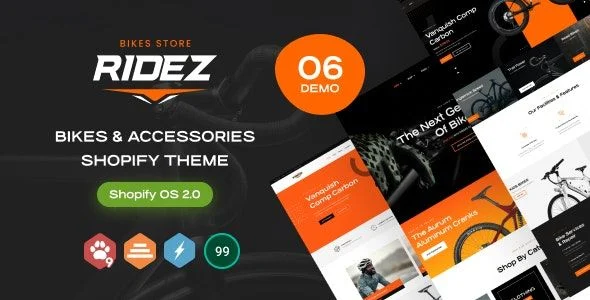
Ridez Overview & Storefront Foundation for Cycling Retail
Ridez is a Bike & Accessories Shopify Theme engineered for cycling retailers and e-commerce agencies that need a production-ready storefront for bicycles, electric bikes, BMX models, apparel, helmets, protective gear, and spare parts. The package addresses the structural bottleneck of generic storefronts—fixed page layouts, shallow catalog navigation, and checkout friction—by shipping multiple homepage layouts, a mega menu, attribute-based filtering by size, color, and brand, and an AJAX-powered cart on top of Shopify’s Online Store 2.0 architecture. Within agency delivery and production workflows, it operates as the presentation layer that converts a merchant’s cycling catalog into a navigable, purchase-oriented storefront without custom theme engineering from scratch.
Technical Specifications & Deployment Matrix
| Engineering Metric | Deployment Specification |
|---|---|
| Base Technology / Framework | Shopify Online Store 2.0 theme architecture with sections available on every page |
| Runtime / Language Requirements | Liquid templating, HTML, CSS, and JavaScript executed on Shopify’s hosted infrastructure |
| Data Exchange / Communication Protocols | AJAX-driven cart requests for add-to-cart and cart-state updates without full page reloads |
| Front-End / Engine Dependencies | Mega menu, quick view, product filtering UI, product comparison module, and blog module |
| Database / Persistence Footprint | No external database; catalog, content, and cart data are persisted and served by the Shopify platform |
Section-Based Rendering & Storefront Execution Pipeline
Ridez assembles storefront pages by composing drag-and-drop sections into templates that Shopify’s Liquid engine renders on demand. Because the package is built on the Online Store 2.0 model, merchants and agency teams can add, remove, reorder, and configure sections across all page types—home, product, collection, and content pages—directly in the theme editor rather than editing template files. Collection views accept filtering parameters against product attributes such as size, color, and brand, narrowing visible catalog results as the customer interacts with the filter controls. The quick view component loads product detail data into an overlay, letting shoppers inspect specifications without leaving the listing grid. Meanwhile, the AJAX cart module dispatches asynchronous add-to-cart requests and re-renders cart state in place, preserving the shopper’s browsing position instead of forcing a redirect to a dedicated cart page. The mega menu exposes deep taxonomy links—bike categories, gear, apparel, and parts—within a single navigation surface, which matters for large catalogs where flat menus collapse under their own weight. For merchants evaluating vertical-specific alternatives on the same section-based editing model, Koza applies a comparable storefront approach to the leather and fashion accessories vertical.
Core Technical Capabilities of Ridez
- Multiple Homepage Layouts: Preconfigured section compositions let teams deploy distinct storefront entry points—catalog-led, category-led, or promotional—without rebuilding templates, shortening agency delivery timelines for client launches.
- Attribute-Based Product Filtering: Collection pages accept filter parameters for size, color, and brand, allowing shoppers to narrow large bicycle and gear catalogs down to relevant SKUs through native storefront controls.
- AJAX Cart State Synchronization: Add-to-cart actions execute asynchronously and update cart contents in place, eliminating full-page reloads and reducing drop-off points between product discovery and checkout.
- Mega Menu Navigation: A multi-column navigation surface renders deep category taxonomies, which is essential for stores carrying mountain bikes, road bikes, e-bikes, BMX models, and their respective parts inventories.
- Quick View, Comparison, and Blog Modules: A modal product inspector, a side-by-side product comparison module, and an integrated blogging layer support research-heavy purchase decisions typical of cycling equipment buyers.
Production Implementation & Operational Resilience
In production deployments, the theme installs into a Shopify store as the active presentation layer, with all rendering, asset delivery, and cart transactions handled by Shopify’s hosted runtime. Customization is confined to the boundaries the theme editor exposes: section reordering, section-level settings, and content population. Because every page type accepts sections under the OS 2.0 model, merchant-installed app blocks can be anchored into templates through the editor, extending storefront behavior without code changes. Teams extending beyond the editor’s surface work within the Liquid template files and CSS/JavaScript assets of the package, where layout and styling overrides are scoped to theme files rather than platform internals. Operational boundaries are worth stating plainly: the package does not carry its own persistence layer, does not expose a server-side runtime outside Shopify, and cannot be transplanted into a WordPress or self-hosted PHP stack—its Liquid templates and AJAX endpoints only execute inside a Shopify store environment. Stores in adjacent consumer verticals weighing comparable architectures can assess Monfee, which targets coffee shops and cafés with the same hosted storefront model. Error resilience depends on Shopify’s platform guarantees for checkout and data integrity, while the theme’s own JavaScript components—quick view, filters, and the cart drawer—degrade to standard navigation flows if scripts fail to initialize.
Frequently Asked Questions
Can Ridez be used for service-based businesses such as bike rentals or repair shops?
Yes, the theme adapts to storefronts that showcase a rental fleet or sell repair-related parts alongside bicycles, gear, and apparel, making it suitable for retailers combining product sales with cycling services.
Does the theme support both single-brand showcases and multi-vendor marketplaces?
Yes, its layout system and navigation structure scale from focused single-brand catalogs to large multi-vendor marketplace inventories spanning bikes, components, and apparel, as documented in the product scope.
Can the theme files be deployed on a self-hosted server or a WordPress installation?
No. The package is built exclusively for Shopify’s hosted Online Store 2.0 runtime; its Liquid templates, section definitions, and AJAX cart endpoints execute only within a Shopify store environment.