RestApi Module for TableTrack
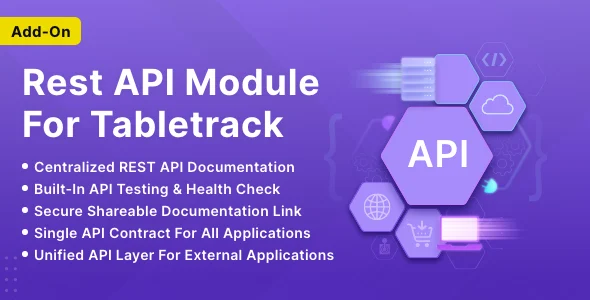
RestApi Module for TableTrack Overview & API Layer Extension
RestApi Module for TableTrack is a Laravel add-on that exposes RESTful API endpoints for TableTrack, the complete SaaS restaurant management solution, and it is engineered for developers building mobile apps, POS terminals, and third-party connections. The package resolves the bottleneck of external data access by layering token-based authentication, granular per-client permission controls, and automatic OpenAPI documentation onto an existing codebase without modifying it. Within agency delivery pipelines, the module operates as a drop-in extension whose service provider auto-registers on install, supplying a versioned, documented interface that performs in both staging and production environments.
Technical Specifications & Deployment Matrix
| Engineering Metric | Deployment Specification |
|---|---|
| Base Technology / Framework | Laravel framework, delivered as a native PHP module |
| Runtime / Language Requirements | PHP 8.x; TableTrack main application v1.2.1 or newer recommended |
| Authentication Layer | Laravel Sanctum or Laravel Passport token guards |
| Data Exchange Protocol | RESTful HTTP supporting GET, POST, PUT/PATCH, and DELETE verbs |
| Documentation & Testing | Auto-generated OpenAPI (Swagger) documentation at the /api/docs endpoint; built-in smoke testing system |
| Installation Footprint | Drop-in module; service provider auto-registers with zero base code modifications |
RESTful Endpoint Architecture & Execution Pipeline
Every inbound request enters through versioned API routes registered by the module’s auto-discovered service provider. Before any controller logic executes, authentication middleware validates the bearer token issued through Laravel Sanctum or Passport, then resolves the API client’s permission set to determine which TableTrack resources—restaurants, menus, orders, and related entities—may be read or mutated. Controllers apply standard HTTP verb semantics: GET retrieves resource collections, POST creates records, PUT and PATCH apply full or partial updates, and DELETE removes them.
Extensible event hooks fire at defined points in this request lifecycle, letting custom listeners react to resource state changes without touching module internals. For outbound, webhook-style integrations, those dispatch points provide the attachment surface where notification transports can be wired in; teams building an independent notification pipeline on a separate SaaS platform can instead evaluate the eCommerce Webhook Notifications Addon for WhatsMarkSaaS as a decoupled implementation outside the Laravel runtime. The included smoke testing system then exercises the endpoint surface after installation, confirming that routing, token validation, and response contracts behave correctly before external traffic arrives.
Architectural & Functional Highlights
- Token-Based Authentication: Bearer-token guards built on Sanctum or Passport verify every request prior to controller dispatch, so external clients never bypass the application’s identity layer.
- Granular Client Permissions: Each API client receives a scoped permission set governing which restaurant, menu, and order endpoints it may access, limiting exposure if credentials are compromised.
- Automatic OpenAPI Documentation: The module generates Swagger documentation at /api/docs, giving consumers an interactive reference and testing surface without hand-written specification files.
- Versioned Routing & Event Hooks: API routes carry version identifiers for non-breaking upgrades, while dispatched events allow developers to attach custom listeners for third-party workflows.
- Dynamic Shareable Links: The endpoint output supports shareable link generation, simplifying collaboration between backend engineers and frontend or mobile consumers.
Production Implementation & Operational Resilience
Deployment follows a low-friction path: install the module into the TableTrack application, confirm PHP 8.x and an authentication package (Sanctum or Passport) are present, and rely on auto-registration of the service provider—no manual edits to the host codebase are required. The module carries no standalone runtime; it strictly requires the TableTrack main application, and version 1.2.1 or newer is the recommended baseline for compatibility.
Operationally, mobile clients and custom frontends consuming the API from separate origins depend on standard Laravel CORS configuration at the HTTP layer, a deployment concern that sits outside module scope. Token lifecycle management—issuance, revocation, and expiry—delegates entirely to the chosen authentication package, while versioned routing shields existing consumers from breaking changes when endpoint revisions ship. The smoke testing system acts as a post-install verification gate, catching configuration drift between environments before production traffic reaches affected routes.
For secondary development, the event hooks are the sanctioned extension mechanism: custom listeners can augment order flows, sync data to external systems, or trigger side effects without forking module code, preserving upgradeability. Teams operating multi-tenant Laravel directory platforms outside this stack face a different routing problem—per-country domain and subdomain distribution—where the Multisite & Domain Mapping Plugin serves LaraClassifier and JobClass codebases as an independent concern from API exposure.
Frequently Asked Questions
Does the RestApi Module require modifications to the base TableTrack codebase?
No. The module installs as a drop-in extension whose service provider auto-registers automatically, requires only minimal configuration, and leaves the host application’s source files untouched, which preserves upgrade paths for the main platform.
Can this module operate as a standalone product without TableTrack?
No. It is strictly an add-on that depends on the TableTrack restaurant management application, with version 1.2.1 or newer recommended, and it cannot deliver its endpoint surface without that main application installed.
Is API documentation generated automatically by the module?
Yes. OpenAPI (Swagger) documentation is generated automatically and served through the /api/docs endpoint, which developers can also use for interactive endpoint testing during integration work.
Does the package include a mechanism to verify endpoint health after installation?
Yes. A smoke testing system ships inside the module, allowing engineers to confirm that routes, token validation, and response behavior are functioning correctly in both development and production environments.
-
2.0.03 LatestOct 28, 2026