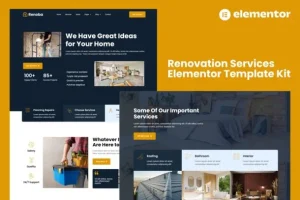
Renova – Kitchen Bathroom & Renovation Supplies Store Elementor Pro Template Kit
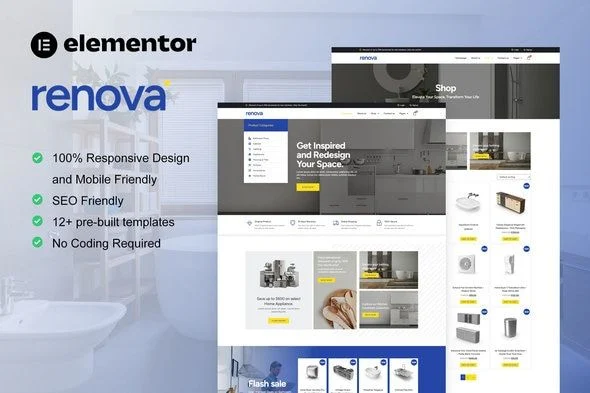
Renova Kitchen & Renovation Supplies Template Kit Overview & E-Commerce Layout Architecture
Renova is an Elementor Pro Template Kit for WooCommerce kitchen, bathroom, and renovation supplies storefronts, distributed as pre-structured page content for the Elementor page builder on WordPress. The package removes the blank-canvas bottleneck that slows commerce builds — assembling cart, checkout, product archive, and blog views widget by widget — by shipping 12+ ready-made templates wired around a shared global style layer. Inside an agency delivery pipeline, it functions as the design layer dropped onto an active WooCommerce installation, letting teams stand up a functioning store site through drag-and-drop editing instead of hand-building each screen.
Technical Specifications & Deployment Matrix
| Engineering Metric | Deployment Specification |
|---|---|
| Base Technology / Framework | Elementor Pro page builder paired with the WooCommerce storefront engine |
| Runtime / Language Requirements | WordPress running the Elementor page builder; optimized for the free Hello Elementor theme, compatible with most themes supporting Elementor |
| Data Exchange / Communication Protocols | Template JSON payloads imported via the Envato Elements Template Kit Import plugin or Elementor’s native import mechanism |
| Front-End / Engine Dependencies | Elementor Pro (premium upgrade, not included), WooCommerce, Skyboot Icons |
| Database / Persistence Footprint | No standalone persistence layer; imported layouts persist as Elementor page content inside WordPress |
WooCommerce Layout Blueprints & Template Execution Pipeline
The kit operates as a collection of JSON layout blueprints that Elementor parses into its editable node tree, converting stored widget and container definitions into rendered front-end markup. Each template maps onto a specific WooCommerce or editorial surface: the Archive Product and Single Product screens align with product listing and detail views, while Cart, Checkout, and My Account templates correspond to the plugin’s commerce endpoints. A dedicated Purchase Summary page handles post-transaction confirmation, and the Archive Blog plus Single Post templates cover content marketing output. Because everything travels as design data rather than executable theme code, the package modifies presentation only — the underlying WooCommerce cart state, order flow, and account logic remain untouched. Teams weighing a complete theme package with bundled demo import instead of a kit-based workflow can evaluate Bathrooms And Kitchens, which covers the same kitchen and renovation vertical as an independent WordPress theme.
Architectural & Functional Highlights
- Full WooCommerce screen coverage: Six commerce-facing templates — Cart, Checkout, My Account, Archive Product, Single Product, and Purchase Summary — match the core transaction surfaces a supplies store needs, reducing layout assembly to content substitution.
- Global Style token layer: Centralized typography and color variables propagate across every included template, so a single token update recolors the homepage, blog, and store screens without per-page edits.
- Global header and footer architecture: Shared header and footer templates apply site-wide, keeping navigation and footer content synchronized across the entire page set included in the zip.
- Responsive container behavior: Layouts ship 100% responsive and mobile-friendly, with Elementor’s container system governing how column and grid structures reflow across smaller viewports.
Production Implementation & Operational Resilience
Deployment follows the Envato Template Kit import path: install the Template Kit Import plugin for WordPress, or push templates directly through Elementor’s import interface, after which each page becomes an editable Elementor document. Two prerequisites govern the process. First, an Elementor Pro upgrade is required for some templates and features — the premium builder is not bundled with the zip, so procurement must account for it separately. Second, WooCommerce must be active before the commerce templates render their product-driven widgets, since the store screens depend on the plugin’s data layer. Hosts should carry adequate PHP memory headroom (wp_memory_limit) for the import routine, as parsing a full multi-template JSON payload in one session can strain restrictive default configurations.
Beyond commerce screens, the package ships operational infrastructure pages — Error 404, Login, Help Center, About, Contact, and Team — so client handoff covers the full navigation surface rather than the storefront alone. The stock imagery shown in the demo comes from Envato Elements and must be cleared for production use or swapped for owned assets, a standard pre-launch checklist item. Customization stays inside the style-overriding boundary: agencies adjust colors, typography, images, and widget content through the Elementor editor, while structural PHP work sits outside the kit’s scope by design. For projects where a full theme with demo import better fits the delivery model, ColorCrafters Pro addresses adjacent painting and building-renovation niches as an independent WooCommerce-ready theme. When deeper guidance is needed, the Elementor Get Help menu inside WordPress provides the documented troubleshooting path.
Frequently Asked Questions
Does Renova render correctly without an Elementor Pro subscription?
No, an Elementor Pro upgrade is required for some templates and features, and the premium builder is not included in the package, so a separate Elementor Pro installation must be active before the full kit renders correctly.
Can templates be imported without the Envato Template Kit Import plugin?
Yes, the kit supports two installation paths — the Envato Template Kit Import plugin for WordPress or direct import through Elementor — so teams already standardized on Elementor’s native workflow can skip the helper plugin entirely.
Are the demo images bundled with the kit cleared for live site use?
No, the demo imagery is sourced from Envato Elements, and production sites must either clear those assets through Envato Elements or replace them with owned photography before a public launch, since the kit distributes layouts only.